Jang Hyesun, Lee Sanghun, Kim Tae-Hun, Kim Ae-Ran, Lee Minhee, Lee Jun-Hwan
Acupuncture, Moxibustion and Meridian Research Group, Medical Research Division, Korea Institute of Oriental Medicine, 1672 Yuseongdaero, Yuseong-gu 305-811, Daejeon, South Korea.
Trials. 2013 Oct 24;14:351. doi: 10.1186/1745-6215-14-351.
Dry eye syndrome is a frequent complication of refractive surgery. Acupuncture has been widely used to alleviate the associated symptoms. However, the use of acupuncture for patients who suffer from dry eye syndrome following refractive surgery has certain drawbacks. This pilot study aims to evaluate the efficacy of acupuncture treatment in treating the signs and symptoms of dry eye syndrome after refractive surgery.
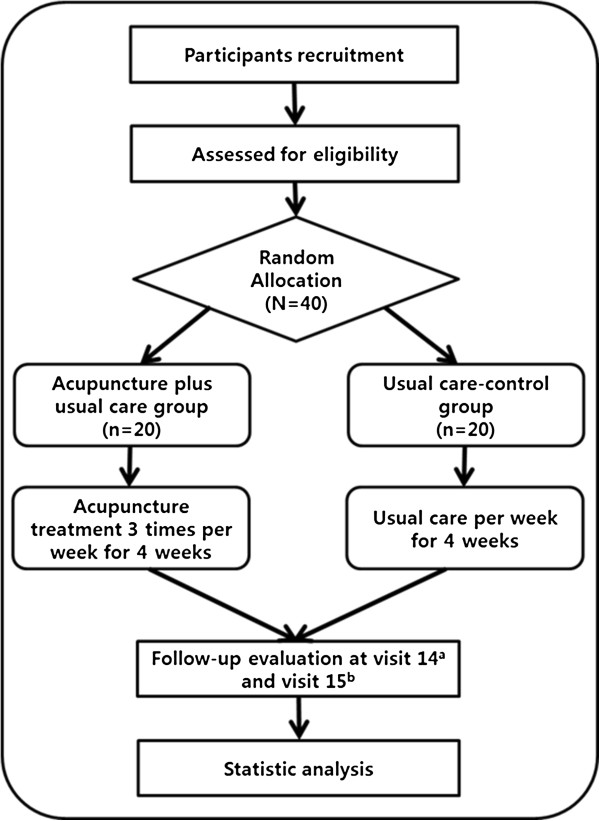
METHODS/DESIGN: Forty participants will be randomly assigned to the acupuncture plus usual care group or the usual care control group. The acupuncture plus usual care group will undergo treatments on seventeen acupuncture points, three times per week for four weeks. The control group will receive only usual care during the same period. The primary outcomes will be scores on the Ocular Surface Disease Index (OSDI) and the results of examinations at 1, 3, 5, and 13 weeks. The secondary outcomes will be Tear Film Break-up Time (TBUT), as well as scores on the Schirmer-I test, visual analog scale (VAS), and quality of life (QOL) questionnaire for the self-assessment of ocular discomfort. Digital photographs will be taken to document the pattern of fluorescein staining observed on the corneal surface. The results of the Schirmer-I test, TBUT, and fluorescein-stained corneal surface digital photographs will be assessed at the screening and at week 13. VAS scores will be assessed at the screening, as well as at 1, 3, 5, and 13 weeks. QOL will be evaluated at 1, 3, 5, and 13 weeks.
This trial will provide primary data with which to investigate the clinical effectiveness and safety of acupuncture treatment for dry eye syndrome after refractive surgery.
Current Controlled (Identifier: KCT0000727).
干眼症是屈光手术常见的并发症。针灸已被广泛用于缓解相关症状。然而,对屈光手术后患有干眼症的患者使用针灸存在一定缺陷。本初步研究旨在评估针灸治疗屈光手术后干眼症体征和症状的疗效。
方法/设计:40名参与者将被随机分配到针灸加常规护理组或常规护理对照组。针灸加常规护理组将在17个穴位进行治疗,每周3次,共4周。对照组在同一时期仅接受常规护理。主要结局指标将是眼表疾病指数(OSDI)得分以及第1、3、5和13周的检查结果。次要结局指标将是泪膜破裂时间(TBUT),以及泪液分泌试验-Ⅰ(Schirmer-I)测试得分、视觉模拟量表(VAS)得分和用于自我评估眼部不适的生活质量(QOL)问卷得分。将拍摄数码照片以记录角膜表面观察到的荧光素染色模式。泪液分泌试验-Ⅰ测试、TBUT和荧光素染色角膜表面数码照片的结果将在筛查时和第13周进行评估。VAS得分将在筛查时以及第1、3、5和13周进行评估。QOL将在第1、3、5和13周进行评估。
本试验将提供原始数据,用于研究针灸治疗屈光手术后干眼症的临床有效性和安全性。
当前受控试验(标识符:KCT0000727)。