Paes Geert, Paepe Dominique, Meyer Evelyne, Kristensen Annemarie T, Duchateau Luc, Campos Miguel, Daminet Sylvie
Department of Small Animal Medicine and Clinical Biology, Faculty of Veterinary Medicine, University of Ghent, Salisburylaan 133, 9820 Merelbeke, Belgium.
Acta Vet Scand. 2013 Oct 25;55(1):74. doi: 10.1186/1751-0147-55-74.
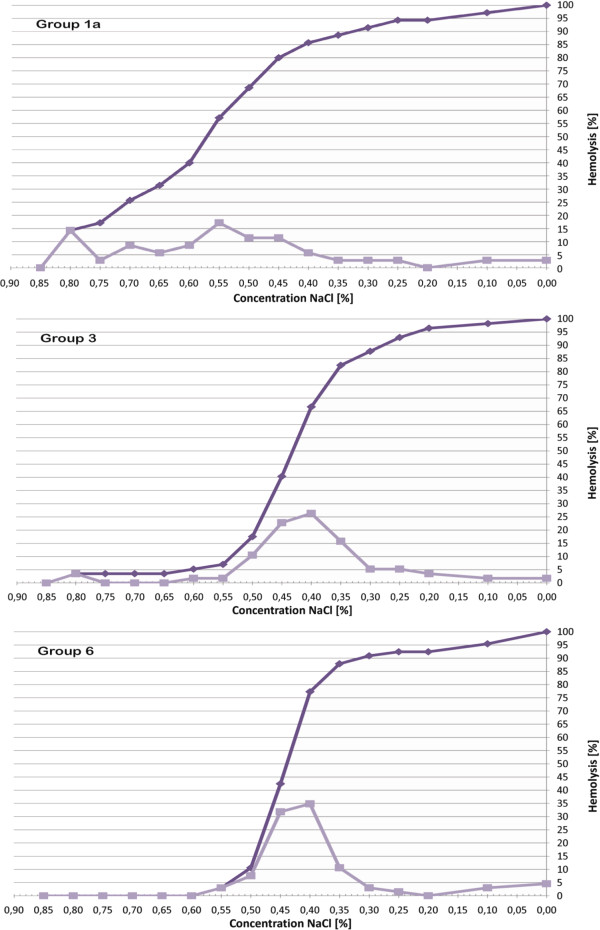
Diagnosing canine immune-mediated haemolytic anaemia (IMHA) is often challenging because all currently available tests have their limitations. Dogs with IMHA often have an increased erythrocyte osmotic fragility (OF), a characteristic that is sometimes used in the diagnosis of IMHA. Since the classic osmotic fragility test (COFT) is time-consuming and requires specialized equipment, an easy and less labour-intensive rapid osmotic fragility test (ROFT) has been used in some countries, but its diagnostic value has not yet been investigated.This study aimed to evaluate erythrocyte osmotic fragility in dogs with and without IMHA, to compare results of the classic (COFT) and rapid (ROFT) test and to assess the value of the ROFT as diagnostic test for canine IMHA.Nineteen dogs with IMHA (group 1a), 21 anaemic dogs without IMHA (group 1b), 8 dogs with microcytosis (group 2), 13 hyperlipemic dogs (group 3), 10 dogs with lymphoma (group 4), 8 dogs with an infection (group 5) and 13 healthy dogs (group 6) were included.In all dogs, blood smear examination, in-saline auto-agglutination test, Coombs' test, COFT and ROFT were performed. In the COFT, OF5, OF50 and OF90 were defined as the NaCl concentrations at which respectively 5, 50 and 90% of erythrocytes were haemolysed.
Compared with healthy dogs, OF5 and OF50 were significantly higher in group 1a (P < 0.001) and OF5 was significantly higher in group 3 (P = 0.0266). The ROFT was positive in 17 dogs with IMHA, 10 hyperlipemic dogs, one anaemic dog without IMHA and one healthy dog.
Osmotic fragility was increased in the majority of dogs with IMHA and in dogs with hyperlipidemia, but not in dogs with microcytosis, lymphoma or an infection. Although more detailed information was obtained about the osmotic fragility by using the COFT, the COFT and ROFT gave similar results. The ROFT does not require specialized equipment, is rapid and easy to perform and can be used easily in daily practice. Although, the ROFT cannot replace other diagnostic tests, it may be a valuable additional tool to diagnose canine IMHA.
诊断犬免疫介导性溶血性贫血(IMHA)往往具有挑战性,因为目前所有可用的检测方法都有其局限性。患有IMHA的犬通常红细胞渗透脆性(OF)增加,这一特征有时用于IMHA的诊断。由于经典渗透脆性试验(COFT)耗时且需要专门设备,一些国家已采用一种简便且劳动强度较小的快速渗透脆性试验(ROFT),但其诊断价值尚未得到研究。本研究旨在评估患有和未患有IMHA的犬的红细胞渗透脆性,比较经典(COFT)和快速(ROFT)试验的结果,并评估ROFT作为犬IMHA诊断试验的价值。纳入了19只患有IMHA的犬(1a组)、21只未患有IMHA的贫血犬(1b组)、8只小红细胞症犬(2组)、13只高脂血症犬(3组)、10只淋巴瘤犬(4组)、8只感染犬(5组)和13只健康犬(6组)。对所有犬进行了血液涂片检查、生理盐水自凝试验、库姆斯试验、COFT和ROFT。在COFT中,OF5、OF50和OF90分别定义为使5%、50%和90%红细胞发生溶血的氯化钠浓度。
与健康犬相比,1a组的OF5和OF50显著更高(P<0.001),3组的OF5显著更高(P = 0.0266)。ROFT在17只患有IMHA的犬、10只高脂血症犬、1只未患有IMHA的贫血犬和1只健康犬中呈阳性。
大多数患有IMHA的犬以及高脂血症犬的渗透脆性增加,但小红细胞症犬、淋巴瘤犬或感染犬则不然。虽然使用COFT可获得关于渗透脆性的更详细信息,但COFT和ROFT的结果相似。ROFT不需要专门设备,快速且易于操作,可在日常实践中轻松使用。虽然ROFT不能替代其他诊断试验,但它可能是诊断犬IMHA的一种有价值的辅助工具。