Department of Medical Science, Seoul National University College of Medicine, Seoul, Korea.
J Gynecol Oncol. 2013 Oct;24(4):367-75. doi: 10.3802/jgo.2013.24.4.367. Epub 2013 Oct 2.
Little is known regarding cervical cancer survivors' employment status, which represents social integration of cancer survivors as a pivotal domain of long-term quality of life. The goal of this study was to assess the correlates of unemployment and evaluate the impact on the comprehensive quality of life in cervical cancer survivors.
We enrolled 858 cervical cancer survivors from the gynecologic oncology departments of multi-centers in Korea. Factors associated with unemployment were identified using multivariate logistic regression analyses. We assessed different health-related quality of life domains with multivariate-adjusted least-square means between cervical cancer survivors who currently work and do not.
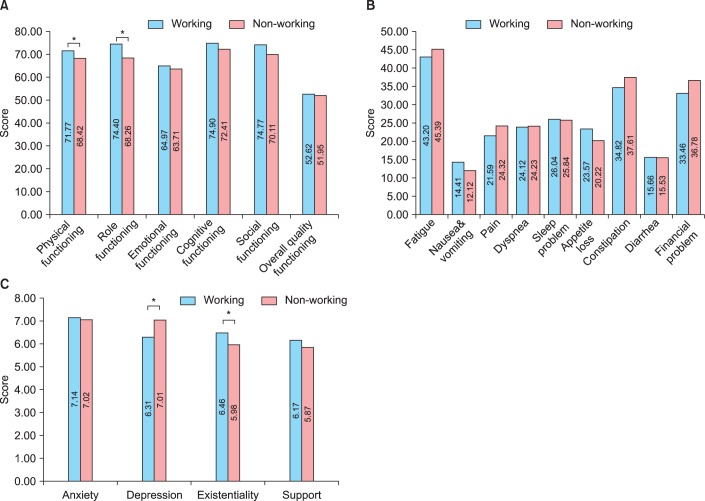
After diagnosis and treatment, the percentage of unemployed survivors increased from 50.6% to 72.8%. Lower income (adjusted odds ratio [aOR], 1.97; 95% confidence interval [CI], 1.38 to 2.81), medical aid (aOR, 1.58; 95% CI, 1.05 to 2.38), two or more comorbidities (aOR, 1.80; 95% CI, 1.12 to 2.90), current alcohol drinkers (aOR, 2.33; 95% CI, 1.54 to 3.52), and employed at the time of diagnosis (aOR, 10.72; 95% CI, 7.10 to 16.16) were significantly associated with unemployment. Non-working groups showed significant differences with respect to physical functioning, role functioning, depression, and existential well-being.
The proportion of unemployed cervical cancer survivors seems to increase, with low-income status and the presence of medical aid negatively being associated with employment, in addition to other comorbidities and previous working status. Effort should be made to secure the financial status of cervical cancer survivors.
关于宫颈癌幸存者的就业状况知之甚少,这是癌症幸存者融入社会的一个关键领域,也是长期生活质量的一个关键领域。本研究的目的是评估失业的相关因素,并评估其对宫颈癌幸存者综合生活质量的影响。
我们从韩国多中心妇科肿瘤科招募了 858 名宫颈癌幸存者。使用多变量逻辑回归分析确定与失业相关的因素。我们评估了目前工作和不工作的宫颈癌幸存者之间不同健康相关生活质量领域的差异。
诊断和治疗后,失业幸存者的比例从 50.6%增加到 72.8%。较低的收入(调整后的优势比[aOR],1.97;95%置信区间[CI],1.38 至 2.81)、医疗补助(aOR,1.58;95%CI,1.05 至 2.38)、两种或更多合并症(aOR,1.80;95%CI,1.12 至 2.90)、当前饮酒者(aOR,2.33;95%CI,1.54 至 3.52)和诊断时就业(aOR,10.72;95%CI,7.10 至 16.16)与失业显著相关。非工作组在身体功能、角色功能、抑郁和存在幸福感方面存在显著差异。
失业的宫颈癌幸存者比例似乎在增加,低收入和医疗补助的存在与就业呈负相关,此外还有其他合并症和以前的工作状态。应努力确保宫颈癌幸存者的经济状况。