Center for Statistics and Quantitative Infectious Diseases, Vaccine and Infectious Disease Division, Fred Hutchinson Cancer Research Center, Seattle, Washington, United States of America.
PLoS One. 2013 Oct 21;8(10):e76044. doi: 10.1371/journal.pone.0076044. eCollection 2013.
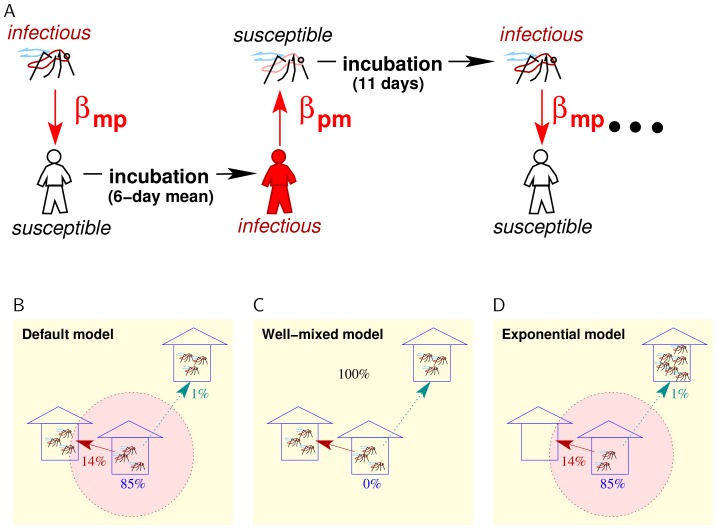
Mathematical models have been used to study the dynamics of infectious disease outbreaks and predict the effectiveness of potential mass vaccination campaigns. However, models depend on simplifying assumptions to be tractable, and the consequences of making such assumptions need to be studied. Two assumptions usually incorporated by mathematical models of vector-borne disease transmission is homogeneous mixing among the hosts and vectors and homogeneous distribution of the vectors.
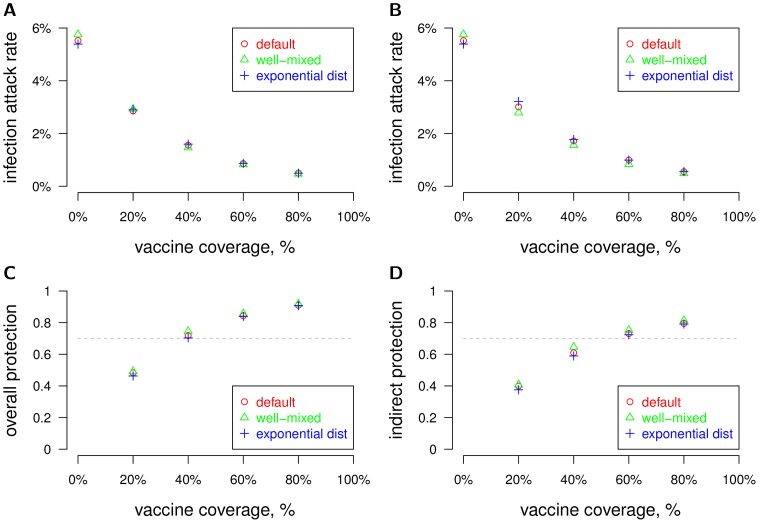
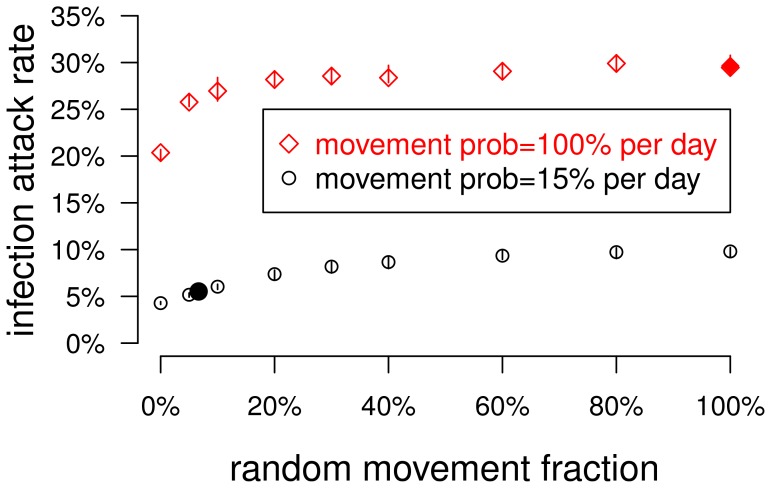
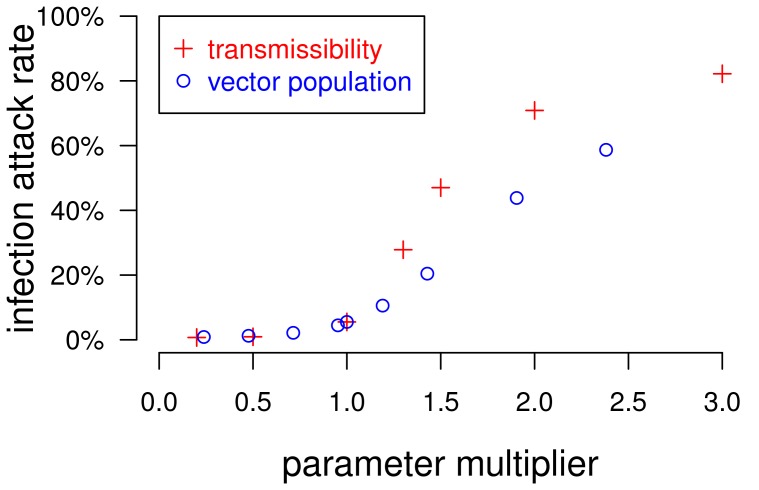
METHODOLOGY/PRINCIPAL FINDINGS: We explored the effects of mosquito movement and distribution in an individual-based model of dengue transmission in which humans and mosquitoes are explicitly represented in a spatial environment. We found that the limited flight range of the vector in the model greatly reduced its ability to transmit dengue among humans. A model that does not assume a limited flight range could yield similar attack rates when transmissibility of dengue was reduced by 39%. A model in which mosquitoes are distributed uniformly across locations behaves similarly to one in which the number of mosquitoes per location is drawn from an exponential distribution with a slightly higher mean number of mosquitoes per location. When the models with different assumptions were calibrated to have similar human infection attack rates, mass vaccination had nearly identical effects.
CONCLUSIONS/SIGNIFICANCE: Small changes in assumptions in a mathematical model of dengue transmission can greatly change its behavior, but estimates of the effectiveness of mass dengue vaccination are robust to some simplifying assumptions typically made in mathematical models of vector-borne disease.
数学模型已被用于研究传染病暴发的动态,并预测潜在大规模疫苗接种运动的效果。然而,模型依赖于简化假设以使其具有可处理性,并且需要研究做出这些假设的后果。在蚊媒疾病传播的数学模型中,通常包含两个假设,即宿主和媒介之间的均匀混合以及媒介的均匀分布。
方法/主要发现:我们在登革热传播的基于个体的模型中探索了蚊子运动和分布的影响,其中人类和蚊子在空间环境中被明确表示。我们发现,模型中媒介的有限飞行范围大大降低了其在人类之间传播登革热的能力。当登革热的传染性降低 39%时,不假设有限飞行范围的模型可能会产生类似的攻击率。在一个模型中,蚊子在各个位置均匀分布,其行为类似于一个假设每个位置的蚊子数量来自于具有稍高平均蚊子数量的指数分布的模型。当用不同假设对模型进行校准以获得相似的人类感染攻击率时,大规模疫苗接种的效果几乎相同。
结论/意义:登革热传播的数学模型中的假设微小变化可能会极大地改变其行为,但大规模登革热疫苗接种效果的估计对于蚊媒疾病数学模型中通常做出的一些简化假设是稳健的。