Department of Pathology, China-Japan Friendship Hospital, Beijing, China ; Division of Pediatric Surgery, Department of Surgery, Children's Research Institute, Medical College of Wisconsin, Milwaukee, Wisconsin, United States of America ; Divisions of Pediatric Pathology, Department of Pathology, Children's Research Institute, Medical College of Wisconsin, Milwaukee, Wisconsin, United States of America.
PLoS One. 2013 Nov 4;8(11):e78083. doi: 10.1371/journal.pone.0078083. eCollection 2013.
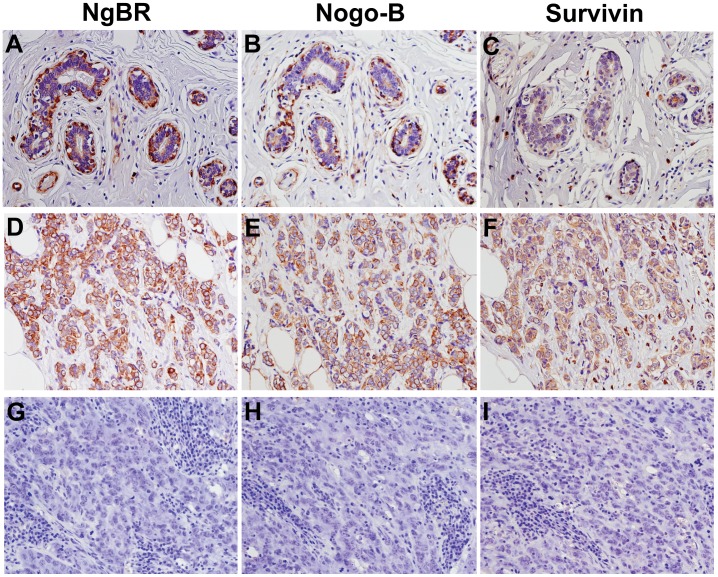
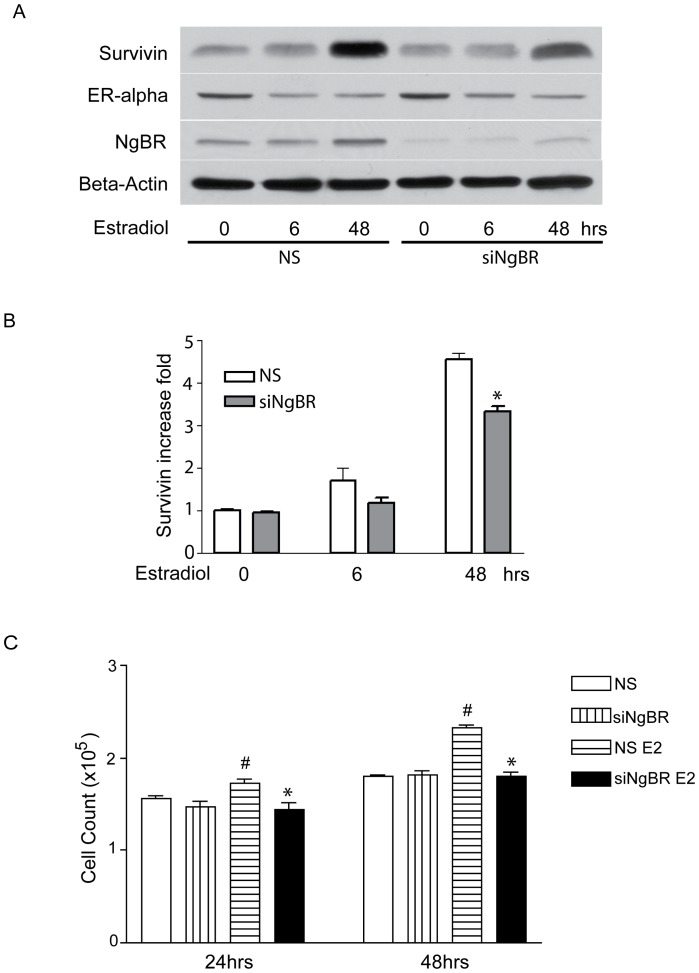
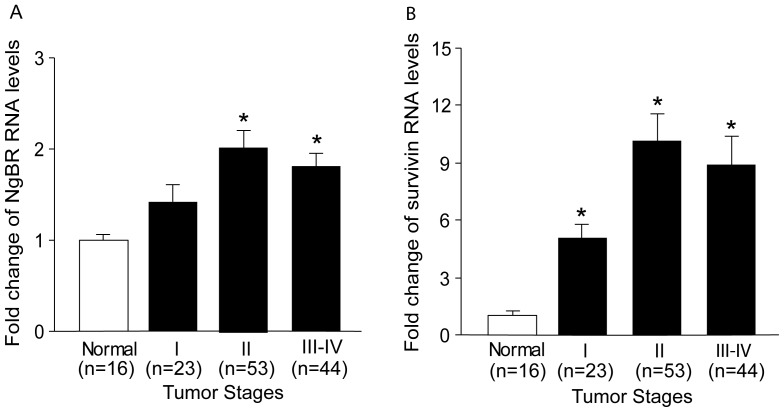
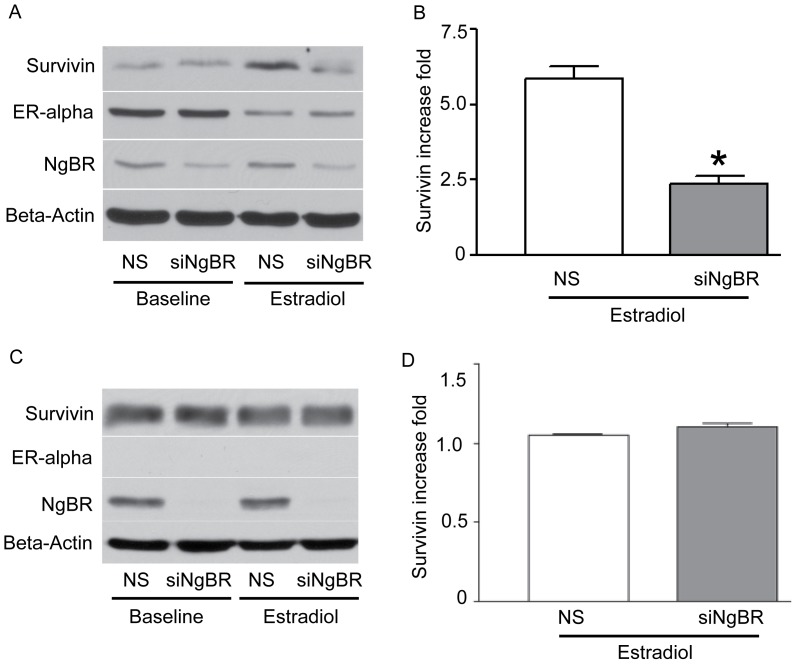
NgBR is a type I receptor with a single transmembrane domain and was identified as a specific receptor for Nogo-B. Our recent findings demonstrated that NgBR binds farnesylated Ras and recruits Ras to the plasma membrane, which is a critical step required for the activation of Ras signaling in human breast cancer cells and tumorigenesis. Here, we first use immunohistochemistry and real-time PCR approaches to examine the expression patterns of Nogo-B and NgBR in both normal and breast tumor tissues. Then, we examine the relationship between NgBR expression and molecular subtypes of breast cancer, and the roles of NgBR in estrogen-dependent survivin signaling pathway. Results showed that NgBR and Nogo-B protein were detected in both normal and breast tumor tissues. However, the expression of Nogo-B and NgBR in breast tumor tissue was much stronger than in normal breast tissue. The statistical analysis demonstrated that NgBR is highly associated with ER-positive/HER2-negative breast cancer. We also found that the expression of NgBR has a strong correlation with the expression of survivin, which is a well-known apoptosis inhibitor. The correlation between NgBR and survivin gene expression was further confirmed by real-time PCR. In vitro results also demonstrated that estradiol induces the expression of survivin in ER-positive T47D breast tumor cells but not in ER-negative MDA-MB-468 breast tumor cells. NgBR knockdown with siRNA abolishes estradiol-induced survivin expression in ER-positive T47D cells but not in ER-negative MDA-MB-468 cells. In addition, estradiol increases the expression of survivin and cell growth in ER-positive MCF-7 and T47D cells whereas knockdown of NgBR with siRNA reduces estradiol-induced survivin expression and cell growth. In summary, these results indicate that NgBR is a new molecular marker for breast cancer. The data suggest that the expression of NgBR may be essential in promoting ER-positive tumor cell proliferation via survivin induction in breast cancer.
NgBR 是一种 I 型受体,具有单一的跨膜结构域,被鉴定为 Nogo-B 的特异性受体。我们最近的研究结果表明,NgBR 结合法尼基化 Ras 并将 Ras 募集到质膜,这是 Ras 信号在人乳腺癌细胞中激活和肿瘤发生所必需的关键步骤。在这里,我们首先使用免疫组织化学和实时 PCR 方法检查 Nogo-B 和 NgBR 在正常和乳腺癌组织中的表达模式。然后,我们检查 NgBR 表达与乳腺癌分子亚型之间的关系,以及 NgBR 在雌激素依赖性生存素信号通路中的作用。结果表明,NgBR 和 Nogo-B 蛋白在正常和乳腺癌组织中均有检测到。然而,乳腺癌组织中 Nogo-B 和 NgBR 的表达明显强于正常乳腺组织。统计学分析表明,NgBR 与 ER 阳性/HER2 阴性乳腺癌高度相关。我们还发现,NgBR 的表达与生存素的表达具有很强的相关性,生存素是一种众所周知的凋亡抑制剂。实时 PCR 进一步证实了 NgBR 与生存素基因表达之间的相关性。体外实验结果还表明,雌二醇诱导 ER 阳性 T47D 乳腺癌细胞中生存素的表达,但不诱导 ER 阴性 MDA-MB-468 乳腺癌细胞中生存素的表达。用 siRNA 敲低 NgBR 可消除 ER 阳性 T47D 细胞中雌二醇诱导的生存素表达,但不能消除 ER 阴性 MDA-MB-468 细胞中的生存素表达。此外,雌二醇增加 ER 阳性 MCF-7 和 T47D 细胞中生存素的表达和细胞生长,而用 siRNA 敲低 NgBR 则降低雌二醇诱导的生存素表达和细胞生长。综上所述,这些结果表明 NgBR 是乳腺癌的一个新的分子标志物。数据表明,NgBR 的表达可能通过诱导生存素在乳腺癌中促进 ER 阳性肿瘤细胞的增殖。