• 文献检索
  • 文档翻译
  • 深度研究
  • 学术资讯
  • Suppr Zotero 插件Zotero 插件
  • 邀请有礼
  • 套餐&价格
  • 历史记录
应用&插件
Suppr Zotero 插件Zotero 插件浏览器插件Mac 客户端Windows 客户端微信小程序
定价
高级版会员购买积分包购买API积分包
服务
文献检索文档翻译深度研究API 文档MCP 服务
关于我们
关于 Suppr公司介绍联系我们用户协议隐私条款
关注我们

Suppr 超能文献

核心技术专利:CN118964589B侵权必究
粤ICP备2023148730 号-1Suppr @ 2026

文献检索

告别复杂PubMed语法,用中文像聊天一样搜索,搜遍4000万医学文献。AI智能推荐,让科研检索更轻松。

立即免费搜索

文件翻译

保留排版,准确专业,支持PDF/Word/PPT等文件格式,支持 12+语言互译。

免费翻译文档

深度研究

AI帮你快速写综述,25分钟生成高质量综述,智能提取关键信息,辅助科研写作。

立即免费体验

相似文献

1
Innate immune mechanisms in vitiligo: danger from within.先天性免疫机制在白癜风中的作用:来自内部的危险。
Curr Opin Immunol. 2013 Dec;25(6):676-82. doi: 10.1016/j.coi.2013.10.010. Epub 2013 Nov 12.
2
New insights into immune mechanisms of vitiligo.白癜风免疫机制的新见解。
G Ital Dermatol Venereol. 2016 Feb;151(1):44-54. Epub 2015 Oct 29.
3
Perspectives of New Advances in the Pathogenesis of Vitiligo: From Oxidative Stress to Autoimmunity.白癜风发病机制新进展的研究视角:从氧化应激到自身免疫。
Med Sci Monit. 2019 Feb 6;25:1017-1023. doi: 10.12659/MSM.914898.
4
A Concise Review on the Role of Endoplasmic Reticulum Stress in the Development of Autoimmunity in Vitiligo Pathogenesis.内质网应激在白癜风发病机制中自身免疫发展中的作用的简要综述。
Front Immunol. 2021 Feb 4;11:624566. doi: 10.3389/fimmu.2020.624566. eCollection 2020.
5
Understanding autoimmunity of vitiligo and alopecia areata.了解白癜风和斑秃的自身免疫性。
Curr Opin Pediatr. 2016 Aug;28(4):463-9. doi: 10.1097/MOP.0000000000000375.
6
Vitiligo: Mechanistic insights lead to novel treatments.白癜风:机制研究新进展带来新疗法
J Allergy Clin Immunol. 2017 Sep;140(3):654-662. doi: 10.1016/j.jaci.2017.07.011. Epub 2017 Aug 1.
7
Cellular stress and innate inflammation in organ-specific autoimmunity: lessons learned from vitiligo.器官特异性自身免疫中的细胞应激与先天性炎症:白癜风的经验教训
Immunol Rev. 2016 Jan;269(1):11-25. doi: 10.1111/imr.12369.
8
Vitiligo Pathogenesis and Emerging Treatments.白癜风的发病机制与新兴治疗方法
Dermatol Clin. 2017 Apr;35(2):257-265. doi: 10.1016/j.det.2016.11.014.
9
Patho-immunological mechanisms of vitiligo: the role of the innate and adaptive immunities and environmental stress factors.白癜风的病理免疫学机制:固有免疫和适应性免疫及环境应激因素的作用。
Clin Exp Immunol. 2022 Jan 28;207(1):27-43. doi: 10.1093/cei/uxab002.
10
Clinical Features, Immunopathogenesis, and Therapeutic Strategies in Vitiligo.白癜风的临床特征、免疫发病机制与治疗策略。
Clin Rev Allergy Immunol. 2021 Dec;61(3):299-323. doi: 10.1007/s12016-021-08868-z. Epub 2021 Jul 20.

引用本文的文献

1
A Study to Delineate the Immunohistological Parameters of Active Versus Stable Vitiligo Using S100, Melan A in Conjunction with CD4 and CD8 Immunohistochemistry Markers.一项利用S100、Melan A联合CD4和CD8免疫组化标记物来描绘活动期与稳定期白癜风免疫组织学参数的研究。
Indian Dermatol Online J. 2025 Jun 12;16(4):576-580. doi: 10.4103/idoj.idoj_729_24. eCollection 2025 Jul-Aug.
2
Vitiligo: From mechanisms of disease to treatable pathways.白癜风:从发病机制到可治疗途径
Skin Health Dis. 2024 Sep 30;4(6):e460. doi: 10.1002/ski2.460. eCollection 2024 Dec.
3
Harnessing the Anti-Inflammatory Effects of Perinatal Tissue Derived Therapies for the Treatment of Inflammatory Skin Diseases: A Comprehensive Review.利用围产期组织衍生疗法的抗炎作用治疗炎症性皮肤病:综述
Stem Cell Rev Rep. 2025 Feb;21(2):351-371. doi: 10.1007/s12015-024-10822-3. Epub 2024 Nov 12.
4
Up-and-Coming Drugs for the Treatment of Vitiligo.治疗白癜风的新兴药物
Ann Dermatol. 2024 Aug;36(4):197-208. doi: 10.5021/ad.24.038.
5
Exosome-derived microRNAs: emerging players in vitiligo.外泌体衍生的 microRNAs:白癜风中的新兴参与者。
Front Immunol. 2024 Jul 8;15:1419660. doi: 10.3389/fimmu.2024.1419660. eCollection 2024.
6
Endoplasmic Reticulum Dysfunction: An Emerging Mechanism of Vitiligo Pathogenesis.内质网功能障碍:白癜风发病机制的新机制
Clin Cosmet Investig Dermatol. 2024 May 17;17:1133-1144. doi: 10.2147/CCID.S459070. eCollection 2024.
7
Pathogenesis of Alopecia Areata and Vitiligo: Commonalities and Differences.斑秃与白癜风的发病机制:共性与差异
Int J Mol Sci. 2024 Apr 17;25(8):4409. doi: 10.3390/ijms25084409.
8
Protocol for a systematic review and meta-analysis on Janus kinase inhibitors in the management of vitiligo.Janus 激酶抑制剂治疗白癜风的系统评价和荟萃分析方案。
Syst Rev. 2024 Apr 19;13(1):110. doi: 10.1186/s13643-024-02522-3.
9
Association between miR-202, miR-211, and miR-1238 gene polymorphisms and risk of vitiligo.miR-202、miR-211 和 miR-1238 基因多态性与白癜风发病风险的关联。
Arch Dermatol Res. 2024 Apr 10;316(5):118. doi: 10.1007/s00403-024-02847-y.
10
Circulating Podocalyxin, Tumstatin/Col-IVα3 and Chitinase 1: New Culprits in Vitiligo Occurrence.循环中的足细胞标记蛋白、tumstatin/IV型胶原α3链和几丁质酶1:白癜风发病的新元凶
Dermatol Pract Concept. 2024 Jan 1;14(1):e2024095. doi: 10.5826/dpc.1401a95.

本文引用的文献

1
BACH2 represses effector programs to stabilize T(reg)-mediated immune homeostasis.BACH2 抑制效应器程序以稳定 T(reg)介导的免疫动态平衡。
Nature. 2013 Jun 27;498(7455):506-10. doi: 10.1038/nature12199. Epub 2013 Jun 2.
2
Modern vitiligo genetics sheds new light on an ancient disease.现代白癜风遗传学为这一古老疾病带来新曙光。
J Dermatol. 2013 May;40(5):310-8. doi: 10.1111/1346-8138.12147.
3
Mutant HSP70 reverses autoimmune depigmentation in vitiligo.突变 HSP70 逆转白癜风的自身免疫性脱色。
Sci Transl Med. 2013 Feb 27;5(174):174ra28. doi: 10.1126/scitranslmed.3005127.
4
Transcriptome analysis reveals markers of aberrantly activated innate immunity in vitiligo lesional and non-lesional skin.转录组分析揭示了白癜风皮损和非皮损皮肤中先天免疫异常激活的标记物。
PLoS One. 2012;7(12):e51040. doi: 10.1371/journal.pone.0051040. Epub 2012 Dec 10.
5
XBP1 mRNA splicing triggers an autophagic response in endothelial cells through BECLIN-1 transcriptional activation.XBP1 mRNA 剪接通过 BECLIN-1 的转录激活触发内皮细胞的自噬反应。
J Biol Chem. 2013 Jan 11;288(2):859-72. doi: 10.1074/jbc.M112.412783. Epub 2012 Nov 26.
6
Signalling danger: endoplasmic reticulum stress and the unfolded protein response in pancreatic islet inflammation.信号危险:内质网应激和未折叠蛋白反应在胰岛炎症中的作用。
Diabetologia. 2013 Feb;56(2):234-41. doi: 10.1007/s00125-012-2762-3. Epub 2012 Nov 7.
7
Exosomes: new players in cell-cell communication.外泌体:细胞间通讯的新角色。
Int J Biochem Cell Biol. 2012 Nov;44(11):2060-4. doi: 10.1016/j.biocel.2012.08.007. Epub 2012 Aug 10.
8
Vitiligo-inducing phenols activate the unfolded protein response in melanocytes resulting in upregulation of IL6 and IL8.致癜风诱导酚类物质激活黑素细胞中的未折叠蛋白反应,导致白细胞介素 6 和白细胞介素 8 的上调。
J Invest Dermatol. 2012 Nov;132(11):2601-9. doi: 10.1038/jid.2012.181. Epub 2012 Jun 14.
9
Global activation of CD8+ cytotoxic T lymphocytes correlates with an impairment in regulatory T cells in patients with generalized vitiligo.全身性白癜风患者的 CD8+ 细胞毒性 T 淋巴细胞的整体激活与调节性 T 细胞的损伤有关。
PLoS One. 2012;7(5):e37513. doi: 10.1371/journal.pone.0037513. Epub 2012 May 23.
10
Systemic analyses of immunophenotypes of peripheral T cells in non-segmental vitiligo: implication of defective natural killer T cells.非节段性白癜风外周 T 细胞免疫表型的系统分析:自然杀伤 T 细胞缺陷的意义。
Pigment Cell Melanoma Res. 2012 Sep;25(5):602-11. doi: 10.1111/j.1755-148X.2012.01019.x. Epub 2012 Jul 12.

先天性免疫机制在白癜风中的作用:来自内部的危险。

Innate immune mechanisms in vitiligo: danger from within.

机构信息

Department of Medicine, Division of Dermatology, University of Massachusetts Medical School, 364 Plantation St., LRB 325, Worcester, MA 01605, USA.

出版信息

Curr Opin Immunol. 2013 Dec;25(6):676-82. doi: 10.1016/j.coi.2013.10.010. Epub 2013 Nov 12.

DOI:10.1016/j.coi.2013.10.010
PMID:24238922
原文链接:https://pmc.ncbi.nlm.nih.gov/articles/PMC3935321/
Abstract

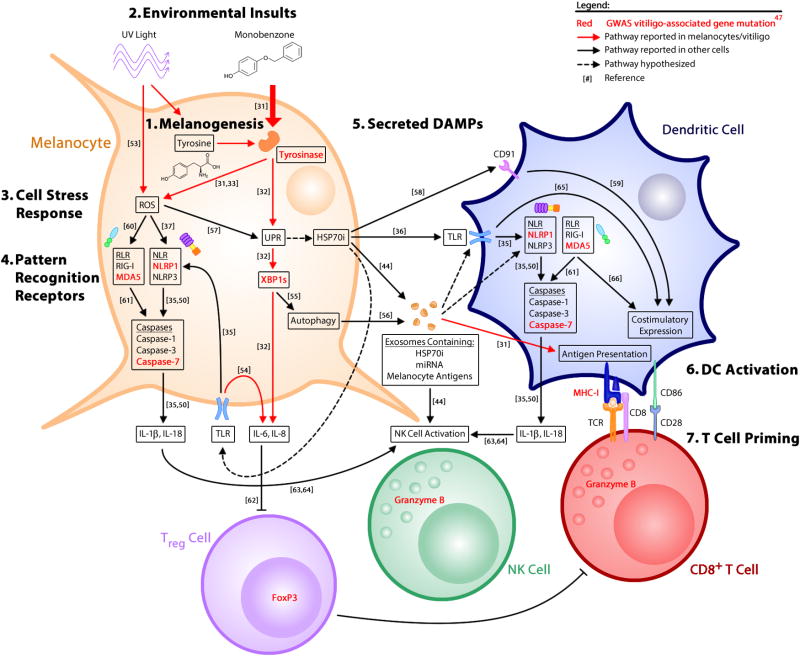
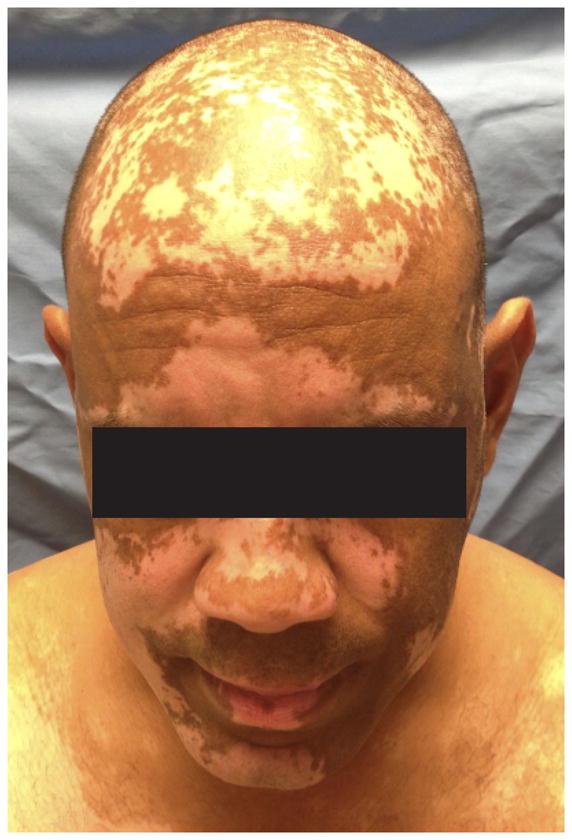
Vitiligo is an autoimmune disease of the skin in which melanocytes are destroyed by antigen-specific T cells, resulting in patchy depigmentation. Although adaptive immunity plays a clear role in disease progression, initiating factors are largely unknown. Many studies report that cellular stress pathways are dysregulated in melanocytes from vitiligo patients, suggesting that melanocyte-intrinsic defects participate in disease pathogenesis. Recent studies reveal that melanocyte stress generates damage-associated molecular patterns that activate innate immunity, thus connecting stress to organ-specific inflammation. Genetic studies in vitiligo support a role for stress, innate immunity, and adaptive mechanisms. Here, we discuss advances in the field that highlight how cellular stress, endogenous danger signals, and innate immune activation promote the onset of vitiligo.

摘要

白癜风是一种皮肤自身免疫性疾病,其中黑素细胞被抗原特异性 T 细胞破坏,导致色素脱失。尽管适应性免疫在疾病进展中起着明显的作用,但启动因素在很大程度上尚不清楚。许多研究报告称,白癜风患者的黑素细胞中细胞应激途径失调,表明黑素细胞内在缺陷参与疾病发病机制。最近的研究揭示,黑素细胞应激产生损伤相关分子模式,激活先天免疫,从而将应激与器官特异性炎症联系起来。白癜风的遗传研究支持应激、先天免疫和适应性机制的作用。在这里,我们讨论了该领域的进展,这些进展强调了细胞应激、内源性危险信号和先天免疫激活如何促进白癜风的发生。
https://cdn.ncbi.nlm.nih.gov/pmc/blobs/36f8/3935321/9aaaf3392119/nihms534940f2.jpg
https://cdn.ncbi.nlm.nih.gov/pmc/blobs/36f8/3935321/0f4f39beb596/nihms534940f1.jpg
https://cdn.ncbi.nlm.nih.gov/pmc/blobs/36f8/3935321/9aaaf3392119/nihms534940f2.jpg
https://cdn.ncbi.nlm.nih.gov/pmc/blobs/36f8/3935321/0f4f39beb596/nihms534940f1.jpg
https://cdn.ncbi.nlm.nih.gov/pmc/blobs/36f8/3935321/9aaaf3392119/nihms534940f2.jpg