
使用皮质群体率码解释听觉频率和强度辨别。
Auditory frequency and intensity discrimination explained using a cortical population rate code.
机构信息
Department of Psychology, University of Minnesota, Minneapolis, Minnesota, United States of America.
出版信息
PLoS Comput Biol. 2013;9(11):e1003336. doi: 10.1371/journal.pcbi.1003336. Epub 2013 Nov 14.
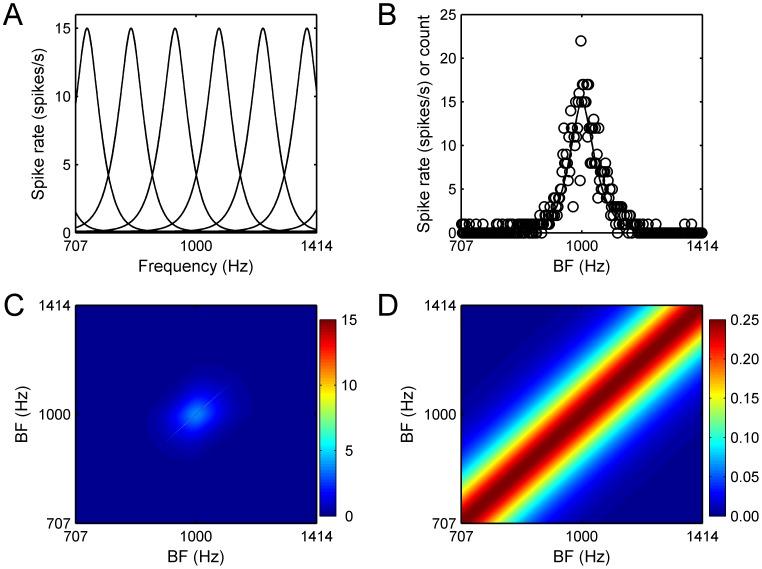
The nature of the neural codes for pitch and loudness, two basic auditory attributes, has been a key question in neuroscience for over century. A currently widespread view is that sound intensity (subjectively, loudness) is encoded in spike rates, whereas sound frequency (subjectively, pitch) is encoded in precise spike timing. Here, using information-theoretic analyses, we show that the spike rates of a population of virtual neural units with frequency-tuning and spike-count correlation characteristics similar to those measured in the primary auditory cortex of primates, contain sufficient statistical information to account for the smallest frequency-discrimination thresholds measured in human listeners. The same population, and the same spike-rate code, can also account for the intensity-discrimination thresholds of humans. These results demonstrate the viability of a unified rate-based cortical population code for both sound frequency (pitch) and sound intensity (loudness), and thus suggest a resolution to a long-standing puzzle in auditory neuroscience.
音高和响度这两个基本听觉属性的神经编码本质,是一个多世纪以来神经科学的关键问题。目前一个广泛的观点是,声音强度(主观上为响度)由尖峰率编码,而声音频率(主观上为音高)由精确的尖峰定时编码。在这里,我们使用信息论分析表明,具有类似于在灵长类动物初级听觉皮层中测量的频率调谐和尖峰计数相关性特征的虚拟神经单元群体的尖峰率包含足以解释人类听众测量的最小频率辨别阈值的统计信息。同样的群体和相同的尖峰率编码也可以解释人类的强度辨别阈值。这些结果表明,对于声音频率(音高)和声音强度(响度),基于皮层群体的统一率编码是可行的,因此解决了听觉神经科学中的一个长期存在的难题。


 Zotero 插件