Ahmed Aliya, Latif Naveed, Khan Robyna
Department of Anaesthesiology, Aga Khan University, Karachi, Pakistan.
J Anaesthesiol Clin Pharmacol. 2013 Oct;29(4):472-7. doi: 10.4103/0970-9185.119137.
Post-operative pain is often inadequately treated. Optimal utilization of the available resources is essential for improving pain management.
The aim of our study was to determine pain management strategies employed after major abdominal surgeries at our institute and their efficacy and safety.
Prospective observational study conducted at a tertiary care hospital.
Patients undergoing elective major abdominal surgeries were included. Post-operative analgesic strategy, co-analgesics used, pain and sedation scores, motor block, nausea and vomiting were recorded and patient satisfaction was determined.
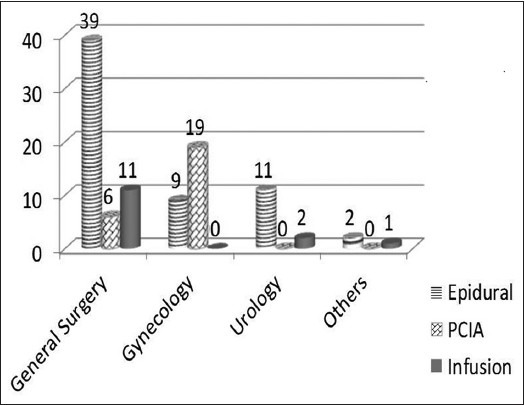
Data was collected on 100 patients. Epidural analgesia was used in 61, patient controlled intravenous analgesia (PCIA) in 25 and opioid infusion in 14 patients. Multimodal analgesia was employed in 98 patients. The level of epidural was between L1-L3 in 31, T10-L1 in 20 and T8-T10 in 10 patients. Pethidine was used in 80% of patients receiving PCIA. Patients with epidurals at T8-T10 had lower pain scores. Fifteen patients had motor block, 73% of which were with epidural at L1-L3. Fourteen patients complained of nausea. Ninety nine out of 100 patients were satisfied with their analgesia.
Epidural, PCIA and opioid infusions are used for pain relief after major abdominal surgeries at our hospital. Although there is limited drug availability, regular assessments and appropriate dose adjustments by acute pain management service (APMS) and use of multimodal analgesia led to a high level of patient satisfaction. We recommend that feedback to the primary anesthesiologists by APMS is of utmost importance to enable improvement in practice.
术后疼痛常常未得到充分治疗。优化可用资源的利用对于改善疼痛管理至关重要。
我们研究的目的是确定我院大型腹部手术后采用的疼痛管理策略及其有效性和安全性。
在一家三级护理医院进行的前瞻性观察性研究。
纳入接受择期大型腹部手术的患者。记录术后镇痛策略、使用的辅助镇痛药、疼痛和镇静评分、运动阻滞、恶心和呕吐情况,并确定患者满意度。
收集了100例患者的数据。61例患者使用硬膜外镇痛,25例使用患者自控静脉镇痛(PCIA),14例使用阿片类药物输注。98例患者采用多模式镇痛。31例患者硬膜外穿刺节段在L1-L3,20例在T10-L1,10例在T8-T10。接受PCIA的患者中80%使用了哌替啶。硬膜外穿刺节段在T8-T10的患者疼痛评分较低。15例患者出现运动阻滞,其中73%硬膜外穿刺节段在L1-L3。14例患者主诉恶心。100例患者中有99例对镇痛效果满意。
我院大型腹部手术后使用硬膜外镇痛、PCIA和阿片类药物输注来缓解疼痛。尽管药物供应有限,但急性疼痛管理服务(APMS)进行定期评估和适当剂量调整以及使用多模式镇痛导致了较高的患者满意度。我们建议APMS向初级麻醉医生提供反馈对于改进实践至关重要。