Jones David B, Jerry Dean R, Khatkar Mehar S, Raadsma Herman W, Zenger Kyall R
Centre for Sustainable Tropical Fisheries & Aquaculture, The School of Marine and Tropical Biology, James Cook University, Townsville, QLD, Australia.
BMC Genomics. 2013 Nov 20;14(1):810. doi: 10.1186/1471-2164-14-810.
The silver-lipped pearl oyster, Pinctada maxima, is an important tropical aquaculture species extensively farmed for the highly sought "South Sea" pearls. Traditional breeding programs have been initiated for this species in order to select for improved pearl quality, but many economic traits under selection are complex, polygenic and confounded with environmental factors, limiting the accuracy of selection. The incorporation of a marker-assisted selection (MAS) breeding approach would greatly benefit pearl breeding programs by allowing the direct selection of genes responsible for pearl quality. However, before MAS can be incorporated, substantial genomic resources such as genetic linkage maps need to be generated. The construction of a high-density genetic linkage map for P. maxima is not only essential for unravelling the genomic architecture of complex pearl quality traits, but also provides indispensable information on the genome structure of pearl oysters.
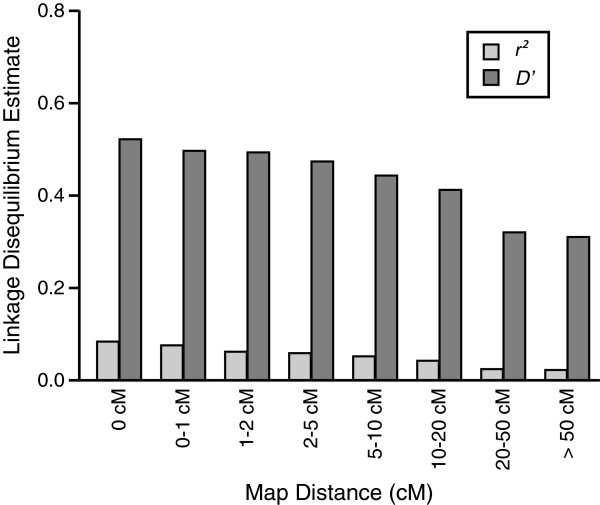
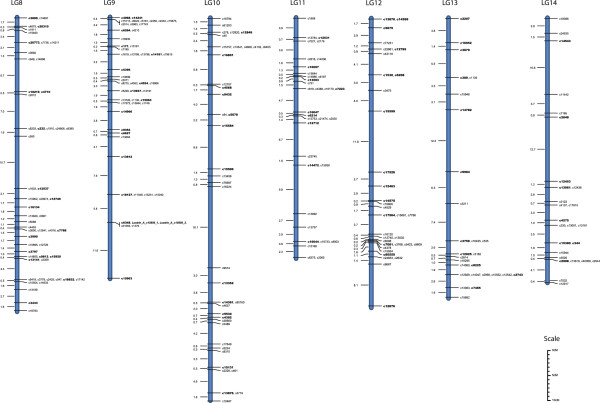
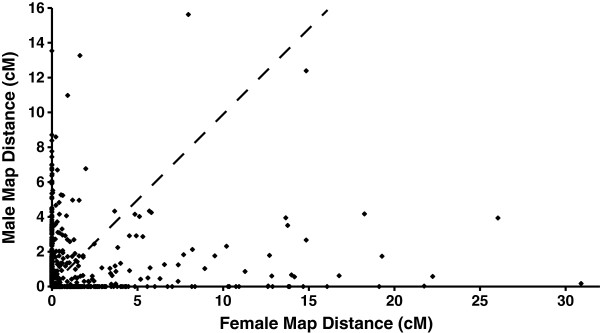
A total of 1,189 informative genome-wide single nucleotide polymorphisms (SNPs) were incorporated into linkage map construction. The final linkage map consisted of 887 SNPs in 14 linkage groups, spans a total genetic distance of 831.7 centimorgans (cM), and covers an estimated 96% of the P. maxima genome. Assessment of sex-specific recombination across all linkage groups revealed limited overall heterochiasmy between the sexes (i.e. 1.15:1 F/M map length ratio). However, there were pronounced localised differences throughout the linkage groups, whereby male recombination was suppressed near the centromeres compared to female recombination, but inflated towards telomeric regions. Mean values of LD for adjacent SNP pairs suggest that a higher density of markers will be required for powerful genome-wide association studies. Finally, numerous nacre biomineralization genes were localised providing novel positional information for these genes.
This high-density SNP genetic map is the first comprehensive linkage map for any pearl oyster species. It provides an essential genomic tool facilitating studies investigating the genomic architecture of complex trait variation and identifying quantitative trait loci for economically important traits useful in genetic selection programs within the P. maxima pearling industry. Furthermore, this map provides a foundation for further research aiming to improve our understanding of the dynamic process of biomineralization, and pearl oyster evolution and synteny.
银唇珠母贝(Pinctada maxima)是一种重要的热带水产养殖物种,因其备受追捧的“南海”珍珠而被广泛养殖。为了选育出品质更优的珍珠,已针对该物种启动了传统育种计划,但许多被选育的经济性状复杂、受多基因控制且与环境因素相互混杂,这限制了选择的准确性。采用标记辅助选择(MAS)育种方法将极大地有益于珍珠育种计划,因为它能直接选择负责珍珠品质的基因。然而,在纳入MAS之前,需要生成大量的基因组资源,如遗传连锁图谱。构建P. maxima的高密度遗传连锁图谱不仅对于揭示复杂珍珠品质性状的基因组结构至关重要,而且还能提供有关珠母贝基因组结构的不可或缺的信息。
总共1189个全基因组信息性单核苷酸多态性(SNP)被纳入连锁图谱构建。最终的连锁图谱由14个连锁群中的887个SNP组成,总遗传距离为831.7厘摩(cM),估计覆盖了P. maxima基因组的96%。对所有连锁群的性别特异性重组进行评估发现,两性之间总体异配交换有限(即F/M图谱长度比为1.15:1)。然而,连锁群中存在明显的局部差异,与雌性重组相比,雄性重组在着丝粒附近受到抑制,但在端粒区域则有所增加。相邻SNP对的LD平均值表明,对于强大的全基因组关联研究,需要更高密度的标记。最后,定位了许多珍珠层生物矿化基因,为这些基因提供了新的位置信息。
这一高密度SNP遗传图谱是首个针对任何珠母贝物种的全面连锁图谱。它提供了一个重要的基因组工具,有助于研究复杂性状变异的基因组结构,并识别在P. maxima珍珠养殖行业的遗传选择计划中对经济重要性状有用的数量性状位点。此外,该图谱为进一步研究奠定了基础,旨在增进我们对生物矿化动态过程以及珠母贝进化和同线性的理解。