Lee Young Ik, Kim Ji Won, Bae Sang Rak, Paick Sung Hyun, Kim Ki Woong, Kim Hyeong Gon, Lho Yong Soo, Park Hyoung Keun
Department of Urology, Konkuk University Medical Center, Seoul, Korea.
Korean J Urol. 2013 Nov;54(11):762-6. doi: 10.4111/kju.2013.54.11.762. Epub 2013 Nov 6.
To evaluate the association of a specific type of lower urinary tract symptom (LUTS) and the depression in community-dwelling elderly Korean men.
A total of 392 men aged 65 years or older, who completed urological and psychiatric evaluations as a participant of the Korean Longitudinal Study on Health and Aging, were included. From each subject, an interview on the demographic characteristics and medical history, IPSS, and psychiatric questionnaire were taken. Subjects were divided into two groups; depression and euthymic. Subjects with IPSS subscore more than 3 points was considered 'high' subscore. IPSS subscores were compared between the two groups, and the relationship between depression and LUTS severity was assessed.
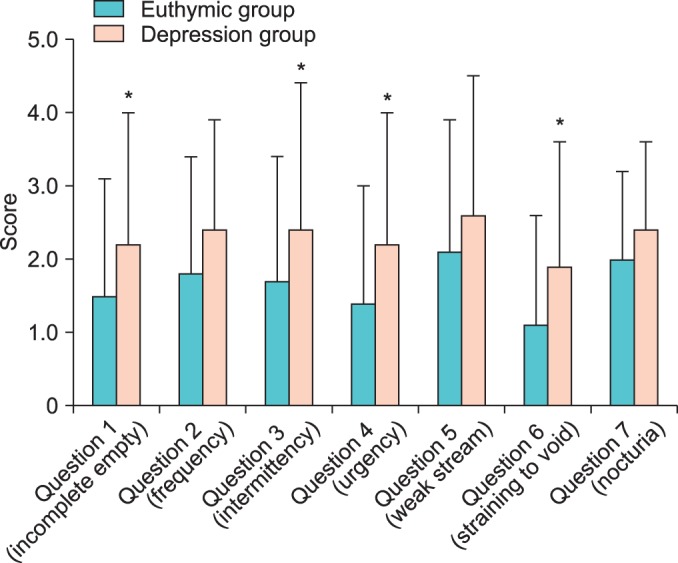
The mean age of the subjects was 75, and 6.4% of the subjects were diagnosed to have major depressive disorders. The depression group showed higher IPSS scores than the euthymic group (16.1±9.9 vs. 11.6±8.6, p=0.01). IPSS subscores of question 1 (incomplete empty), question 3 (intermittency), question 4 (urgency) and question 6 (straining to void) were higher in the depression group compared with the euthymic group. Chi-square test revealed subjects with high IPSS 1, 3, 4, and 6 score were associated with depression, but multivariate analysis identified only high IPSS question 4 as a significant prognostic factor for depression.
Elderly population with depression is more likely to have more severe LUTS than population without depression. Among the urinary symptoms, urgency was strongly associated with depression. Patients with moderate to severe LUTS and especially urgency may need their mental health status evaluation.
评估韩国社区居住老年男性中特定类型下尿路症状(LUTS)与抑郁症之间的关联。
纳入了392名65岁及以上的男性,他们作为韩国健康与老龄化纵向研究的参与者完成了泌尿外科和精神科评估。对每位受试者进行了人口统计学特征和病史访谈、国际前列腺症状评分(IPSS)以及精神科问卷调查。受试者分为两组:抑郁症组和心境正常组。IPSS分项得分超过3分的受试者被认为是“高分”。比较两组之间的IPSS分项得分,并评估抑郁症与LUTS严重程度之间的关系。
受试者的平均年龄为75岁,6.4%的受试者被诊断患有重度抑郁症。抑郁症组的IPSS得分高于心境正常组(16.1±9.9对11.6±8.6,p = 0.01)。抑郁症组中问题1(排尿不尽)、问题3(尿线间断)、问题4(尿急)和问题6(排尿费力)的IPSS分项得分高于心境正常组。卡方检验显示,IPSS问题1、3、4和6得分高的受试者与抑郁症相关,但多因素分析仅确定IPSS问题4是抑郁症的一个重要预后因素。
与无抑郁症的人群相比,患有抑郁症的老年人群更有可能出现更严重的LUTS。在尿路症状中,尿急与抑郁症密切相关。中重度LUTS患者,尤其是尿急患者,可能需要评估其心理健康状况。