University of Cambridge, Zoology Department, Downing Street, Cambridge CB2 3EJ, UK.
Development. 2014 Jan;141(1):176-86. doi: 10.1242/dev.097592. Epub 2013 Nov 20.
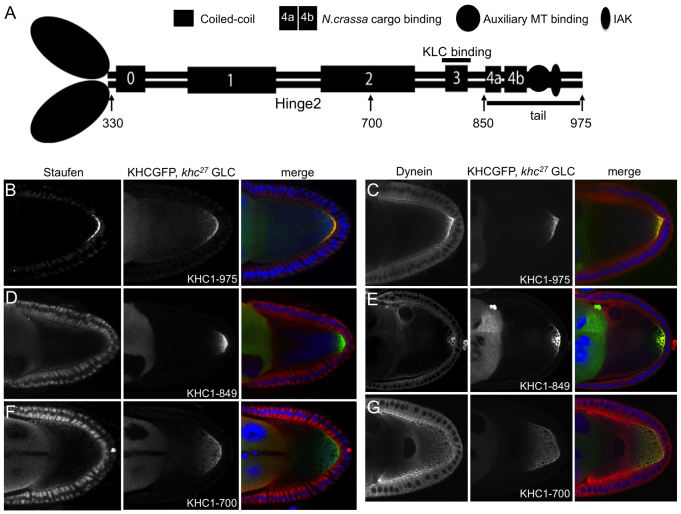
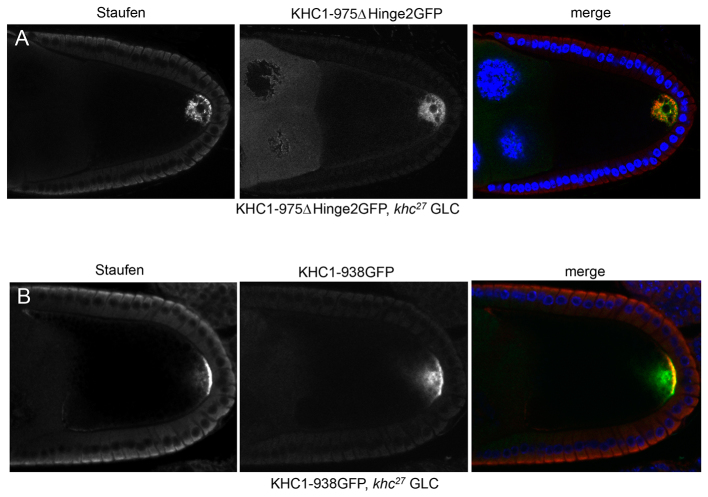
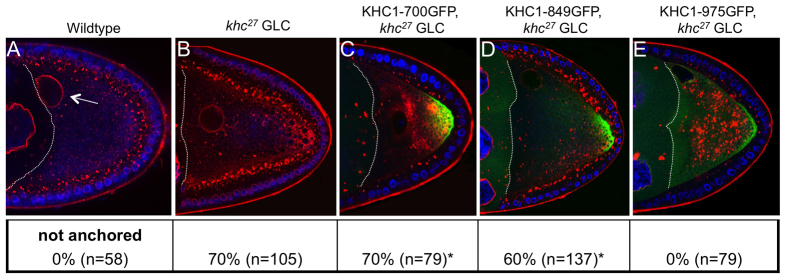
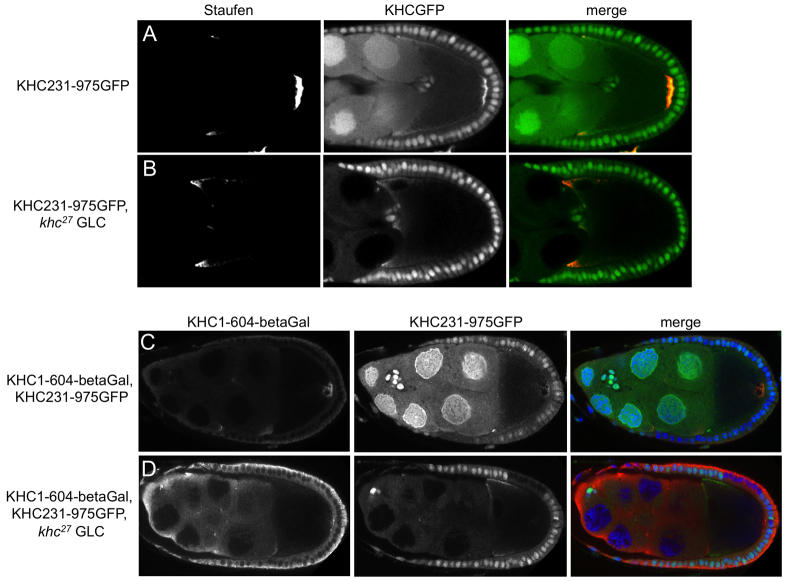
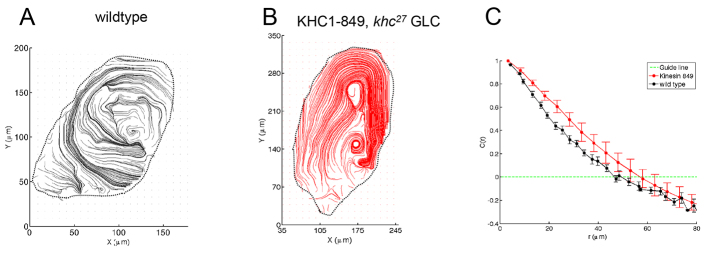
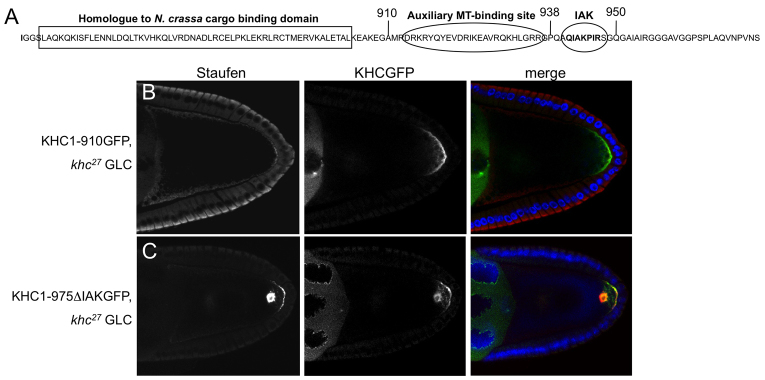
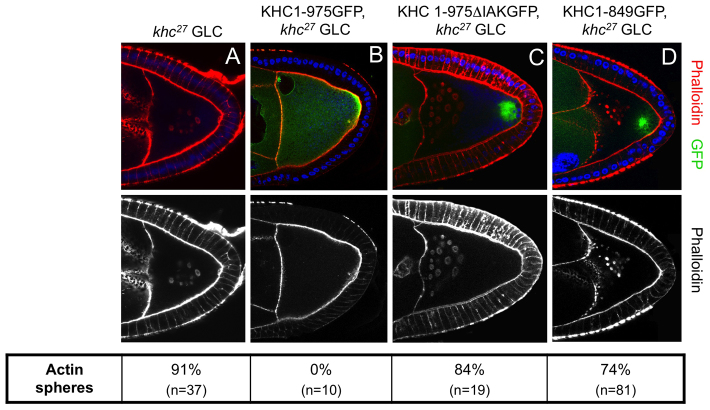
The major motor Kinesin-1 provides a key pathway for cell polarization through intracellular transport. Little is known about how Kinesin works in complex cellular surroundings. Several cargos associate with Kinesin via Kinesin light chain (KLC). However, KLC is not required for all Kinesin transport. A putative cargo-binding domain was identified in the C-terminal tail of fungal Kinesin heavy chain (KHC). The tail is conserved in animal KHCs and might therefore represent an alternative KLC-independent cargo-interacting region. By comprehensive functional analysis of the tail during Drosophila oogenesis we have gained an understanding of how KHC achieves specificity in its transport and how it is regulated. This is, to our knowledge, the first in vivo structural/functional analysis of the tail in animal Kinesins. We show that the tail is essential for all functions of KHC except Dynein transport, which is KLC dependent. These tail-dependent KHC activities can be functionally separated from one another by further characterizing domains within the tail. In particular, our data show the following. First, KHC is temporally regulated during oogenesis. Second, the IAK domain has an essential role distinct from its auto-inhibitory function. Third, lack of auto-inhibition in itself is not necessarily detrimental to KHC function. Finally, the ATP-independent microtubule-binding motif is required for cargo localization. These results stress that two unexpected highly conserved domains, namely the auto-inhibitory IAK and the auxiliary microtubule-binding motifs, are crucial for transport by Kinesin-1 and that, although not all cargos are conserved, their transport involves the most conserved domains of animal KHCs.
驱动蛋白-1 是主要的运动蛋白,通过细胞内运输为细胞极化提供了关键途径。目前尚不清楚驱动蛋白在复杂的细胞环境中是如何工作的。几种货物通过驱动蛋白轻链(KLC)与驱动蛋白结合。然而,并非所有的驱动蛋白运输都需要 KLC。在真菌驱动蛋白重链(KHC)的 C 端尾部发现了一个假定的货物结合域。该尾部在动物 KHC 中保守,因此可能代表另一种与 KLC 无关的货物相互作用区域。通过在果蝇卵子发生过程中对尾部进行全面的功能分析,我们了解了 KHC 如何实现其运输的特异性以及如何对其进行调节。据我们所知,这是首次对动物驱动蛋白尾部进行体内结构/功能分析。我们发现,除了依赖 KLC 的 Dynein 运输外,尾部对于 KHC 的所有功能都是必不可少的。通过进一步分析尾部内的结构域,可以将这些依赖尾部的 KHC 活性彼此功能分离。特别是,我们的数据显示:第一,在卵子发生过程中,KHC 是受时间调控的。第二,IAK 结构域具有与其自动抑制功能不同的必需作用。第三,缺乏自动抑制本身不一定对 KHC 功能有害。最后,ATP 非依赖性微管结合基序对于货物定位是必需的。这些结果强调了两个意想不到的高度保守结构域,即自动抑制的 IAK 和辅助微管结合基序,对于驱动蛋白-1 的运输至关重要,尽管并非所有货物都保守,但它们的运输涉及动物 KHC 最保守的结构域。