Department of Social and Behavioral Sciences, Harvard School of Public Health, Boston, Massachusetts.
Department of Epidemiology, Columbia Mailman School of Public Health, New York, New York.
JAMA Psychiatry. 2014 Jan;71(1):44-51. doi: 10.1001/jamapsychiatry.2013.2798.
Posttraumatic stress disorder (PTSD) indicates a chronic stress reaction in response to trauma. This prevalent condition has been identified as a possible risk factor for obesity. Whether PTSD symptoms alter the trajectory of weight gain or constitute a comorbid condition has not been established.
To determine whether women who develop PTSD symptoms are subsequently more likely to gain weight and become obese relative to trauma-exposed women who do not develop PTSD symptoms or women with no trauma exposure or PTSD symptoms and whether the effects are independent of depression.
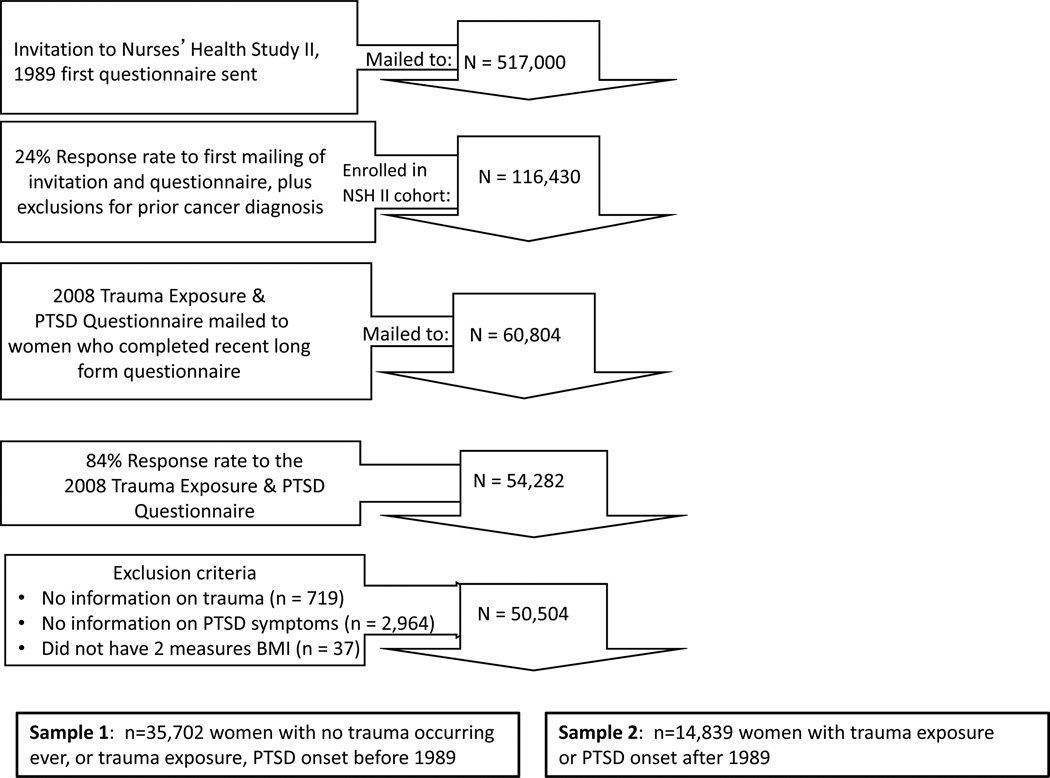
DESIGN, SETTING, AND PARTICIPANTS: The Nurses' Health Study II, a prospective observational study initiated in 1989 with follow-up to 2005, using a PTSD screener to measure PTSD symptoms and time of onset. We included the subsample of the Nurses' Health Study II (54 224 participants; ages 24-44 years in 1989) in whom trauma and PTSD symptoms were measured.
Trauma and PTSD symptoms.
Development of overweight and obesity using body mass index (BMI) (calculated as weight in kilograms divided by height in meters squared) cut points 25.0 and 30.0, respectively; change in BMI during follow-up among women reporting PTSD symptom onset before 1989; and BMI trajectory before and after PTSD symptom onset among women who developed PTSD symptoms in 1989 or during follow-up.
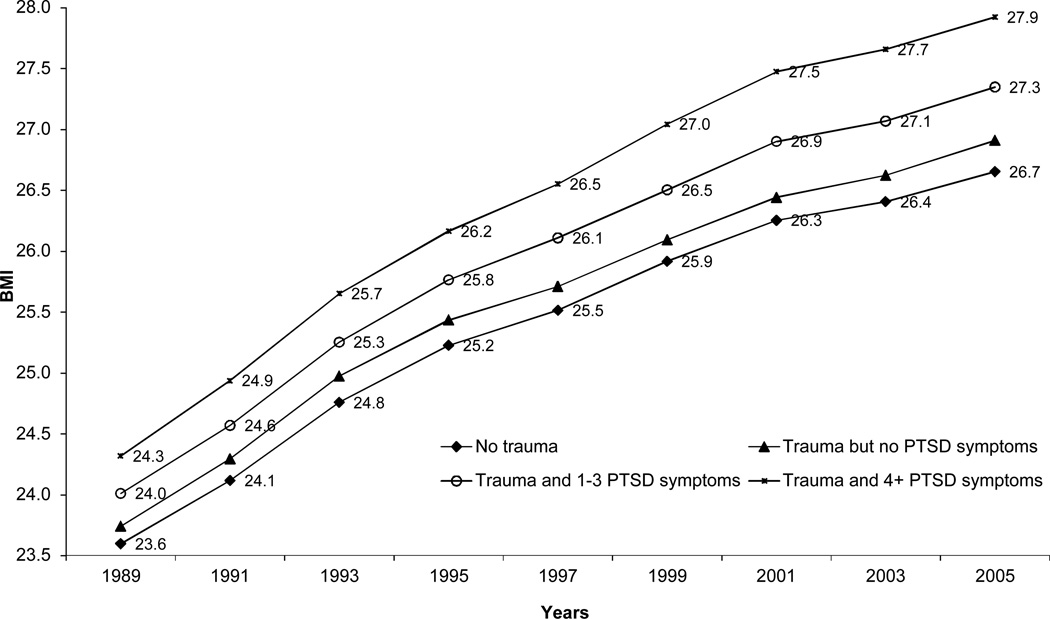
Among women with at least 4 PTSD symptoms before 1989 (cohort initiation), BMI increased more steeply (b = 0.09 [SE = 0.01]; P < .001) during the follow-up. Among women who developed PTSD symptoms in 1989 or later, BMI trajectory did not differ by PTSD status before PTSD onset. After PTSD symptom onset, women with at least 4 symptoms had a faster rise in BMI (b = 0.08 [SE = 0.02]; P < .001). The onset of at least 4 PTSD symptoms in 1989 or later was also associated with an increased risk of becoming overweight or obese (odds ratio, 1.36 [95% CI, 1.19-1.56]) among women with a normal BMI in 1989. Effects were maintained after adjusting for depression.
Experience of PTSD symptoms is associated with an increased risk of becoming overweight or obese, and PTSD symptom onset alters BMI trajectories over time. The presence of PTSD symptoms should raise clinician concerns about physical health problems that may develop and prompt closer attention to weight status.
创伤后应激障碍(PTSD)表明是一种对创伤的慢性应激反应。这种普遍存在的疾病已被确定为肥胖的一个可能的危险因素。是否 PTSD 症状会改变体重增加的轨迹或构成合并症尚未确定。
确定患有 PTSD 症状的女性是否随后更容易体重增加和肥胖,与未患 PTSD 症状或无创伤暴露或 PTSD 症状的创伤暴露女性相比,以及这些影响是否独立于抑郁。
设计、地点和参与者:护士健康研究 II 是一项始于 1989 年的前瞻性观察性研究,随访至 2005 年,使用 PTSD 筛查器测量 PTSD 症状和发病时间。我们包括了护士健康研究 II 的亚样本(54224 名参与者;1989 年时年龄为 24-44 岁),其中测量了创伤和 PTSD 症状。
创伤和 PTSD 症状。
使用体重指数(BMI)(体重以千克为单位除以身高以米为单位)切点 25.0 和 30.0 来确定超重和肥胖的发展;在 1989 年之前报告 PTSD 症状发作的女性中,随访期间 BMI 的变化;以及在 1989 年或随访期间发生 PTSD 症状的女性中,PTSD 症状发作前后的 BMI 轨迹。
在 1989 年(队列开始)之前至少有 4 个 PTSD 症状的女性中,随访期间 BMI 增加更陡峭(b=0.09 [SE=0.01];P<.001)。在 1989 年或之后发生 PTSD 症状的女性中,PTSD 发病前的 PTSD 状态与 BMI 轨迹没有差异。在 PTSD 症状发作后,至少有 4 个症状的女性 BMI 上升速度加快(b=0.08 [SE=0.02];P<.001)。1989 年或之后至少有 4 个 PTSD 症状的发作也与 1989 年 BMI 正常的女性超重或肥胖的风险增加有关(优势比,1.36 [95%CI,1.19-1.56])。调整抑郁后,效果仍然存在。
经历 PTSD 症状与超重或肥胖的风险增加有关,并且 PTSD 症状的发作会改变 BMI 的轨迹随时间的推移。PTSD 症状的存在应该引起临床医生对可能发展的身体健康问题的关注,并促使更密切地关注体重状况。