Department of Environmental Health, Harvard T.H. Chan School of Public Health, Boston, Massachusetts.
Department of Epidemiology, Harvard T.H. Chan School of Public Health, Boston, Massachusetts.
JAMA Netw Open. 2022 Jun 1;5(6):e2217698. doi: 10.1001/jamanetworkopen.2022.17698.
Posttraumatic stress disorder (PTSD) has been hypothesized to lead to impaired cognitive function. However, no large-scale studies have assessed whether PTSD is prospectively associated with cognitive decline in middle-aged adults.
To assess the association between PTSD and decline in cognitive function over time.
DESIGN, SETTING, AND PARTICIPANTS: This cohort study included participants from the Nurses' Health Study II, an ongoing longitudinal cohort study involving community-dwelling middle-aged female nurses residing in the US who had at least a 2-year nursing degree at the time of enrollment in 1989. The present study included 12 270 trauma-exposed women who were enrolled in the PTSD substudy of the Nurses' Health Study II and completed 1 to 5 cognitive assessments. Data were collected from March 1, 2008, to July 30, 2019.
Lifetime PTSD symptoms, assessed using a validated questionnaire between March 1, 2008, and February 28, 2010.
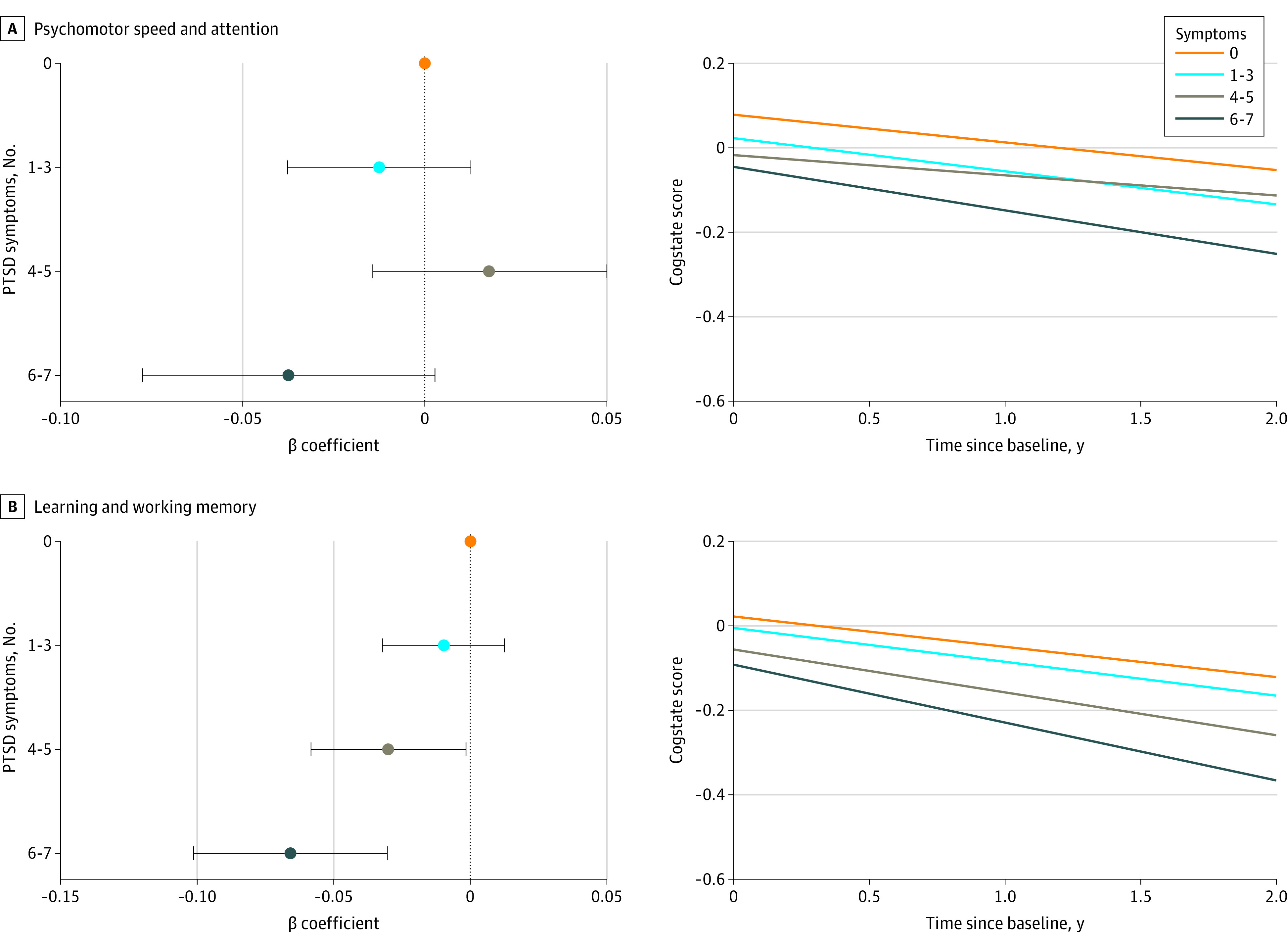
The main outcome was evaluated using the Cogstate Brief Battery, a self-administered online cognitive battery. Cognitive function was measured by a psychomotor speed and attention composite score and a learning and working memory composite score. Women completed the Cogstate Brief Battery every 6 or 12 months (up to 24 months) from October 3, 2014, to July 30, 2019. Linear mixed-effects models were used to evaluate the association of PTSD symptoms with the rate of change in cognition over follow-up, considering a broad range of relevant covariates, including the presence of depression symptoms and history of clinician-diagnosed depression. The rate of cognitive change was adjusted for potential practice effects (ie, potential changes in test results that occur when a test is taken more than once) by including indicators for the number of previous tests taken.
Among 12 270 women, the mean (SD) age at the baseline cognitive assessment was 61.1 (4.6) years; 125 women (1.0%) were Asian, 75 (0.6%) were Black, 156 (1.3%) were Hispanic, 11 767 (95.9%) were non-Hispanic White, and 147 (1.2%) were of other race and/or ethnicity. A higher number of PTSD symptoms was associated with worse cognitive trajectories. Compared with women with no PTSD symptoms, women with the highest symptom level (6-7 symptoms) had a significantly worse rate of change in both learning and working memory (β = -0.08 SD/y; 95% CI, -0.11 to -0.04 SD/y; P < .001) and psychomotor speed and attention (β = -0.05 SD/y; 95% CI, -0.09 to -0.01 SD/y; P = .02), adjusted for demographic characteristics. Associations were unchanged when additionally adjusted for behavioral factors (eg, 6-7 symptoms in the analysis of learning and working memory: β = -0.08 SD/y; 95% CI, -0.11 to -0.04 SD/y; P < .001) and health conditions (eg, 6-7 symptoms in the analysis of learning and working memory: β = -0.08 SD/y; 95% CI, -0.11 to -0.04 SD/y; P < .001) and were partially attenuated but still evident when further adjusted for practice effects (eg, 6-7 symptoms in the analysis of learning and working memory: β = -0.07 SD/y; 95% CI, -0.10 to -0.03 SD/y; P < .001) and comorbid depression (eg, 6-7 symptoms in the analysis of learning and working memory: β = -0.07 SD/y; 95% CI, -0.11 to -0.03 SD/y; P < .001).
In this large-scale prospective cohort study, PTSD was associated with accelerated cognitive decline in middle-aged women, suggesting that earlier cognitive screening among women with PTSD may be warranted. Given that cognitive decline is strongly associated with subsequent Alzheimer disease and related dementias, better understanding of this association may be important to promote healthy aging.
创伤后应激障碍(PTSD)已被假设会导致认知功能受损。然而,尚无大规模研究评估 PTSD 是否与中年成年人的认知能力下降具有前瞻性关联。
评估 PTSD 与认知功能随时间下降的关联。
设计、设置和参与者:这项队列研究包括来自护士健康研究 II 的参与者,这是一项正在进行的纵向队列研究,涉及居住在美国的社区中年女性护士,她们在 1989 年入组时至少拥有 2 年的护理学位。本研究包括 12270 名创伤后应激障碍症状暴露的女性,她们参加了护士健康研究 II 的 PTSD 子研究,并完成了 1 到 5 次认知评估。数据收集于 2008 年 3 月 1 日至 2019 年 7 月 30 日。
使用在 2008 年 3 月 1 日至 2010 年 2 月 28 日之间的验证问卷评估终生 PTSD 症状。
主要结局通过 Cogstate 简要电池进行评估,这是一种自我管理的在线认知电池。认知功能通过心理运动速度和注意力综合评分以及学习和工作记忆综合评分来衡量。女性从 2014 年 10 月 3 日至 2019 年 7 月 30 日,每 6 或 12 个月(最多 24 个月)完成一次 Cogstate 简要电池测试。线性混合效应模型用于评估 PTSD 症状与随访期间认知变化率的关联,考虑了广泛的相关协变量,包括抑郁症状的存在和临床诊断的抑郁症病史。通过包括之前测试次数的指标,对认知变化的潜在练习效应(即测试多次时发生的测试结果的潜在变化)进行了调整。
在 12270 名女性中,基线认知评估时的平均(SD)年龄为 61.1(4.6)岁;125 名女性(1.0%)为亚洲人,75 名(0.6%)为黑人,156 名(1.3%)为西班牙裔,11767 名(95.9%)为非西班牙裔白人,147 名(1.2%)为其他种族和/或族裔。更多的 PTSD 症状与更差的认知轨迹相关。与没有 PTSD 症状的女性相比,症状水平最高(6-7 个症状)的女性在学习和工作记忆方面的变化速度明显更差(β=-0.08 SD/y;95%CI,-0.11 至-0.04 SD/y;P<0.001)和心理运动速度和注意力(β=-0.05 SD/y;95%CI,-0.09 至-0.01 SD/y;P=0.02),调整了人口统计学特征。当进一步调整行为因素(例如,学习和工作记忆分析中的 6-7 个症状:β=-0.08 SD/y;95%CI,-0.11 至-0.04 SD/y;P<0.001)和健康状况(例如,学习和工作记忆分析中的 6-7 个症状:β=-0.08 SD/y;95%CI,-0.11 至-0.04 SD/y;P<0.001)时,关联不变,并且在部分调整了练习效应(例如,学习和工作记忆分析中的 6-7 个症状:β=-0.07 SD/y;95%CI,-0.10 至-0.03 SD/y;P<0.001)和共病性抑郁(例如,学习和工作记忆分析中的 6-7 个症状:β=-0.07 SD/y;95%CI,-0.11 至-0.03 SD/y;P<0.001)后,关联仍然明显。
在这项大规模前瞻性队列研究中,PTSD 与中年女性的认知能力下降加速有关,这表明可能需要对 PTSD 女性进行更早的认知筛查。鉴于认知能力下降与随后的阿尔茨海默病和相关痴呆症密切相关,更好地了解这种关联可能对促进健康衰老很重要。