First Department of Internal Medicine, Faculty of Medicine, University of Toyama, Toyama, Japan.
Nutr Diabetes. 2013 Nov 25;3(11):e96. doi: 10.1038/nutd.2013.37.
The objective of this study was to clarify the generation and gender differences in the association between central obesity and the accumulation of metabolic risk factors (RFs) in the Japanese population.
A total of 12 389 subjects (age: 18-80 years) without receiving medication for diabetes, dyslipidemia or hypertension were enrolled in this study and divided according to age and gender. In each group, we performed analyses as follows: (1) a receiver operating characteristic (ROC) analysis to evaluate the utility of the waist circumference (WC) for detecting subjects with multiple RFs of metabolic syndrome (MS); (2) a cross-sectional study to examine the relationship between the WC and the odds ratio (OR) for detecting those subjects and (3) a longitudinal study to examine how longitudinal changes (Δ) in WC over a 1-year period affected the values of each metabolic RF.
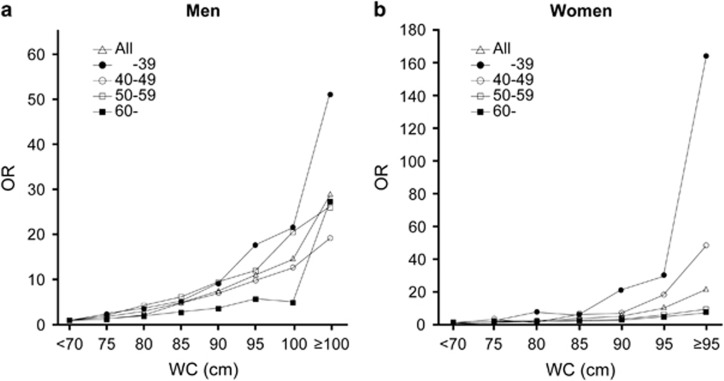
With age, the WC cutoff values yielding the maximum Youden index for detecting subjects with multiple RFs increased only in women, and the areas under the curves of the ROC analysis of WC for detecting those subjects decreased in both genders. The positive correlation between the WC and the OR for detecting subjects with multiple RFs became weaker with age, especially in women. In the longitudinal study, the significant correlation between ΔWC and Δ each metabolic RF, except for hypertension, and between ΔWC and Δ the number of RFs became weaker with age in women, whereas the significant correlation between ΔWC and Δ the number of RFs was not affected with age in men. In women aged 60 years, none of the changes in each metabolic RF were significantly associated with ΔWC.
Aging attenuates the association of central obesity with the accumulation of metabolic RFs, especially in women.
本研究旨在阐明中心性肥胖与代谢危险因素(RFs)在日本人群中的积累之间的产生及其与性别之间的关联。
本研究共纳入 12389 名未服用治疗糖尿病、血脂异常或高血压药物的受试者(年龄:18-80 岁),并根据年龄和性别进行分组。在每组中,我们进行了以下分析:(1)接受者操作特征(ROC)分析,以评估腰围(WC)在检测代谢综合征(MS)多种 RF 中的作用;(2)横断面研究,以检查 WC 与检测这些受试者的比值比(OR)之间的关系;(3)纵向研究,以检查 WC 在 1 年内的纵向变化(Δ)如何影响每个代谢 RF 的值。
随着年龄的增长,用于检测具有多种 RF 的受试者的 WC 截断值仅在女性中增加,且 ROC 分析中 WC 检测这些受试者的曲线下面积在两性中均降低。WC 与检测具有多种 RF 的受试者的 OR 之间的正相关性随着年龄的增长而减弱,尤其是在女性中。在纵向研究中,ΔWC 与除高血压以外的每个代谢 RF 的Δ之间以及 ΔWC 与 RF 数量的Δ之间的显著相关性随着女性年龄的增长而减弱,而男性的ΔWC 与 RF 数量的Δ之间的显著相关性不受年龄影响。在年龄≥60 岁的女性中,每个代谢 RF 的变化均与 ΔWC 无显著相关性。
衰老会削弱中心性肥胖与代谢 RFs 积累之间的关联,尤其是在女性中。