Agrogenomics Research Center, National Institute of Agrobiological Sciences, 2-1-2 Kannondai, Tsukuba, Ibaraki, 305-8602, Japan.
Rice (N Y). 2013 Feb 6;6(1):4. doi: 10.1186/1939-8433-6-4.
Rice research has been enabled by access to the high quality reference genome sequence generated in 2005 by the International Rice Genome Sequencing Project (IRGSP). To further facilitate genomic-enabled research, we have updated and validated the genome assembly and sequence for the Nipponbare cultivar of Oryza sativa (japonica group).
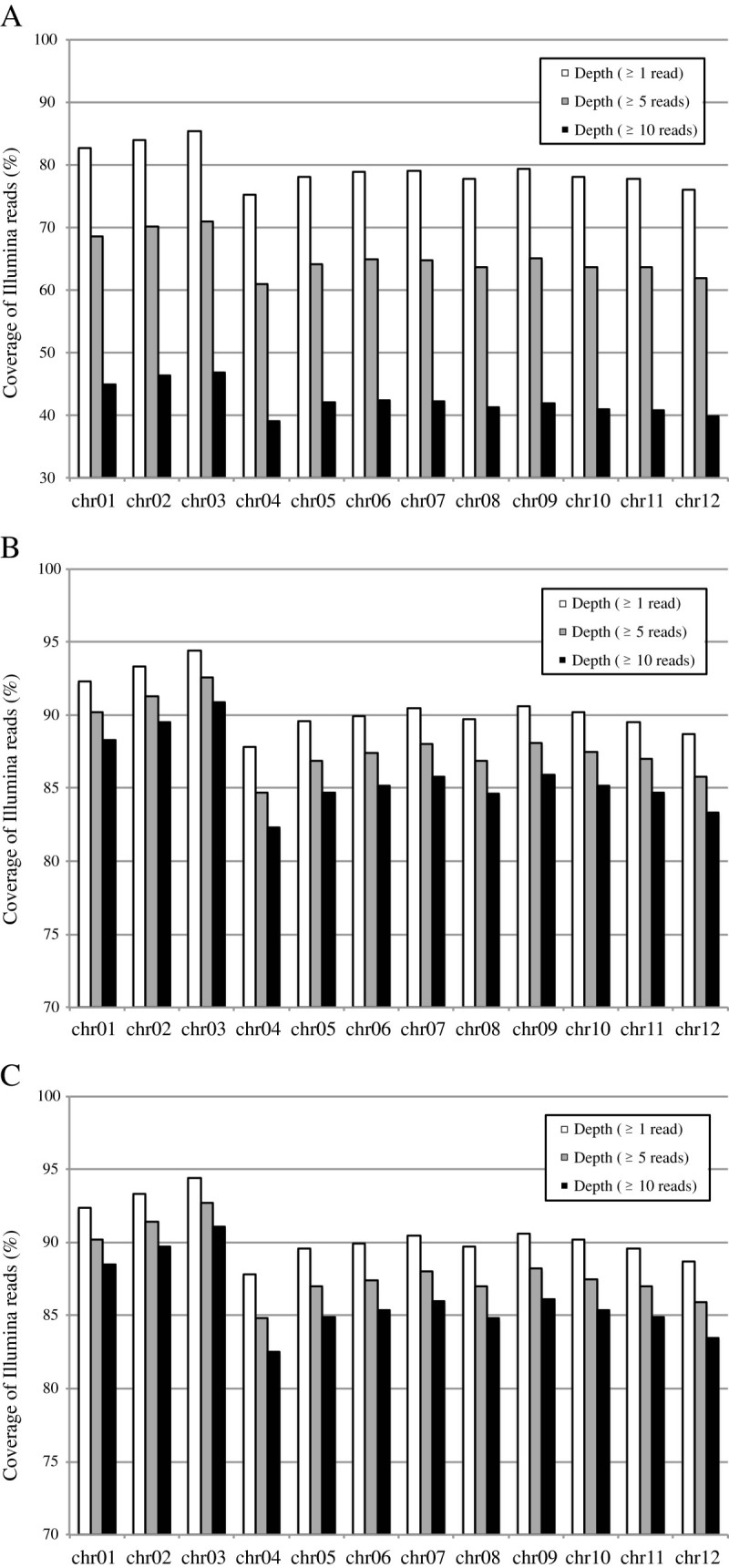
The Nipponbare genome assembly was updated by revising and validating the minimal tiling path of clones with the optical map for rice. Sequencing errors in the revised genome assembly were identified by re-sequencing the genome of two different Nipponbare individuals using the Illumina Genome Analyzer II/IIx platform. A total of 4,886 sequencing errors were identified in 321 Mb of the assembled genome indicating an error rate in the original IRGSP assembly of only 0.15 per 10,000 nucleotides. A small number (five) of insertions/deletions were identified using longer reads generated using the Roche 454 pyrosequencing platform. As the re-sequencing data were generated from two different individuals, we were able to identify a number of allelic differences between the original individual used in the IRGSP effort and the two individuals used in the re-sequencing effort. The revised assembly, termed Os-Nipponbare-Reference-IRGSP-1.0, is now being used in updated releases of the Rice Annotation Project and the Michigan State University Rice Genome Annotation Project, thereby providing a unified set of pseudomolecules for the rice community.
A revised, error-corrected, and validated assembly of the Nipponbare cultivar of rice was generated using optical map data, re-sequencing data, and manual curation that will facilitate on-going and future research in rice. Detection of polymorphisms between three different Nipponbare individuals highlights that allelic differences between individuals should be considered in diversity studies.
水稻研究得益于 2005 年国际水稻基因组测序计划(IRGSP)生成的高质量参考基因组序列。为了进一步促进基因组研究,我们更新并验证了 Nipponbare 水稻品种(粳稻组)的基因组组装和序列。
通过用水稻光学图谱修正和验证克隆的最小平铺路径,更新了 Nipponbare 基因组组装。通过使用 Illumina Genome Analyzer II/IIx 平台对两个不同的 Nipponbare 个体的基因组进行重新测序,确定了修正基因组组装中的测序错误。在组装基因组的 321Mb 中总共鉴定出 4886 个测序错误,表明原始 IRGSP 组装中的错误率仅为每 10000 个核苷酸 0.15 个。使用 Roche 454 焦磷酸测序平台生成的较长读取鉴定出少量(五个)插入/缺失。由于重新测序数据来自两个不同的个体,我们能够鉴定出原始个体与重新测序个体之间的一些等位基因差异。该修订版组装体,称为 Os-Nipponbare-Reference-IRGSP-1.0,现在正用于更新的水稻注释计划和密歇根州立大学水稻基因组注释计划中,从而为水稻社区提供了一套统一的假基因。
使用光学图谱数据、重新测序数据和手动校对生成了 Nipponbare 水稻品种的修订版、纠错和验证组装体,这将促进水稻的持续和未来研究。在三个不同的 Nipponbare 个体之间检测到多态性突出表明,在多样性研究中应该考虑个体之间的等位基因差异。