Mondal Debapriya, Weldon Rosana Hernandez, Armstrong Ben G, Gibson Lorna J, Lopez-Espinosa Maria-Jose, Shin Hyeong-Moo, Fletcher Tony
London School of Hygiene & Tropical Medicine, London, United Kingdom.
Environ Health Perspect. 2014 Feb;122(2):187-92. doi: 10.1289/ehp.1306613. Epub 2013 Nov 26.
The presence of perfluoroalkyl acids (PFAAs) in breast milk has been documented, but their lactational transfer has been rarely studied. Determination of the elimination rates of these chemicals during breastfeeding is important and critical for assessing exposure in mothers and infants.
We aimed to investigate the association between breastfeeding and maternal serum concentrations of perfluorooctanoic acid (PFOA), perfluorooctane sulfonate (PFOS), perfluorononanoic acid (PFNA), and perfluorohexane sulfonate (PFHxS). For a subset of the population, for whom we also have their infants' measurements, we investigated associations of breastfeeding with infant serum PFAA concentrations.
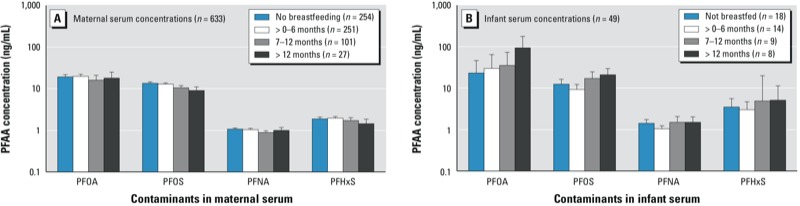
The present analysis included 633 women from the C8 Science Panel Study who had a child < 3.5 years of age and who provided blood samples and reported detailed information on breastfeeding at the time of survey. PFAA serum concentrations were available for all mothers and 8% (n = 49) of the infants. Maternal and infant serum concentrations were regressed on duration of breastfeeding.
Each month of breastfeeding was associated with lower maternal serum concentrations of PFOA (-3%; 95% CI: -5, -2%), PFOS (-3%; 95% CI: -3, -2%), PFNA (-2%; 95% CI: -2, -1%), and PFHxS (-1%; 95% CI: -2, 0%). The infant PFOA and PFOS serum concentrations were 6% (95% CI: 1, 10%) and 4% (95% CI: 1, 7%) higher per month of breastfeeding.
Breast milk is the optimal food for infants, but is also a PFAA excretion route for lactating mothers and exposure route for nursing infants.
母乳中全氟烷基酸(PFAA)的存在已有文献记载,但它们在哺乳期的转移情况鲜有研究。确定这些化学物质在母乳喂养期间的消除率对于评估母婴接触情况非常重要且关键。
我们旨在研究母乳喂养与母亲血清中全氟辛酸(PFOA)、全氟辛烷磺酸(PFOS)、全氟壬酸(PFNA)和全氟己烷磺酸(PFHxS)浓度之间的关联。对于我们也有其婴儿测量数据的一部分人群,我们研究了母乳喂养与婴儿血清PFAA浓度之间的关联。
本分析纳入了来自C8科学小组研究的633名妇女,她们育有年龄小于3.5岁的孩子,在调查时提供了血样并报告了有关母乳喂养的详细信息。所有母亲和8%(n = 49)的婴儿均有PFAA血清浓度数据。将母婴血清浓度与母乳喂养持续时间进行回归分析。
母乳喂养的每个月与母亲血清中PFOA(-3%;95%可信区间:-5,-2%)、PFOS(-3%;95%可信区间:-3,-2%)、PFNA(-2%;95%可信区间:-2,-1%)和PFHxS(-1%;95%可信区间:-2,0%)的浓度降低相关。母乳喂养的每个月婴儿PFOA和PFOS血清浓度分别高出6%(95%可信区间:1,10%)和4%(95%可信区间:1,7%)。
母乳是婴儿的最佳食物,但也是哺乳期母亲排泄PFAA的途径以及哺乳婴儿的接触途径。