UK Clinical Research Collaboration Centre for Diet and Activity Research (KC and EMFvS), Medical Research Council (MRC) Epidemiology Unit (KC, CLR, RMS, EMFvS, and UE), University of Cambridge School of Clinical Medicine, Institute of Metabolic Science, Cambridge Biomedical Campus, Cambridge, United Kingdom; the MRC Human Nutrition Research, Elsie Widdowson Laboratory, Cambridge, United Kingdom (CJP and AMS); the Developmental Psychiatry Section, Department of Psychiatry, University of Cambridge, Cambridge, United Kingdom (DJB, VJD, and IMG); and the Department of Sports Medicine, Norwegian School of Sports Sciences, Oslo, Norway (UE).
Am J Clin Nutr. 2014 Feb;99(2):361-8. doi: 10.3945/ajcn.111.027607. Epub 2013 Nov 27.
The association between breakfast consumption and physical activity (PA) is inconclusive.
We aimed to investigate daily associations and hourly patterns of PA and breakfast consumption in British adolescents.
Daily PA [accelerometry-derived moderate and vigorous physical activity (MVPA)] and breakfast consumption (diet diary) were measured simultaneously over 4 d in 860 adolescents (boys: 43.4%; mean ± SD age: 14.5 ± 0.5 y). Associations between MVPA and breakfast consumption were assessed by using a multilevel mixed-effects logistic regression separately by sex and for weekends and weekdays. Hourly patterns of MVPA by breakfast consumption status were displayed graphically, and differences were tested by using ANOVA. Multilevel linear regression was used to investigate differences in log MVPA on days when 570 inconsistent breakfast consumers ate or skipped breakfast.
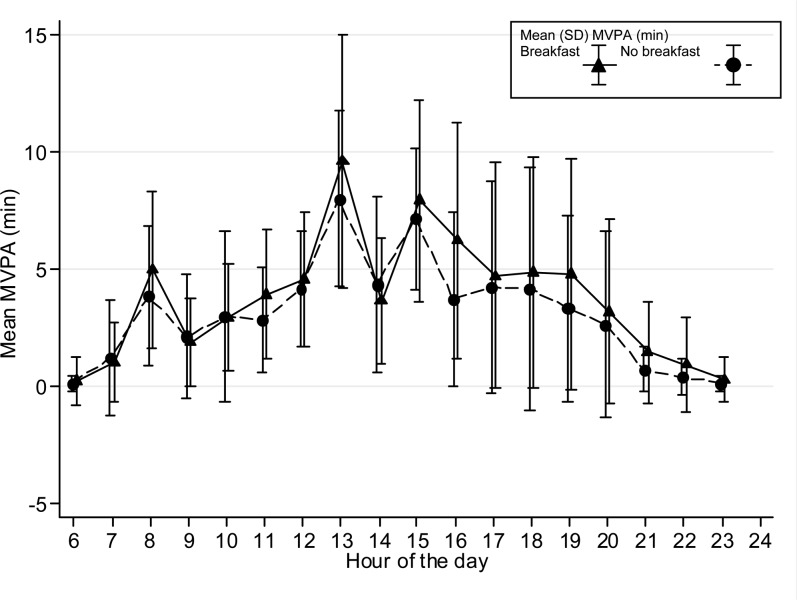
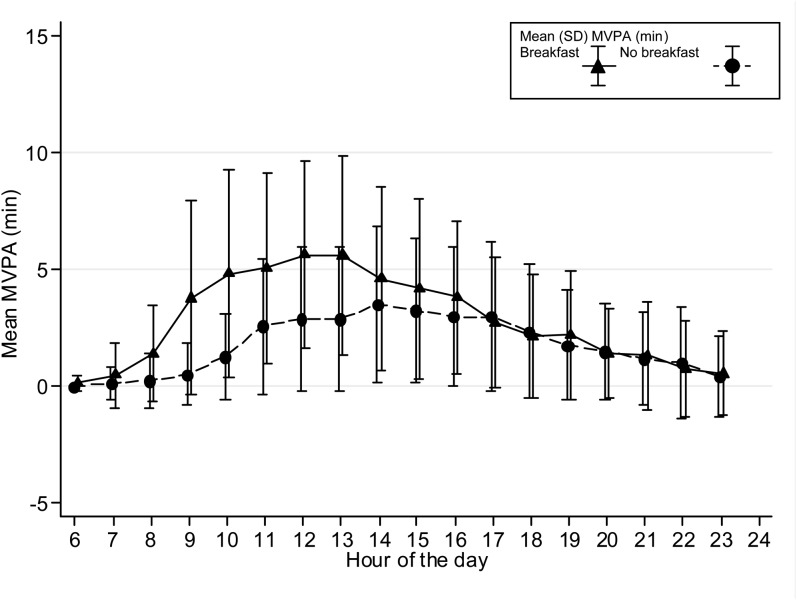
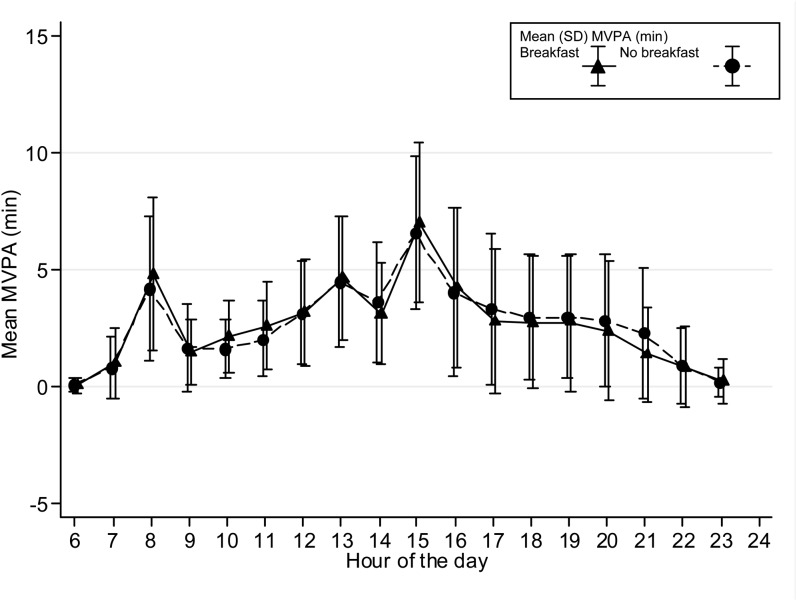
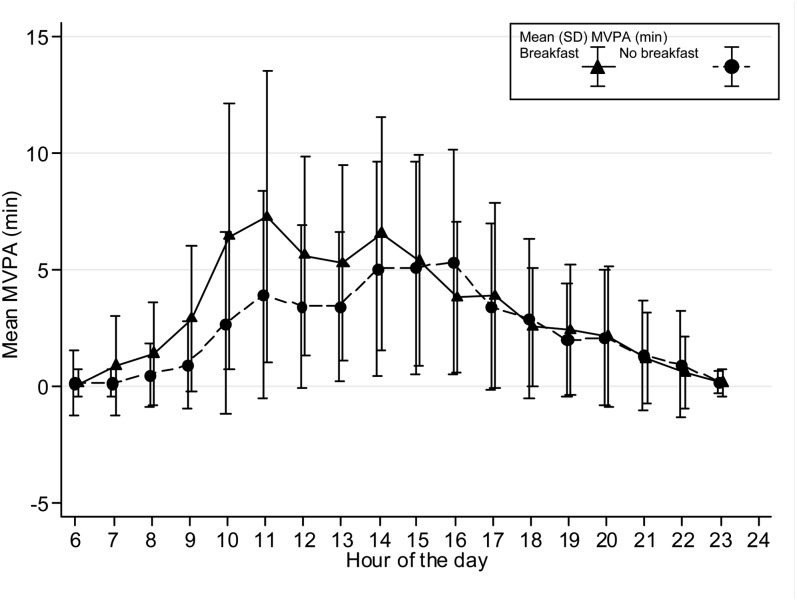
On weekends, boys and girls with higher MVPA were more likely to eat breakfast [OR (95% CI): boys, 1.78 (1.30, 2.45) (P < 0.001); girls, 2.30 (1.66, 3.08) (P < 0.001)] when adjusted for socioeconomic status, percentage of body fat, and total energy intake. Peak hourly MVPA differed for breakfast consumers compared with nonconsumers on weekends (P < 0.001). Inconsistent breakfast consumers did more MVPA on days when they ate breakfast [exponentiated β coefficients (95% CIs): 1.2 (1.0, 1.5) on weekdays and 1.4 (1.1, 1.8) on weekends for boys and 1.6 (1.3, 2.1) on weekends for girls; all P < 0.03].
Eating breakfast was associated with higher MVPA on weekends. The time of peak MVPA differed between breakfast consumers and nonconsumers on weekends. Breakfast consumption at weekends is worth additional investigation to potentially inform PA promotion in adolescents.
早餐摄入与身体活动(PA)之间的关系尚无定论。
我们旨在研究英国青少年日常 PA 和早餐摄入的关联及其时间模式。
860 名青少年(男生:43.4%;平均±标准差年龄:14.5±0.5 岁)连续 4 天通过加速度计测量的日常 PA(中高强度体力活动(MVPA))和早餐摄入(饮食日记)同时进行测量。使用多层混合效应逻辑回归,分别按性别和周末/工作日评估 MVPA 与早餐摄入之间的关联。通过图形显示按早餐摄入状态的 MVPA 时间模式,并通过 ANOVA 检验差异。使用多层线性回归调查 570 名不规律吃早餐或不吃早餐的青少年,在他们吃或不吃早餐的日子里 MVPA 的对数差异。
周末时,MVPA 较高的男孩和女孩更有可能吃早餐[比值比(95%置信区间):男孩,1.78(1.30,2.45)(P<0.001);女孩,2.30(1.66,3.08)(P<0.001)],调整了社会经济地位、体脂百分比和总能量摄入等因素。与非消费者相比,周末时早餐消费者的高峰小时 MVPA 不同(P<0.001)。不规律吃早餐的青少年在吃早餐的日子里进行了更多的 MVPA[工作日的指数系数(95%置信区间):男孩为 1.2(1.0,1.5),周末为 1.4(1.1,1.8);女孩仅在周末为 1.6(1.3,2.1);所有 P<0.03]。
周末时吃早餐与更高的 MVPA 相关。周末时,早餐消费者和非消费者的高峰 MVPA 时间不同。周末时的早餐摄入值得进一步研究,以可能为青少年的 PA 促进提供信息。