Research Group of Drug Development and Analysis, Institute of Pharmacy, Martin Luther University Halle-Wittenberg Halle, Germany.
Front Cell Neurosci. 2013 Nov 19;7:189. doi: 10.3389/fncel.2013.00189.
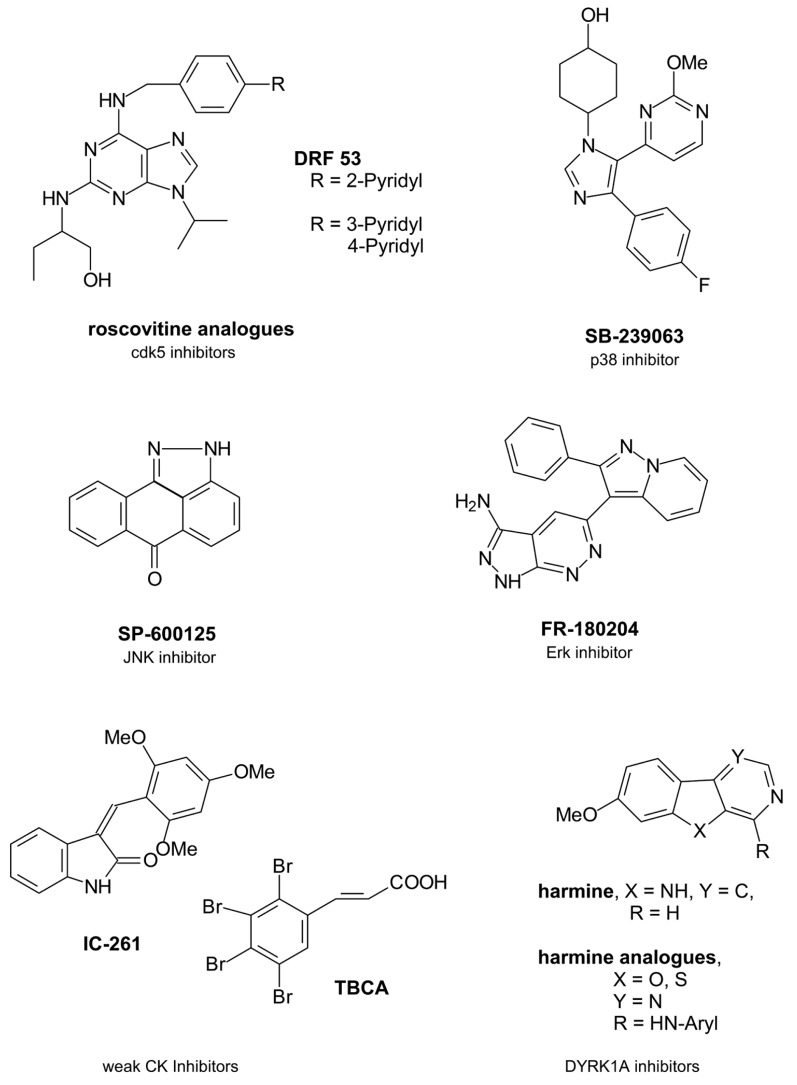
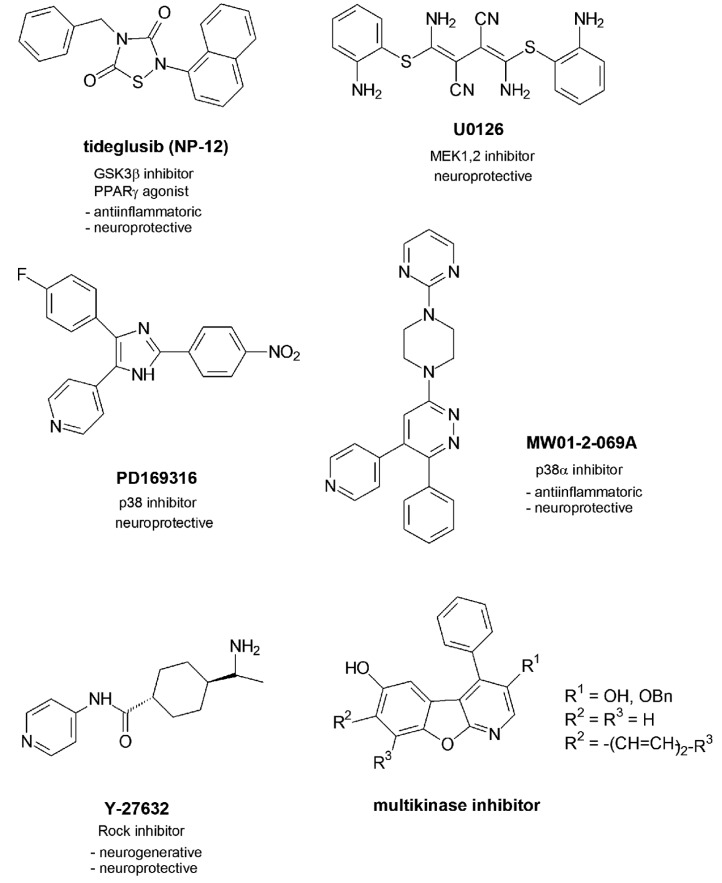
Present Alzheimer's disease (AD) therapies suffer from inefficient effects on AD symptoms like memory or cognition, especially in later states of the disease. Used acteylcholine esterase inhibitors or the NMDA receptor antagonist memantine address one target structure which is involved in a complex, multifactorial disease progression. So the benefit for patients is presently poor. A more close insight in the AD progression identified more suggested target structures for drug development. Strategies of AD drug development concentrate on novel target structures combined with the established ones dedicated for combined therapy regimes, preferably by the use of one drug which may address two target structures. Protein kinases have been identified as promising target structures because they are involved in AD progression pathways like pathophysiological tau protein phosphorylations and amyloid β toxicity. The review article will shortly view early inhibitors of single protein kinases like glycogen synthase kinase (gsk3) β and cyclin dependent kinase 5. Novel inhibitors will be discussed which address novel AD relevant protein kinases like dual-specificity tyrosine phosphorylation regulated kinase 1A (DYRK1A). Moreover, multitargeting inhibitors will be presented which target several protein kinases and those which are suspected in influencing other AD relevant processes. Such a multitargeting is the most promising strategy to effectively hamper the multifactorial disease progression and thus gives perspective hopes for a future better patient benefit.
目前,用于治疗阿尔茨海默病(AD)的药物在改善记忆力或认知等 AD 症状方面的效果并不理想,尤其是在疾病的后期。乙酰胆碱酯酶抑制剂或 NMDA 受体拮抗剂美金刚针对的是一个参与复杂多因素疾病进展的靶标结构。因此,目前患者的获益情况较差。对 AD 进展的更深入了解确定了更多可供药物开发的潜在靶标结构。AD 药物开发策略集中在新的靶标结构上,并结合已有的靶标结构用于联合治疗方案,最好是使用一种药物来针对两个靶标结构。蛋白激酶已被确定为有前途的靶标结构,因为它们参与 AD 进展途径,如病理生理tau 蛋白磷酸化和淀粉样β毒性。本文综述简要介绍了早期针对单个蛋白激酶的抑制剂,如糖原合酶激酶(GSK)β和周期素依赖性激酶 5。还将讨论针对新型 AD 相关蛋白激酶(如双特异性酪氨酸磷酸化调节激酶 1A(DYRK1A))的新型抑制剂。此外,还将介绍针对多种蛋白激酶的多靶点抑制剂,以及那些被怀疑影响其他 AD 相关过程的抑制剂。这种多靶点策略是有效阻止多因素疾病进展的最有前途的策略,因此为未来更好地改善患者获益带来了希望。