Ferguson Andrew L, Falkowska Emilia, Walker Laura M, Seaman Michael S, Burton Dennis R, Chakraborty Arup K
Department of Materials Science and Engineering, University of Illinois at Urbana-Champaign, Urbana, Illinois, United States of America.
PLoS One. 2013 Dec 2;8(12):e80562. doi: 10.1371/journal.pone.0080562. eCollection 2013.
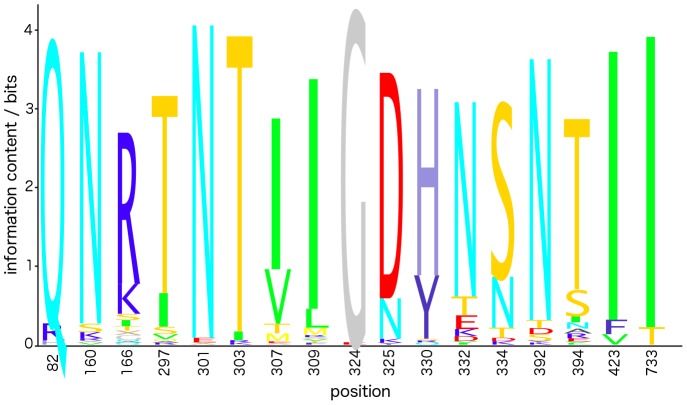
Broadly neutralizing monoclonal antibodies effective against the majority of circulating isolates of HIV-1 have been isolated from a small number of infected individuals. Definition of the conformational epitopes on the HIV spike to which these antibodies bind is of great value in defining targets for vaccine and drug design. Drawing on techniques from compressed sensing and information theory, we developed a computational methodology to predict key residues constituting the conformational epitopes on the viral spike from cross-clade neutralization activity data. Our approach does not require the availability of structural information for either the antibody or antigen. Predictions of the conformational epitopes of ten broadly neutralizing HIV-1 antibodies are shown to be in good agreement with new and existing experimental data. Our findings suggest that our approach offers a means to accelerate epitope identification for diverse pathogenic antigens.
已从少数受感染个体中分离出对大多数循环HIV-1分离株有效的广泛中和单克隆抗体。确定这些抗体所结合的HIV刺突上的构象表位,对于确定疫苗和药物设计的靶点具有重要价值。利用压缩传感和信息论技术,我们开发了一种计算方法,可根据跨亚型中和活性数据预测构成病毒刺突上构象表位的关键残基。我们的方法不需要抗体或抗原的结构信息。十种广泛中和HIV-1抗体的构象表位预测结果与新的和现有的实验数据高度吻合。我们的研究结果表明,我们的方法为加速鉴定多种致病抗原的表位提供了一种手段。