Center for Drug Metabolism and Pharmacokinetics, China Pharmaceutical University, Tongjiaxiang 24, Gulou district, Nanjing 210009, Jiangsu, China.
Nutr Metab (Lond). 2013 Dec 6;10(1):68. doi: 10.1186/1743-7075-10-68.
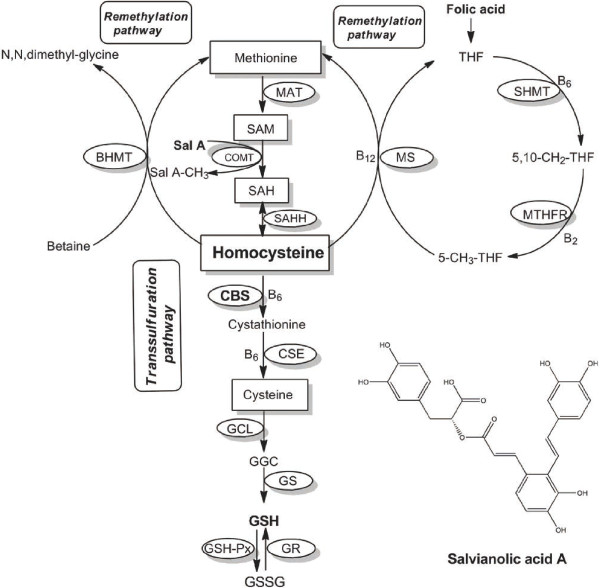
Elevated homocysteine is a cardiovascular risk factor in hyperlipidemia. Transsulfuration pathway provides an endogenous pathway for homocysteine conversion to antioxidant glutathione (GSH). Salvianolic acid A (Sal A) contains two molecules of caffeic acid and one molecule of danshensu that is capable of enhancing homocysteine transsulfuration, which led to the hypothesis that Sal A has activatory effect on transsulfuration pathway and this effect may have beneficial effects on both homocysteine and redox status in hyperlipidemia.
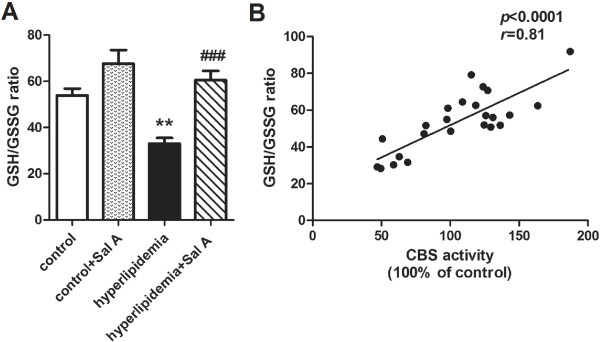
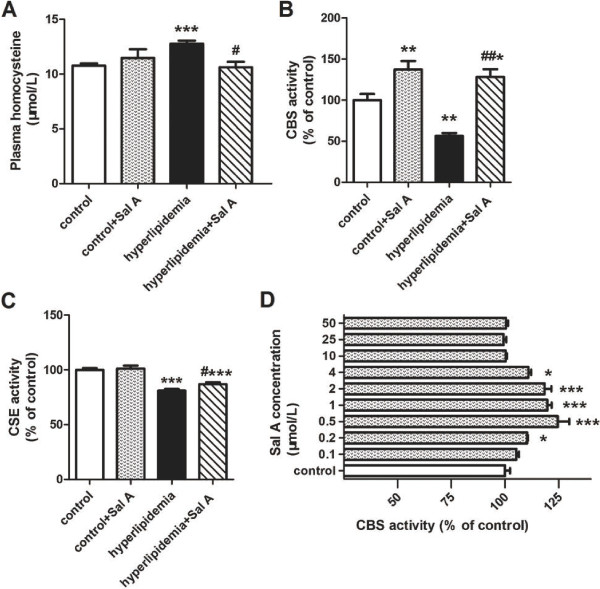
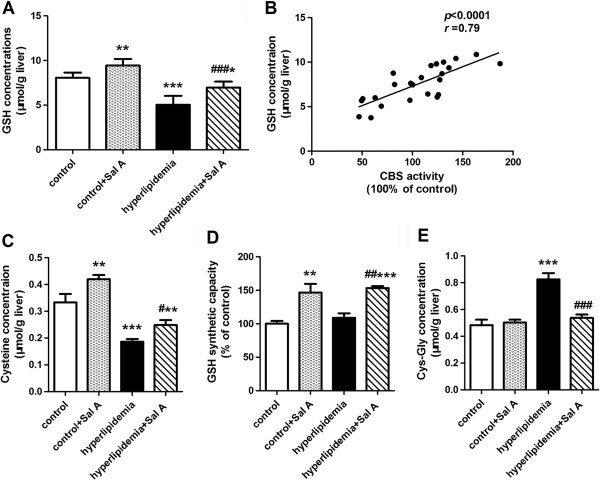
To test this hypothesis, we developed a rat model of hyperlipidemia induced by high-fat diet for 16 weeks, during which rats were treated with 1 mg/kg salvianolic acid A (Sal A) for the final 4 weeks. Activities of key enzymes and metabolite profiling in the transsulfuration pathway revealed that hyperlipidemia led to elevated plasma homocysteine levels after 16-week dietary treatment, which was associated with reduced activities of homocysteine transsulfuration enzymes, cystathionine β-synthase (CBS) and cystathionine γ-lyase (CSE). The impaired transsulfuration pathway prevented homocysteine transsulfuration to cysteine, resulting in cysteine deficiency and subsequent reduction in GSH pool size. The redox status was altered in the setting of hyperlipidemia as indicated by GSH/GSSG ratio. Sal A treatment increased hepatic CBS and CSE activities, which was associated with reduced accumulation in circulating homocysteine levels and attenuated decline in hepatic cysteine content in hyperlipidemic rats. Sal A also led to an increase in GSH pool size, which subsequently caused a restored GSH/GSSG ratio. The activatory effect of Sal A on CBS was also observed in normal rats and in in vitro experiment.
Our results suggest that activation of transsulfuration pathway by Sal A is a promising homocysteine-lowering approach that has beneficial effects on redox homeostasis in hyperlipidemic settings.
同型半胱氨酸升高是高血脂的心血管危险因素。转硫途径为同型半胱氨酸转化为抗氧化剂谷胱甘肽(GSH)提供了内源性途径。丹酚酸 A(Sal A)含有两个咖啡酸分子和一个丹参素分子,能够增强同型半胱氨酸转硫途径,这导致了 Sal A 对转硫途径具有激活作用的假设,这种作用可能对高血脂中的同型半胱氨酸和氧化还原状态都有有益影响。
为了验证这一假设,我们建立了一个高脂肪饮食诱导的 16 周高脂血症大鼠模型,在此期间,大鼠在最后 4 周用 1mg/kg 的丹酚酸 A(Sal A)治疗。转硫途径的关键酶活性和代谢物谱分析显示,高脂血症饮食治疗 16 周后导致血浆同型半胱氨酸水平升高,这与同型半胱氨酸转硫酶胱硫醚-β-合酶(CBS)和胱硫醚-γ-裂合酶(CSE)活性降低有关。受损的转硫途径阻止了同型半胱氨酸向半胱氨酸的转硫,导致半胱氨酸缺乏,随后 GSH 池大小减少。高脂血症时的氧化还原状态发生改变,表现为 GSH/GSSG 比值改变。Sal A 治疗增加了肝 CBS 和 CSE 活性,这与循环同型半胱氨酸水平的降低以及高脂血症大鼠肝半胱氨酸含量的下降有关。Sal A 还导致 GSH 池大小增加,随后恢复 GSH/GSSG 比值。Sal A 对 CBS 的激活作用在正常大鼠和体外实验中也观察到。
我们的结果表明,Sal A 激活转硫途径是一种有前途的降低同型半胱氨酸的方法,对高脂血症环境中的氧化还原平衡有有益影响。