Washington University School of Medicine, Department of Psychiatry, St. Louis, MO, USA.
Washington University School of Medicine, Department of Psychiatry, St. Louis, MO, USA; King's College, Institute of Psychiatry, London, UK.
Drug Alcohol Depend. 2014 Jan 1;134:362-369. doi: 10.1016/j.drugalcdep.2013.11.008. Epub 2013 Nov 16.
We explore the factor structure of DSM-5 cannabis use disorders, examine its prevalence across European- and African-American respondents as well as its genetic underpinnings, utilizing data from a genome-wide study of single nucleotide polymorphisms (SNPs). We also estimate the heritability of DSM-5 cannabis use disorders explained by these common SNPs.
Data on 3053 subjects reporting a lifetime history of cannabis use were utilized. Exploratory and confirmatory factor analyses were conducted to create a factor score, which was used in a genome-wide association analysis. p-values from the single SNP analysis were examined for evidence of gene-based association. The aggregate effect of all SNPs was also estimated using Genome-Wide Complex Traits Analysis.
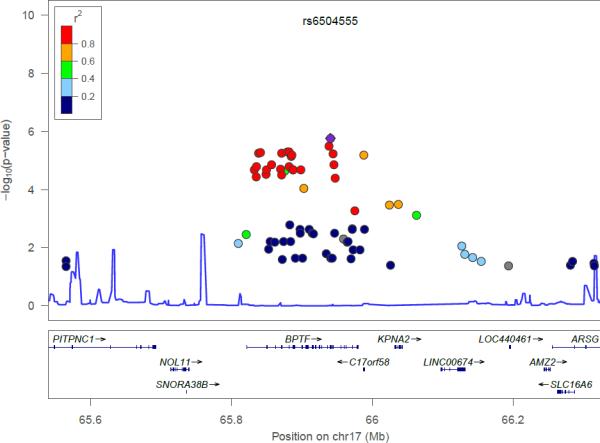
The unidimensionality of DSM-5 cannabis use disorder criteria was demonstrated. Comparing DSM-IV to DSM-5, a decrease in prevalence of cannabis use disorders was only noted in European-American respondents and was exceedingly modest. For the DSM-5 cannabis use disorders factor score, no SNP surpassed the genome-wide significance testing threshold. However, in the European-American subsample, gene-based association testing resulted in significant associations in 3 genes (C17orf58, BPTF and PPM1D) on chromosome 17q24. In aggregate, 21% of the variance in DSM-5 cannabis use disorders was explained by the genome-wide SNPs; however, this estimate was not statistically significant.
DSM-5 cannabis use disorder represents a unidimensional construct, the prevalence of which is only modestly elevated above the DSM-IV version. Considerably larger sample sizes will be required to identify individual SNPs associated with cannabis use disorders and unequivocally establish its polygenic underpinnings.
我们探索了 DSM-5 大麻使用障碍的因素结构,检查了其在欧洲裔和非裔美国人受访者中的流行程度,以及其遗传基础,利用了来自全基因组单核苷酸多态性 (SNP) 研究的数据。我们还估计了这些常见 SNP 解释的 DSM-5 大麻使用障碍的遗传率。
利用了报告有终生大麻使用史的 3053 名受试者的数据。进行了探索性和验证性因素分析,以创建一个因子分数,用于全基因组关联分析。对单 SNP 分析的 p 值进行了检查,以寻找基因关联的证据。还使用全基因组复杂性状分析估计了所有 SNP 的综合效应。
证明了 DSM-5 大麻使用障碍标准的单维性。将 DSM-IV 与 DSM-5 进行比较,仅在欧洲裔美国人受访者中观察到大麻使用障碍的患病率下降,而且非常适度。对于 DSM-5 大麻使用障碍因子分数,没有 SNP 超过全基因组显著性检验阈值。然而,在欧洲裔美国人亚组中,基因关联测试导致了染色体 17q24 上 3 个基因 (C17orf58、BPTF 和 PPM1D) 的显著关联。总体而言,DSM-5 大麻使用障碍的 21%变异由全基因组 SNP 解释;然而,这一估计没有统计学意义。
DSM-5 大麻使用障碍代表了一种单维结构,其患病率仅比 DSM-IV 版本略有升高。需要更大的样本量才能确定与大麻使用障碍相关的单个 SNP,并明确其多基因基础。