UC Lab, Department of Computer Engineering, Kyung Hee University, Yongin-Si 446-701, Korea.
Sensors (Basel). 2013 Dec 5;13(12):16682-713. doi: 10.3390/s131216682.
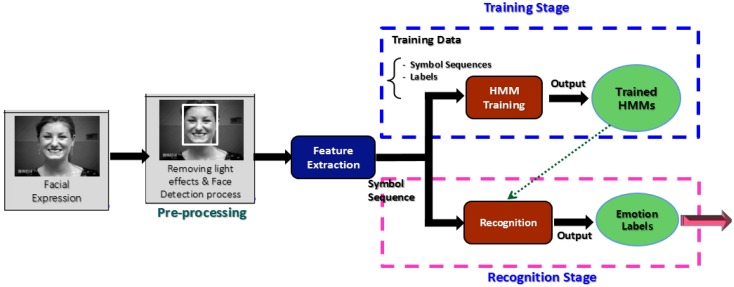
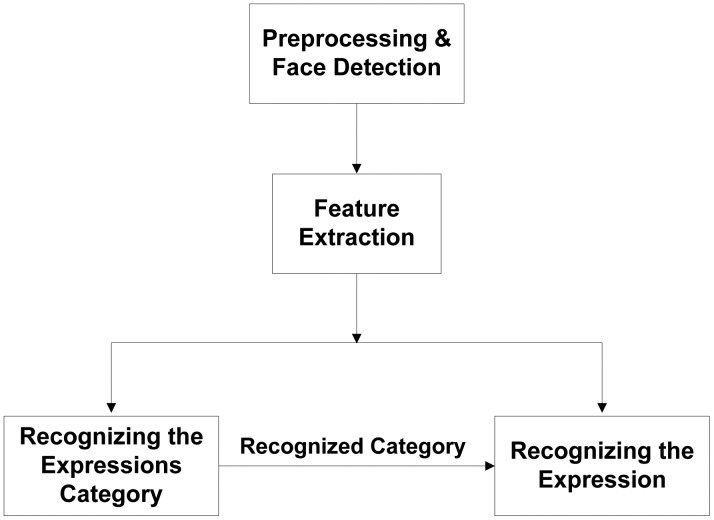
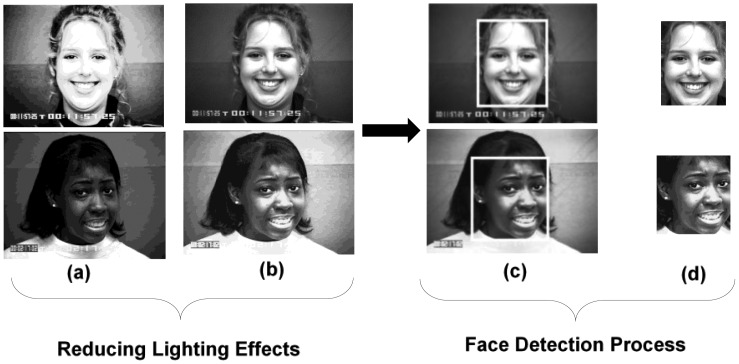
Over the last decade, human facial expressions recognition (FER) has emerged as an important research area. Several factors make FER a challenging research problem. These include varying light conditions in training and test images; need for automatic and accurate face detection before feature extraction; and high similarity among different expressions that makes it difficult to distinguish these expressions with a high accuracy. This work implements a hierarchical linear discriminant analysis-based facial expressions recognition (HL-FER) system to tackle these problems. Unlike the previous systems, the HL-FER uses a pre-processing step to eliminate light effects, incorporates a new automatic face detection scheme, employs methods to extract both global and local features, and utilizes a HL-FER to overcome the problem of high similarity among different expressions. Unlike most of the previous works that were evaluated using a single dataset, the performance of the HL-FER is assessed using three publicly available datasets under three different experimental settings: n-fold cross validation based on subjects for each dataset separately; n-fold cross validation rule based on datasets; and, finally, a last set of experiments to assess the effectiveness of each module of the HL-FER separately. Weighted average recognition accuracy of 98.7% across three different datasets, using three classifiers, indicates the success of employing the HL-FER for human FER.
在过去的十年中,人类面部表情识别(FER)已经成为一个重要的研究领域。有几个因素使得 FER 成为一个具有挑战性的研究问题。这些因素包括训练和测试图像中的光照条件变化;在进行特征提取之前需要自动且准确的人脸检测;以及不同表情之间的高度相似性,这使得很难高精度地区分这些表情。本工作实现了一种基于层次线性判别分析的面部表情识别(HL-FER)系统来解决这些问题。与之前的系统不同,HL-FER 使用预处理步骤来消除光照效果,采用新的自动人脸检测方案,利用方法提取全局和局部特征,并利用 HL-FER 克服不同表情之间高度相似的问题。与之前使用单个数据集进行评估的大多数工作不同,HL-FER 的性能使用三个公开可用的数据集在三种不同的实验设置下进行评估:分别针对每个数据集的 n 折交叉验证基于主体;基于数据集的 n 折交叉验证规则;最后一组实验用于评估 HL-FER 的每个模块的有效性。使用三个分类器在三个不同的数据集中加权平均识别准确率达到 98.7%,这表明采用 HL-FER 进行人类 FER 是成功的。