Stolfi Carmine, Marafini Irene, De Simone Veronica, Pallone Francesco, Monteleone Giovanni
Via Montpellier 1, Department of Systems Medicine, University of Tor Vergata, Rome 00133, Italy.
Int J Mol Sci. 2013 Dec 5;14(12):23774-90. doi: 10.3390/ijms141223774.
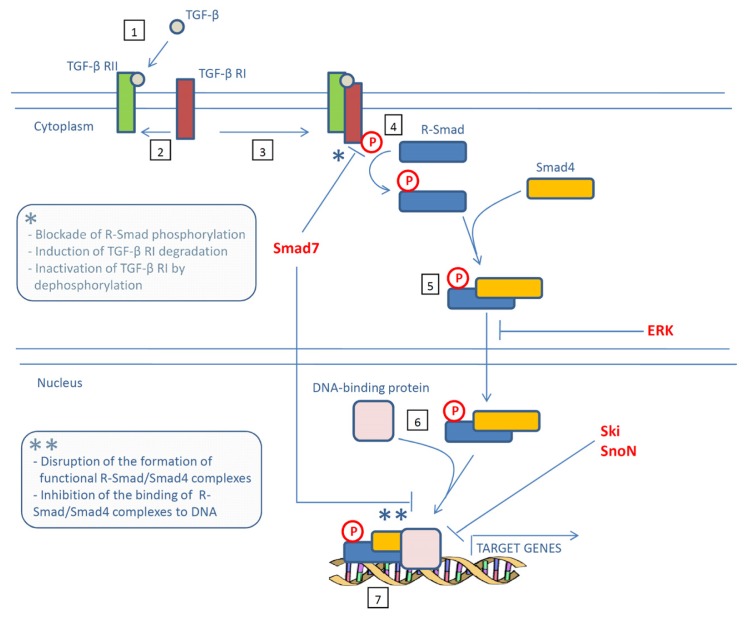
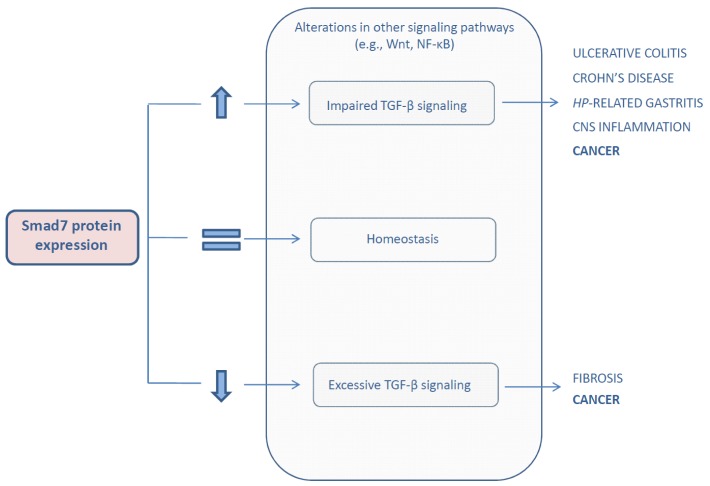
Smad7 was initially identified as an inhibitor of Transforming growth factor (TGF)-β due mainly to its ability to bind TGF-β receptor type I and prevent TGF-β-associated Smad signaling. More recently, it has been demonstrated that Smad7 can interact with other intracellular proteins and regulate also TGF-β-independent signaling pathways thus making a valid contribution to the neoplastic processes in various organs. In particular, data emerging from experimental studies indicate that Smad7 may differently modulate the course of various tumors depending on the context analyzed. These observations, together with the demonstration that Smad7 expression is deregulated in many cancers, suggest that therapeutic interventions around Smad7 can help interfere with the development/progression of human cancers. In this article we review and discuss the available data supporting the role of Smad7 in the modulation of cancer growth and progression.
Smad7最初被鉴定为转化生长因子(TGF)-β的抑制剂的抑制剂,主要是因为它能够结合I型TGF-β受体并阻止TGF-β相关的Smad信号传导。最近,已经证明Smad7可以与其他细胞内蛋白相互作用,并且还可以调节不依赖TGF-β的信号通路,从而对各种器官的肿瘤形成过程做出有效贡献。特别是,实验研究得出的数据表明,根据所分析的背景,Smad7可能对各种肿瘤的进程产生不同的调节作用。这些观察结果,以及Smad7表达在许多癌症中失调的证明,表明围绕Smad7的治疗干预可能有助于干扰人类癌症的发展/进展。在本文中,我们回顾并讨论了支持Smad7在调节癌症生长和进展中作用的现有数据。