Sarode Neha, Davis Sarah E, Tams Robert N, Reynolds Todd B
Department of Microbiology, University of Tennessee, Knoxville, Tennessee 37996.
G3 (Bethesda). 2014 Feb 19;4(2):199-207. doi: 10.1534/g3.113.006361.
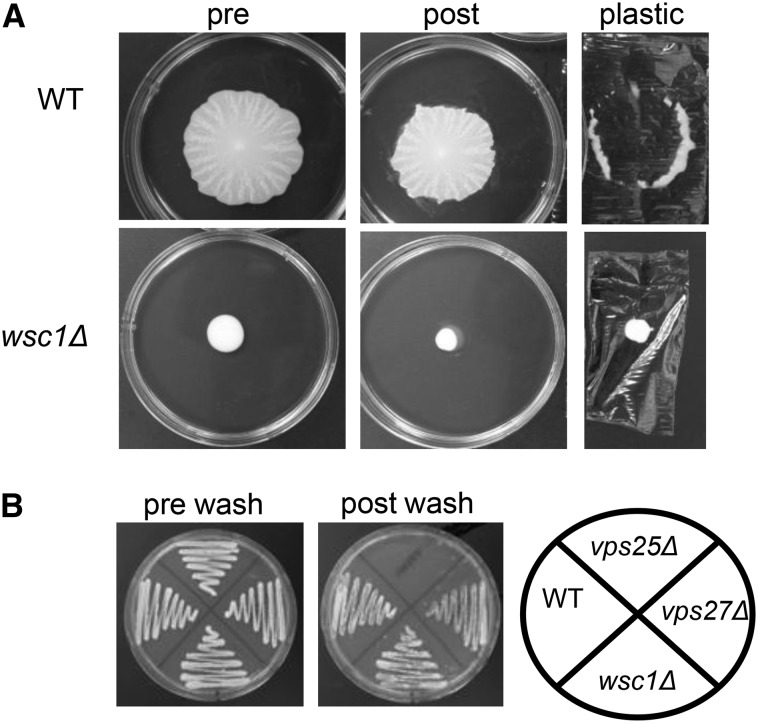
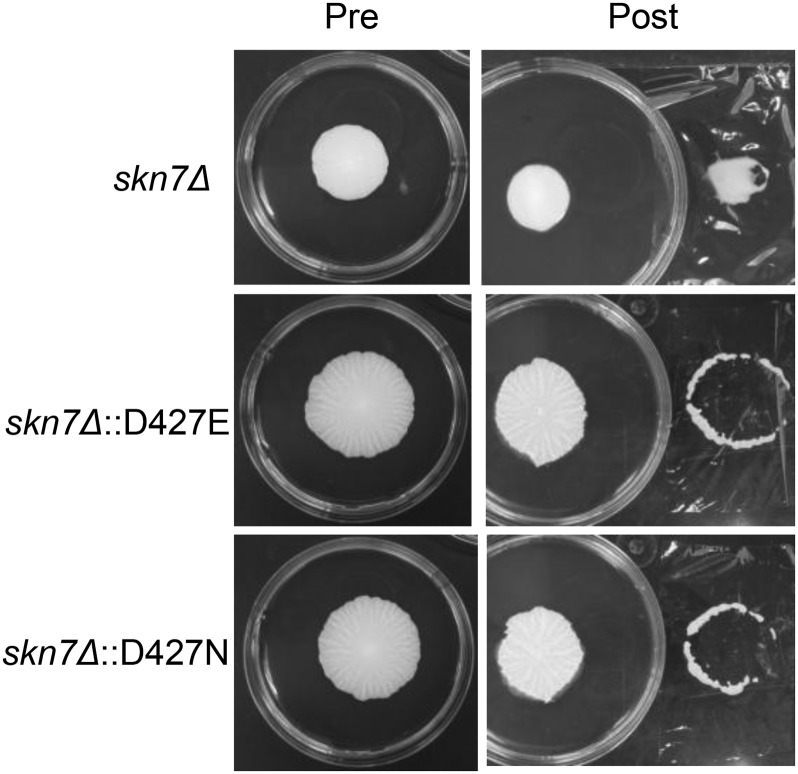
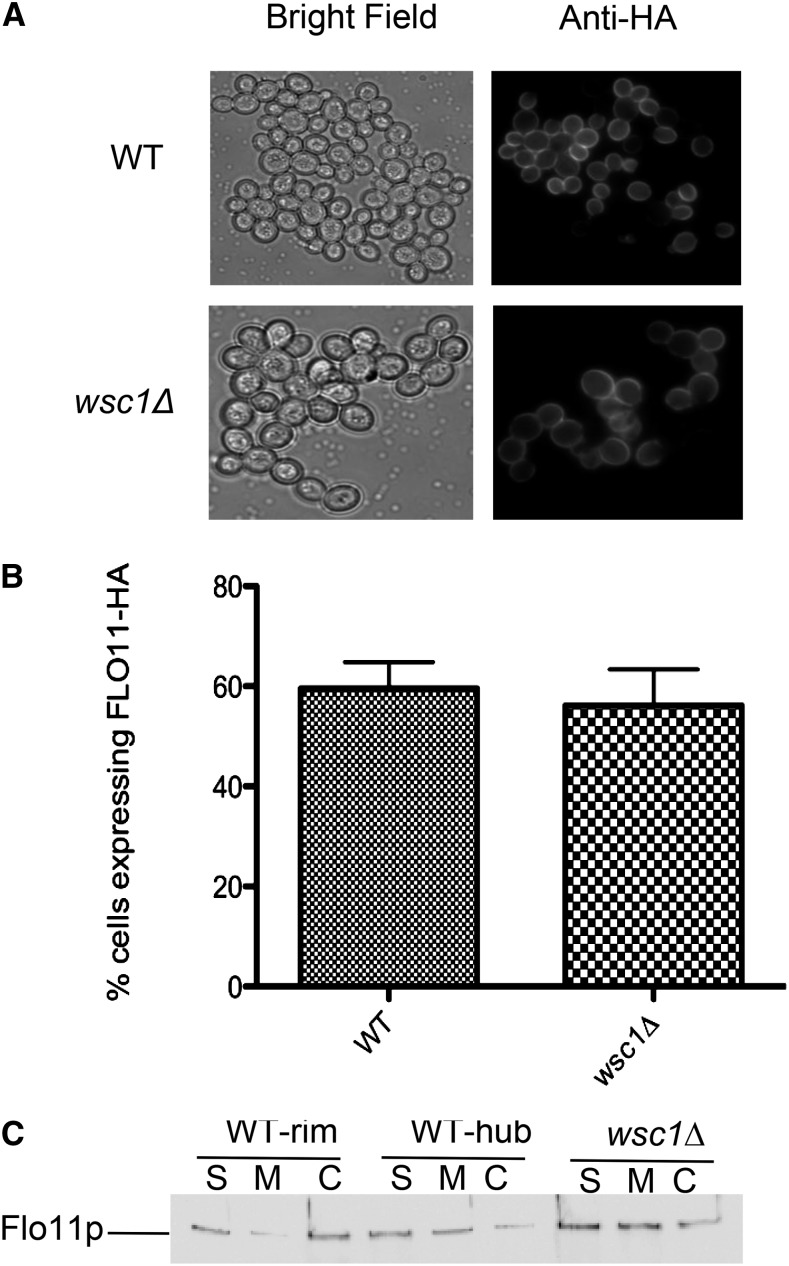
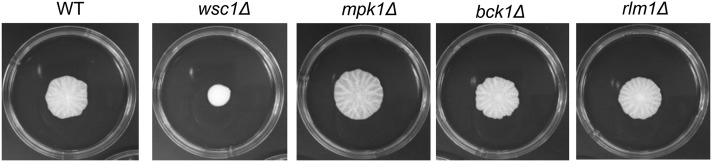
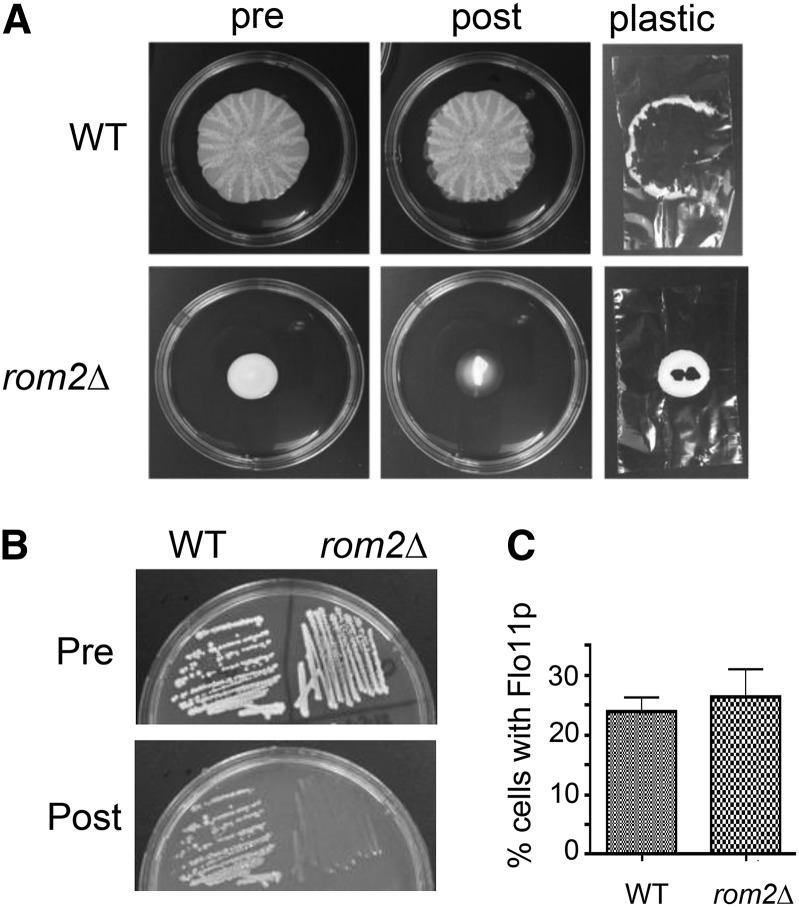
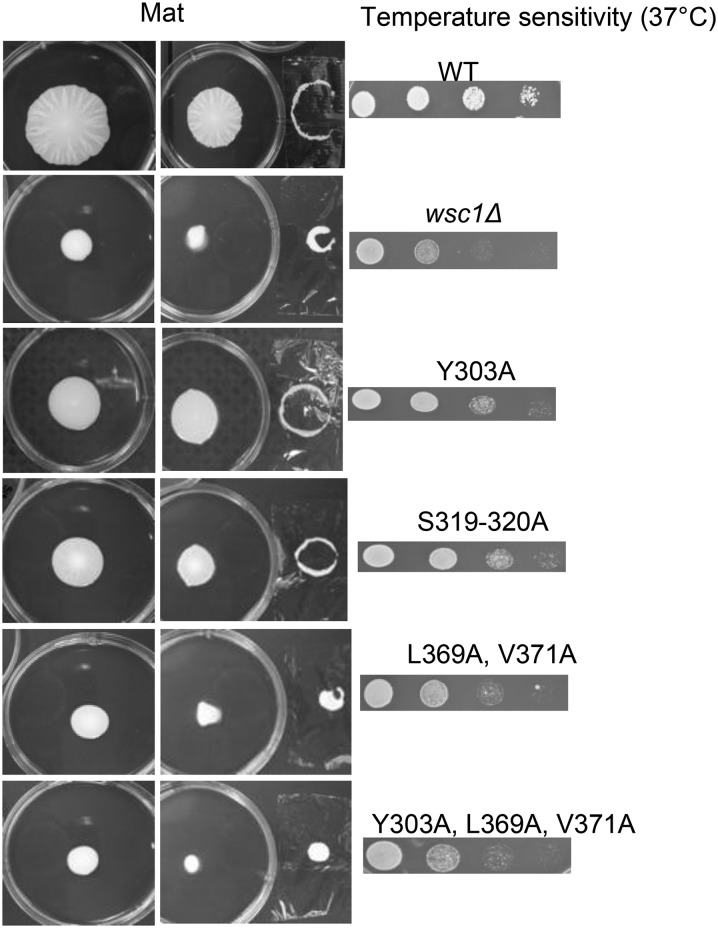
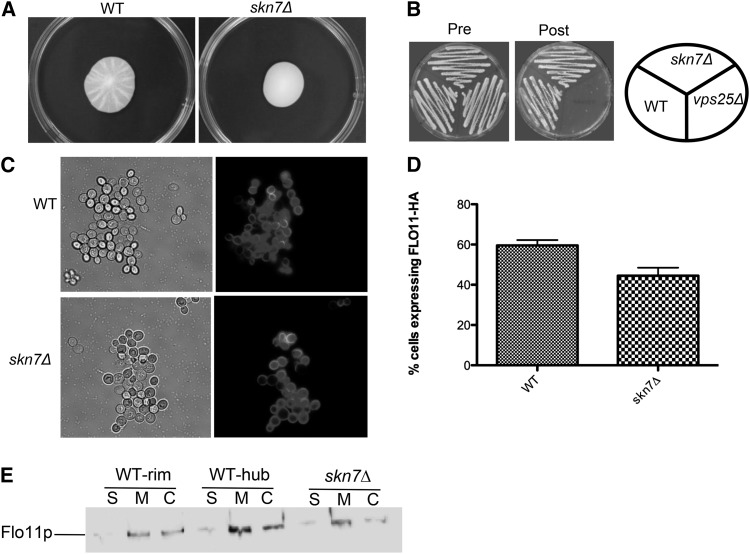
Saccharomyces cerevisiae strains of the ∑1278b background generate biofilms, referred to as mats, on low-density agar (0.3%) plates made with rich media (YPD). Mat formation involves adhesion of yeast cells to the surface of the agar substrate and each other as the biofilm matures, resulting in elaborate water channels that create filigreed patterns of cells. The cell wall adhesion protein Flo11p is required for mat formation; however, genetic data indicate that other unknown effectors are also required. For example, mutations in vacuolar protein sorting genes that affect the multivesicular body pathway, such as vps27Δ, cause mat formation defects independently of Flo11p, presumably by affecting an unidentified signaling pathway. A cell wall signaling protein, Wsc1p, found at the plasma membrane is affected for localization and function by vps27Δ. We found that a wsc1 mutation disrupted mat formation in a Flo11p-independent manner. Wsc1p appears to impact mat formation through the Rom2p-Rho1p signaling module, by which Wsc1p also regulates the cell wall. The Bck1p, Mkk1/Mkk2, Mpk1p MAP kinase signaling cascade is known to regulate the cell wall downstream of Wsc1p-Rom2p-Rho1p but, surprisingly, these kinases do not affect mat formation. In contrast, Wsc1p may impact mat formation by affecting Skn7p instead. Skn7p can also receive signaling inputs from the Sln1p histidine kinase; however, mutational analysis of specific histidine kinase receiver residues in Skn7p indicate that Sln1p does not play an important role in mat formation, suggesting that Skn7p primarily acts downstream of Wsc1p to regulate mat formation.
∑1278b 背景的酿酒酵母菌株在富含培养基(YPD)制成的低密度琼脂(0.3%)平板上形成生物膜,称为菌垫。菌垫形成过程包括酵母细胞在琼脂底物表面的黏附以及随着生物膜成熟细胞之间的相互黏附,最终形成复杂的水通道,形成细胞的精细图案。细胞壁黏附蛋白 Flo11p 是菌垫形成所必需的;然而,遗传数据表明还需要其他未知的效应因子。例如,影响多泡体途径的液泡蛋白分选基因的突变,如 vps27Δ,会独立于 Flo11p 导致菌垫形成缺陷,可能是通过影响一条未明确的信号通路。位于质膜的细胞壁信号蛋白 Wsc1p 的定位和功能会受到 vps27Δ 的影响。我们发现 wsc1 突变以独立于 Flo11p 的方式破坏菌垫形成。Wsc1p 似乎通过 Rom2p-Rho1p 信号模块影响菌垫形成,Wsc1p 也通过该模块调节细胞壁。已知 Bck1p、Mkk1/Mkk2、Mpk1p MAP 激酶信号级联在 Wsc1p-Rom2p-Rho1p 的下游调节细胞壁,但令人惊讶的是,这些激酶并不影响菌垫形成。相反,Wsc1p 可能通过影响 Skn7p 来影响菌垫形成。Skn7p 也可以接收来自 Sln1p 组氨酸激酶的信号输入;然而,对 Skn7p 中特定组氨酸激酶受体残基的突变分析表明,Sln1p 在菌垫形成中不发挥重要作用,这表明 Skn7p 主要在 Wsc1p 的下游起作用来调节菌垫形成。