Modeling, Analysis and Theory Group, Allen Institute for Brain Science, Seattle, WA, USA.
Genes Brain Behav. 2014 Jan;13(1):13-24. doi: 10.1111/gbb.12106. Epub 2013 Dec 10.
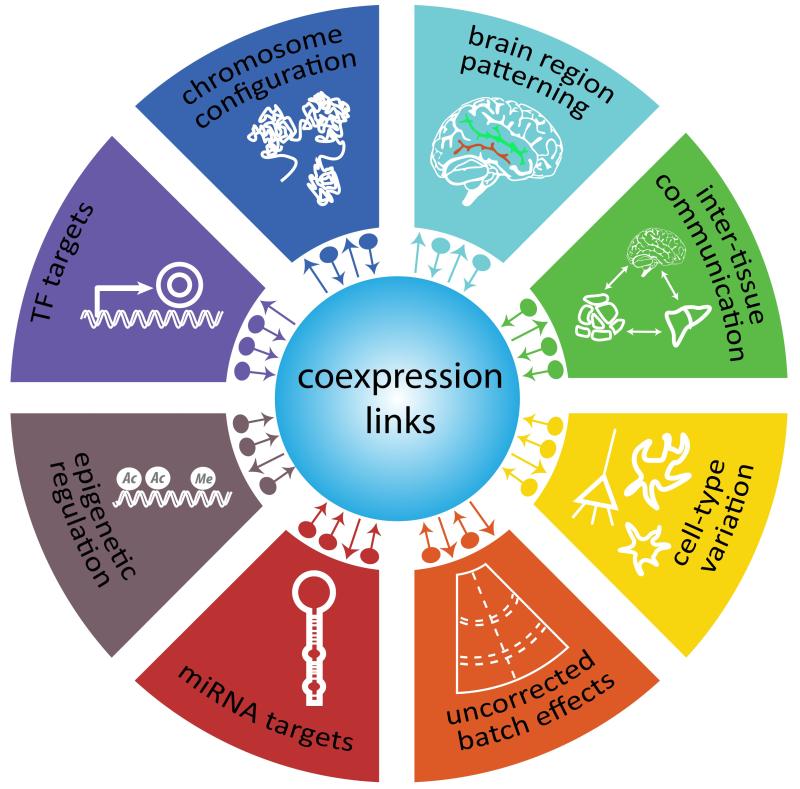
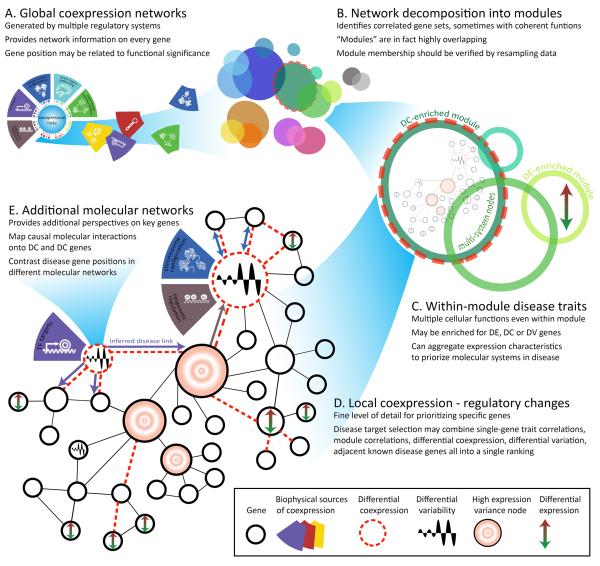
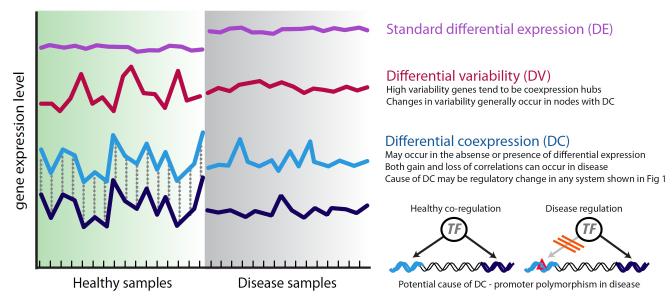
In a research environment dominated by reductionist approaches to brain disease mechanisms, gene network analysis provides a complementary framework in which to tackle the complex dysregulations that occur in neuropsychiatric and other neurological disorders. Gene-gene expression correlations are a common source of molecular networks because they can be extracted from high-dimensional disease data and encapsulate the activity of multiple regulatory systems. However, the analysis of gene coexpression patterns is often treated as a mechanistic black box, in which looming 'hub genes' direct cellular networks, and where other features are obscured. By examining the biophysical bases of coexpression and gene regulatory changes that occur in disease, recent studies suggest it is possible to use coexpression networks as a multi-omic screening procedure to generate novel hypotheses for disease mechanisms. Because technical processing steps can affect the outcome and interpretation of coexpression networks, we examine the assumptions and alternatives to common patterns of coexpression analysis and discuss additional topics such as acceptable datasets for coexpression analysis, the robust identification of modules, disease-related prioritization of genes and molecular systems and network meta-analysis. To accelerate coexpression research beyond modules and hubs, we highlight some emerging directions for coexpression network research that are especially relevant to complex brain disease, including the centrality-lethality relationship, integration with machine learning approaches and network pharmacology.
在以还原论方法为主导的脑疾病机制研究环境中,基因网络分析提供了一个互补的框架,可以解决神经精神和其他神经疾病中发生的复杂失调问题。基因-基因表达相关性是分子网络的常见来源,因为它们可以从高维疾病数据中提取出来,并包含多个调节系统的活性。然而,基因共表达模式的分析通常被视为一种机制黑箱,其中隐约出现的“枢纽基因”指导着细胞网络,而其他特征则被掩盖了。通过研究疾病中发生的共表达和基因调控变化的生物物理基础,最近的研究表明,有可能将共表达网络用作一种多组学筛选程序,为疾病机制生成新的假设。由于技术处理步骤会影响共表达网络的结果和解释,我们检查了常见共表达分析模式的假设和替代方案,并讨论了其他主题,如共表达分析可接受的数据集、模块的稳健识别、与疾病相关的基因和分子系统的优先级以及网络荟萃分析。为了使共表达研究超越模块和枢纽,我们强调了共表达网络研究的一些新兴方向,这些方向特别与复杂的脑疾病有关,包括中心性-致死性关系、与机器学习方法的整合以及网络药理学。