Department of Child Health Care, Hubei Maternal and Child Health Hospital, Wuhan, China.
PLoS One. 2013 Dec 6;8(12):e82098. doi: 10.1371/journal.pone.0082098. eCollection 2013.
Bone mineral density (BMD) increases progressively during childhood and adolescence and is affected by various genetic and environmental factors. The aim of this study was to establish reference values for lumbar BMD in healthy Chinese infants and young children and investigate its influencing factors.
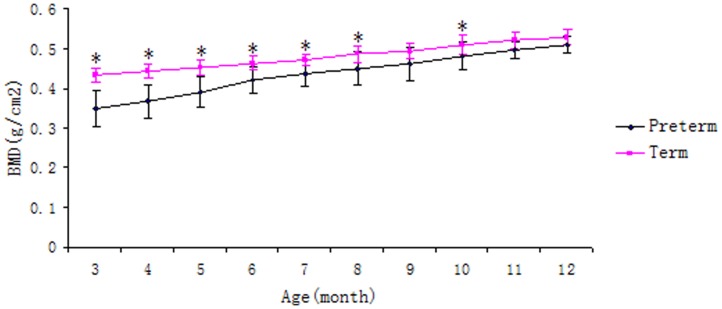
Healthy children aged 0 to 3 years who underwent regular physical examinations at the Child Health Care Clinic of Hubei Maternal and Child Health Hospital (N = 11,898) were recruited for this study. We also chose 379 preterm infants aged 0 to 1 years to preliminarily explore the development of BMD in this special population. BMD (g/cm(2)) measurements of the lumbar spine (L2-L4) were carried out with dual-energy X-ray absorptiometry and a questionnaire was administered to full-term children's parents to gather information on various nutritional and lifestyle factors as well as mothers' nutritional supplement use during pregnancy. Lumbar BMD significantly increased with age among both boys and girls (p<0.05), with fastest growth observed during the first postnatal year. There was no significant difference in lumbar BMD between boys and girls of similar age (p>0.05), either among healthy reference children or preterm infants. However, BMD values in preterm infants were significantly lower than those in term infants 3 to 8 months old (p<0.05) after adjustment for gestational age. Multivariable linear regression analysis indicated significant positive associations between lumbar BMD of healthy children and the child's age and current weight, mother's weight gain during pregnancy, birth weight, children's outdoor activity duration and children's physical activity duration.
Our study provides reference values of lumbar BMD for healthy Chinese children aged 0 to 3 years and identifies several influencing factors.
骨密度(BMD)在儿童和青少年时期逐渐增加,受到多种遗传和环境因素的影响。本研究旨在建立健康中国婴幼儿腰椎 BMD 的参考值,并探讨其影响因素。
本研究纳入了在湖北省妇幼保健院儿童保健科定期体检的 0 至 3 岁健康儿童(n=11898),并选择了 379 名 0 至 1 岁的早产儿初步探讨该人群 BMD 的发育情况。使用双能 X 射线吸收法测量腰椎(L2-L4)的 BMD,并对足月儿童的家长进行问卷调查,收集各种营养和生活方式因素以及母亲在怀孕期间的营养补充情况。男孩和女孩的腰椎 BMD 均随年龄增长而显著增加(p<0.05),在出生后第一年增长最快。在健康参考儿童或早产儿中,同龄男孩和女孩的腰椎 BMD 无显著差异(p>0.05)。然而,调整胎龄后,早产儿的 BMD 值明显低于 3 至 8 个月大的足月儿(p<0.05)。多变量线性回归分析表明,健康儿童的腰椎 BMD 与儿童的年龄、当前体重、母亲怀孕期间的体重增加、出生体重、儿童户外活动时间和儿童体力活动时间呈显著正相关。
本研究为 0 至 3 岁健康中国儿童提供了腰椎 BMD 的参考值,并确定了几个影响因素。