Department of Health Education and Behavioral Sciences, Jimma University, Jimma, Ethiopia ; CIHLMU Center for International Health, Ludwig-Maximilians-Universität, Munich, Germany.
PLoS One. 2013 Dec 4;8(12):e82116. doi: 10.1371/journal.pone.0082116. eCollection 2013.
Public understanding about mental illnesses and attitudes towards people with mental illness (PWMI) play a paramount role in the prevention and treatment of mental illness and the rehabilitation of PWMI. The aim of this study was to measure public stigma against PWMI and the factors associated with stigma in the Gilgel Gibe Field Research Center (GGFRC) in Southwest Ethiopia.
This community-based, cross-sectional study was conducted from June to August 2012 among 845 randomly selected respondents by using the Community Attitudes towards the Mentally Ill (CAMI) scale, an interviewer-administered questionnaire. Data was entered with EPI-DATA and then exported to STATA for analysis. Simple descriptive and linear regression analyses were performed to identify predictors of stigma against PWMI.
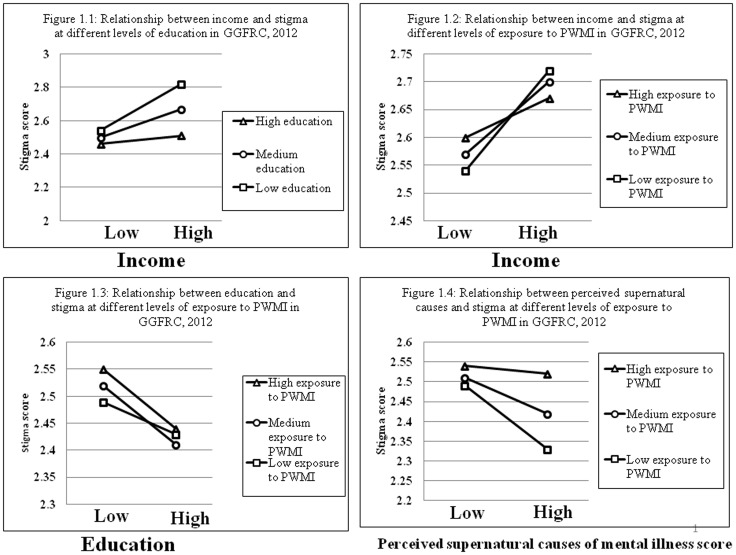
Of the total of 845 respondents, 68.17% were from rural districts. The mean stigma score was 2.62 on a 5-point score. The majority of the respondents (75.27%) believed that mental illness can be cured. Stress, poverty, and rumination were the most often perceived causes of mental illness. Rural residents had significantly higher stigma scores (std. β = 0.61, P<0.001). A statistically significant inverse relationship was found between the level of education and degree of stigma (std. β = -0.14, P<0.01), while higher income was significantly associated with more stigma (std. β = 0.07, P<0.05). Respondents with higher scores for perceived supernatural causes (std. β = -0.09, P<0.01) and perceived psychosocial and biological causes (std. β = -0.14, P<0.001) had significantly lower stigma levels.
The study found a more undermining but less avoidant attitude towards PWMI. Rural residents showed higher levels of stigma. Stigma against PWMI was lower in people with an explanatory concept about the causes of mental illness and a higher level of education. Information, education, and communication about the causes, signs, and nature of mental illnesses would help to reduce stigma.
公众对精神疾病的认识以及对精神疾病患者(PWMI)的态度,对精神疾病的预防、治疗和 PWMI 的康复起着至关重要的作用。本研究旨在衡量吉尔格尔吉布实地研究中心(GGFRC)的公众对 PWMI 的污名化程度,以及与污名化相关的因素。
这是一项基于社区的横断面研究,于 2012 年 6 月至 8 月期间在 845 名随机选择的受访者中进行,使用的是由访谈者管理的问卷《社区对精神病患者的态度量表》(CAMI)。数据由 EPI-DATA 录入,然后导出到 STATA 进行分析。采用简单描述性和线性回归分析来确定 PWMI 污名的预测因素。
在总共 845 名受访者中,68.17%来自农村地区。五分制的平均污名评分为 2.62。大多数受访者(75.27%)认为精神疾病是可以治愈的。压力、贫困和反复思考是最常被认为导致精神疾病的原因。农村居民的污名评分显著更高(标准β=0.61,P<0.001)。教育程度与污名程度呈显著负相关(标准β=-0.14,P<0.01),而较高的收入与更多的污名呈显著正相关(标准β=0.07,P<0.05)。认为精神疾病的超自然原因(标准β=-0.09,P<0.01)和心理社会及生物学原因(标准β=-0.14,P<0.001)更具感知力的受访者,其污名程度显著较低。
本研究发现,人们对 PWMI 的态度更加不利,但也更具回避性。农村居民的污名程度更高。对精神疾病的原因和性质具有解释性概念以及更高教育程度的人,对 PWMI 的污名程度较低。关于精神疾病的原因、症状和性质的信息、教育和宣传,将有助于减少污名。