Holmberg Markus, Murtonen Annukka, Elovaara Irina, Sumelahti Marja-Liisa
School of Medicine, University of Tampere, 33014 Tampere, Finland.
Mult Scler Int. 2013;2013:182516. doi: 10.1155/2013/182516. Epub 2013 Nov 10.
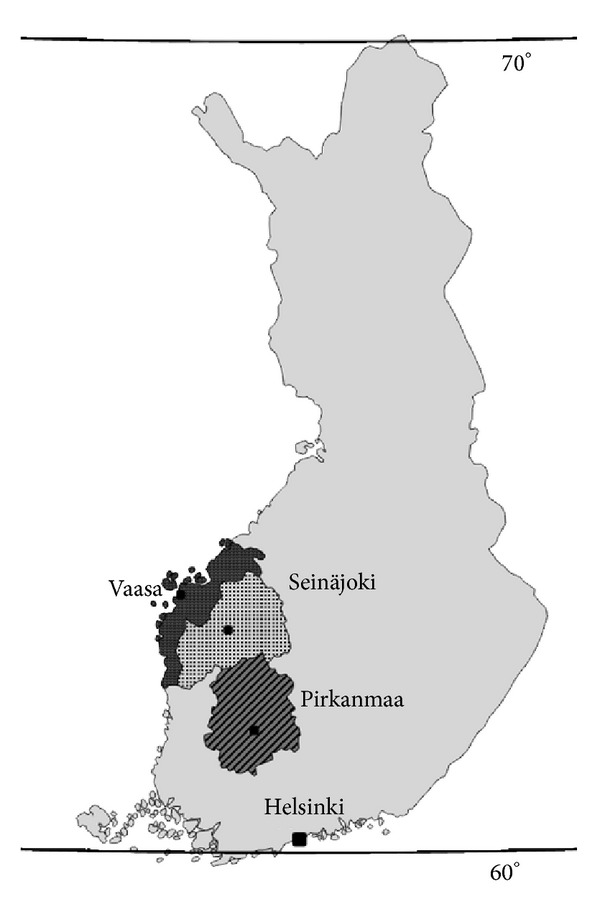
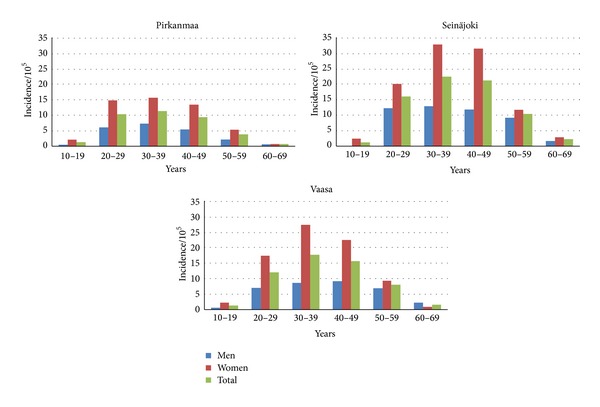
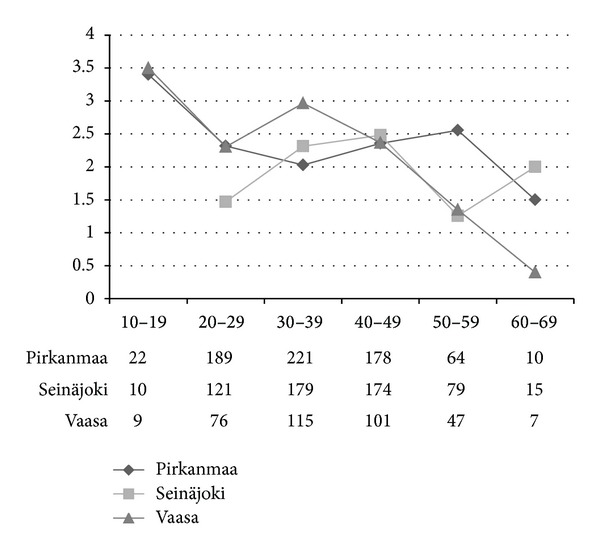
Background. MS incidence has increased among females, suggesting the presence of environmental effect. Object. Regional differences and temporal changes in gender-specific MS incidence were studied in Finland. Methods. Cases from Jan 1, 1981 to Dec 31, 2010 in Pirkanmaa, Seinäjoki and Vaasa districts were included. The standardized incidence rates (SIR), incidences per 10(5) person years with 95% confidence intervals (CI), and female-to-male ratios (F/M) were determined by district. Results. 1617 cases were included. Compared to Pirkanmaa, the MS risk was 1.9-fold (95% CI: 1.7-2.0) greater in Seinäjoki and 1.2-fold (95% CI: 1.1-1.4) in Vaasa, and the risk was high for both genders. The incidence trend stabilized in Seinäjoki and Vaasa, accompanied by an increase in the F/M ratio. A steady increase in Pirkanmaa was accompanied by a high F/M ratio. Conclusion. A high female preponderance accompanied a general increase in incidence since the 1990s, suggesting the influence of environmental factors. In high-risk districts, increased MS risk prevailed in both genders. High risk reflects both genetic and environmental effects. These effects may be shared with autoimmune diseases such as type 1 diabetes mellitus; the incidence of which follows MS in Finland. Population-based case-control studies are needed to identify these factor effects.
背景。多发性硬化症(MS)在女性中的发病率有所上升,提示存在环境影响因素。目的。在芬兰研究MS发病率的性别差异和时间变化。方法。纳入1981年1月1日至2010年12月31日在皮尔卡区、塞纳约基和瓦萨地区的病例。按地区确定标准化发病率(SIR)、每10万人年发病率及95%置信区间(CI),以及女性与男性发病率之比(F/M)。结果。共纳入1617例病例。与皮尔卡区相比,塞纳约基的MS发病风险高1.9倍(95%CI:1.7 - 2.0),瓦萨高1.2倍(95%CI:1.1 - 1.4),且男女发病风险均较高。塞纳约基和瓦萨的发病率趋势趋于稳定,同时F/M比增加。皮尔卡区发病率稳步上升,F/M比也较高。结论。自20世纪90年代以来,女性占优势比例较高且发病率普遍上升,提示环境因素的影响。在高危地区,男女MS发病风险均增加。高风险反映了遗传和环境因素的影响。这些影响可能与1型糖尿病等自身免疫性疾病相同;在芬兰,1型糖尿病的发病率紧随MS之后。需要开展基于人群的病例对照研究来确定这些因素的影响。