Lagbas Clint, Bazargan-Hejazi Shahrzad, Shaheen Magda, Kermah Dulcie, Pan Deyu
Charles R Drew University of Medicine & Science, David Geffen School of Medicine at UCLA, 1731 East 120th Street, Los Angeles, CA 90059, USA.
Biomed Res Int. 2013;2013:143092. doi: 10.1155/2013/143092. Epub 2013 Nov 13.
The aim of this study is to describe the traumatic brain injury (TBI) population and causes and identify factors associated with TBI hospitalizations and mortality in California.
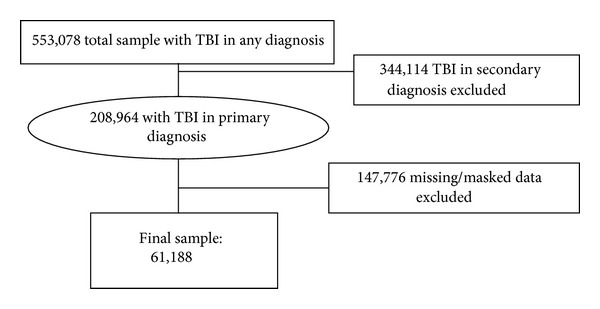
This is a cross-sectional study of 61,188 patients with TBI from the California Hospital Discharge Data 2001 to 2009. We used descriptive, bivariate, and multivariate analyses in SAS version 9.3.
TBI-related hospitalizations decreased by 14% and mortality increased by 19% from 2001 to 2009. The highest percentages of TBI hospitalizations were due to other causes (38.4%), falls (31.2%), being of age ≥75 years old (37.2%), being a males (58.9%), and being of Medicare patients (44%). TBIs due to falls were found in those age ≤4 years old (53.5%), ≥75 years old (44.0%), and females (37.2%). TBIs due to assaults were more frequent in Blacks (29.0%). TBIs due to motor vehicle accidents were more frequent in 15-19 and 20-24 age groups (48.7% and 48.6%, resp.) and among Hispanics (27.8%). Higher odds of mortality were found among motor vehicle accident category (adjusted odds ratio (AOR): 1.27, 95% CI: 1.14-1.41); males (AOR: 1.36, 95% CI: 1.27-1.46); and the ≥75-year-old group (AOR: 6.4, 95% CI: 4.9-8.4).
Our findings suggest a decrease in TBI-related hospitalizations but an increase in TBI-related mortality during the study period. The majority of TBI-related hospitalizations was due to other causes and falls and was more frequent in the older, male, and Medicare populations. The higher likelihood of TBI-related mortalities was found among elderly male ≥75 years old who had motor vehicle accidents. Our data can inform practitioners, prevention planners, educators, service sectors, and policy makers who aim to reduce the burden of TBI in the community. Implications for interventions are discussed.
本研究旨在描述加利福尼亚州创伤性脑损伤(TBI)人群及其病因,并确定与TBI住院治疗和死亡率相关的因素。
这是一项对2001年至2009年加利福尼亚州医院出院数据中61188例TBI患者的横断面研究。我们在SAS 9.3版本中使用了描述性、双变量和多变量分析。
从2001年到2009年,与TBI相关的住院治疗减少了14%,死亡率增加了19%。TBI住院治疗的最高比例归因于其他原因(38.4%)、跌倒(31.2%)、年龄≥75岁(37.2%)、男性(58.9%)和医疗保险患者(44%)。4岁及以下(53.5%)、75岁及以上(44.0%)人群以及女性(37.2%)中因跌倒导致的TBI较为常见。黑人中因袭击导致的TBI更为频繁(29.0%)。15 - 19岁和20 - 24岁年龄组(分别为48.7%和48.6%)以及西班牙裔人群(27.8%)中因机动车事故导致的TBI更为频繁。机动车事故类别(调整后的优势比(AOR):1.27,95%置信区间:1.14 - 1.41)、男性(AOR:1.36,95%置信区间:1.27 - 1.46)以及75岁及以上年龄组(AOR:6.4,95%置信区间:4.9 - 8.4)的死亡率较高。
我们的研究结果表明,在研究期间与TBI相关的住院治疗有所减少,但与TBI相关的死亡率有所增加。大多数与TBI相关的住院治疗归因于其他原因和跌倒,在老年、男性和医疗保险人群中更为常见。在75岁及以上发生机动车事故的老年男性中,与TBI相关的死亡可能性更高。我们的数据可为旨在减轻社区中TBI负担的从业者、预防规划者、教育工作者、服务部门和政策制定者提供参考。文中还讨论了干预措施的意义。