Attfield Kathleen R, Hughes Michael D, Spengler John D, Lu Chensheng
Department of Environmental Health, and.
Environ Health Perspect. 2014 Feb;122(2):201-6. doi: 10.1289/ehp.1306737. Epub 2013 Dec 10.
Children are exposed to pesticides from many sources and routes, including dietary and incidental ingestion, dermal absorption, and inhalation. Linking health outcomes to these exposures using urinary metabolites requires understanding temporal variability within subjects to avoid exposure misclassification.
We characterized the within- and between-child variability of urinary organophosphorus and pyrethroid metabolites in 23 participants of the Children's Pesticide Exposure Study-Washington over 1 year and examined the ability of one to four spot urine samples to categorize mean exposures.
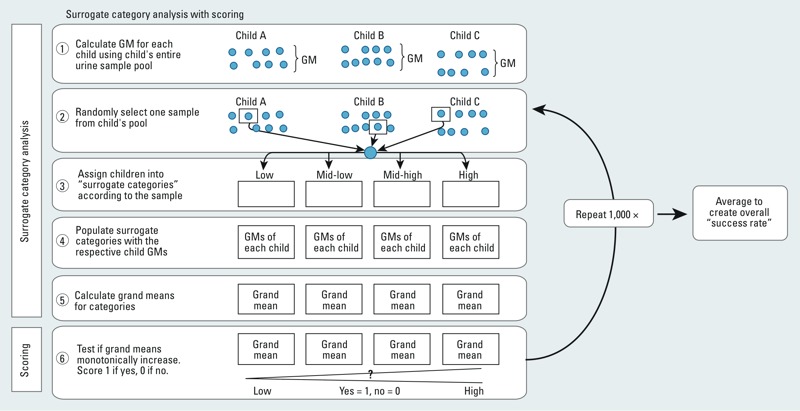
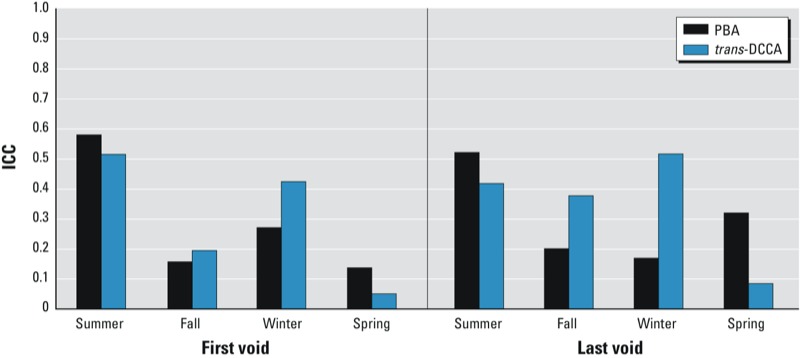
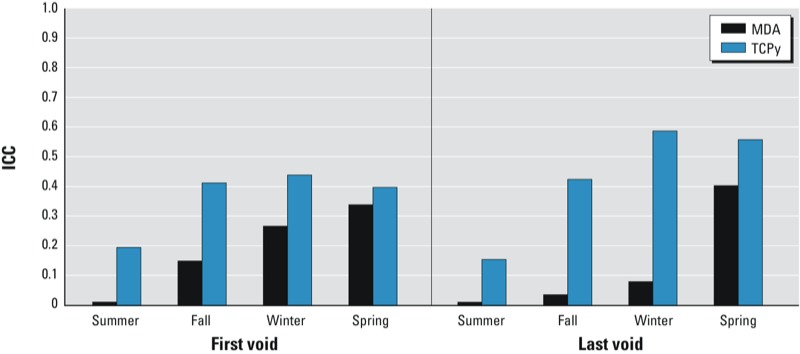
Each child provided urine samples twice daily over 7- to 16-day sessions in four seasons in 2003 and 2004. Samples were analyzed for five pyrethroid and five organophosphorus (OP) metabolites. After adjusting for specific gravity, we used a customized maximum likelihood estimation linear mixed-effects model that accounted for values below the limit of detection to calculate intraclass correlation coefficients (ICC) and conducted surrogate category analyses.
Within-child variability was 2-11 times greater than between-child variability. When restricted to samples collected during a single season, ICCs were higher in the fall, winter, and spring than in summer for OPs, and higher in summer and winter for pyrethroids, indicating an increase in between-person variability relative to within-person variability during these seasons. Surrogate category analyses demonstrated that a single spot urine sample did not categorize metabolite concentrations well, and that four or more samples would be needed to categorize children into quartiles consistently.
Urinary biomarkers of these short half-life pesticides exhibited substantial within-person variability in children observed over four seasons. Researchers investigating pesticides and health outcomes in children may need repeated biomarker measurements to derive accurate estimates of exposure and relative risks.
儿童通过多种来源和途径接触农药,包括饮食摄入、意外摄入、皮肤吸收和吸入。利用尿液代谢物将健康结果与这些接触联系起来,需要了解个体内部的时间变异性,以避免接触错误分类。
我们对华盛顿儿童农药接触研究中23名参与者在1年时间内尿液中有机磷和拟除虫菊酯代谢物的个体内部和个体间变异性进行了特征描述,并研究了一到四个随机尿液样本对平均接触进行分类的能力。
2003年和2004年的四个季节中,每个孩子在7至16天的时间段内每天提供两次尿液样本。对样本进行了五种拟除虫菊酯和五种有机磷(OP)代谢物的分析。在调整比重后,我们使用了一个定制的最大似然估计线性混合效应模型,该模型考虑了低于检测限的值,以计算组内相关系数(ICC)并进行替代类别分析。
个体内部变异性比个体间变异性大2至11倍。当仅限于单个季节收集的样本时,有机磷在秋季、冬季和春季的ICC高于夏季,拟除虫菊酯在夏季和冬季的ICC较高,这表明在这些季节中,个体间变异性相对于个体内变异性有所增加。替代类别分析表明,单个随机尿液样本不能很好地对代谢物浓度进行分类,需要四个或更多样本才能将儿童一致地分为四分位数。
在四个季节观察到的儿童中,这些半衰期短的农药的尿液生物标志物表现出很大的个体内变异性。研究儿童农药与健康结果的研究人员可能需要重复进行生物标志物测量,以获得准确的接触估计和相对风险。