Division of Preventive Medicine, Brigham and Women's Hospital, 900 Commonwealth Avenue, Third Floor, Boston, MA 02215.
Cancer Prev Res (Phila). 2014 Feb;7(2):218-25. doi: 10.1158/1940-6207.CAPR-13-0338-T. Epub 2013 Dec 10.
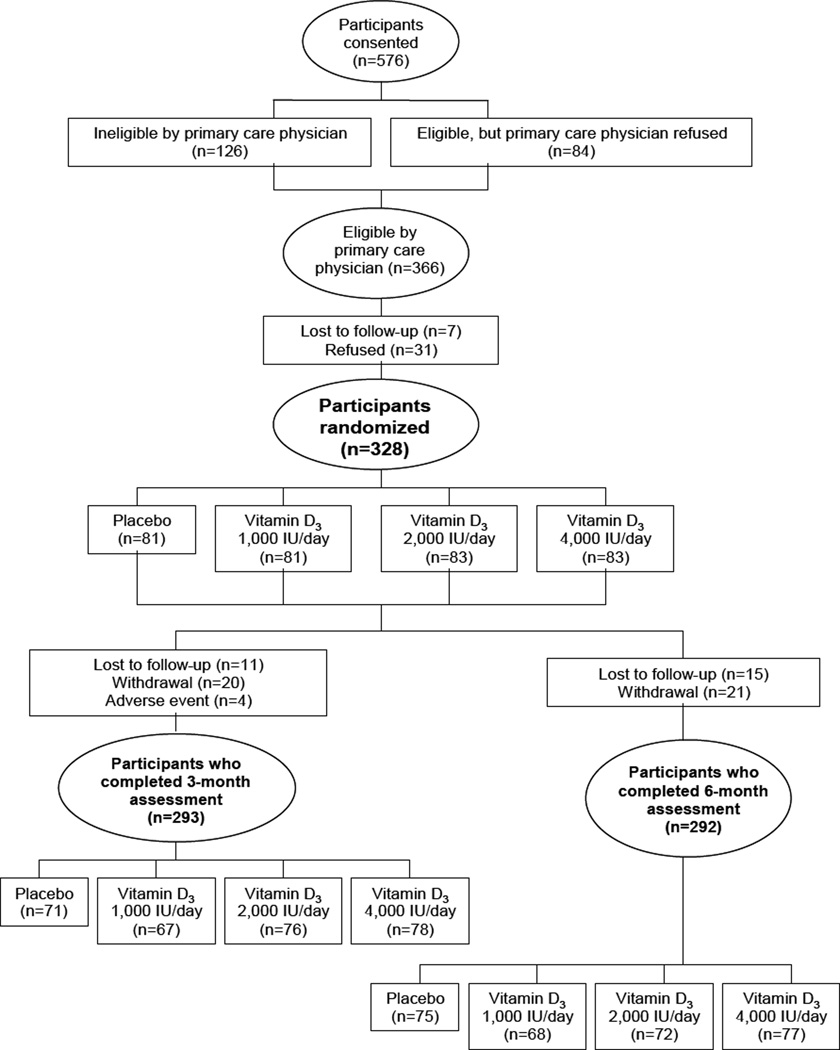
African Americans have a disproportionate burden of inflammation-associated chronic diseases such as cancer and lower circulating levels of 25-hydroxyvitamin D [25(OH)D]. The effect of vitamin D3 (cholecalciferol) supplementation on inflammatory markers is uncertain. We conducted a randomized, double-blind, placebo-controlled trial of supplemental oral vitamin D (placebo, 1,000, 2,000, or 4,000 IU/day of vitamin D3 orally for 3 months) in 328 African Americans (median age, 51 years) of public housing communities in Boston, MA, who were enrolled over three consecutive winter periods (2007-2010). Change from 0 to 3 months of plasma levels of 25(OH)D, high-sensitivity C-reactive protein (CRP), interleukin (IL)-6, IL-10, and soluble TNF-α receptor type 2 (sTNF-R2) in 292 (89%) participants were measured. Overall, no statistically significant changes in CRP, IL-6, IL-10, and sTNF-R2 were observed after the vitamin D supplementation period. Baseline CRP was significantly inversely associated with the baseline 25(OH)D level (P < 0.001) in unadjusted and adjusted models. An interaction between baseline 25(OH)D and vitamin D supplementation was observed for outcome change in log CRP (month 3-month 0; P for interaction = 0.04). Within an unselected population of African Americans, short-term exposure to vitamin D supplementation produced no change in circulating inflammatory markers. This study confirms the strong independent association of CRP with 25(OH)D status even after adjusting for body mass index. Future studies of longer supplemental vitamin D3 duration are necessary to examine the complex influence of vitamin D3 on CRP and other chronic inflammatory cytokines for possible reduction of cancer health disparities in African Americans.
非裔美国人患有多种炎症相关的慢性疾病,如癌症,其循环中的 25-羟维生素 D [25(OH)D]水平也较低。维生素 D3(胆钙化醇)补充剂对炎症标志物的影响尚不确定。我们在马萨诸塞州波士顿的公共住房社区中进行了一项随机、双盲、安慰剂对照试验,共纳入 328 名非裔美国人(中位年龄为 51 岁),他们在三个连续的冬季(2007-2010 年)期间入组。测量了 292 名(89%)参与者从 0 到 3 个月的血浆 25(OH)D、高敏 C 反应蛋白(CRP)、白细胞介素(IL)-6、IL-10 和可溶性肿瘤坏死因子-α受体 2(sTNF-R2)的水平变化。总体而言,在补充维生素 D 后,CRP、IL-6、IL-10 和 sTNF-R2 均未观察到统计学上的显著变化。在未调整和调整模型中,基线 CRP 均与基线 25(OH)D 水平呈显著负相关(P<0.001)。在 CRP 变化的对数中观察到基线 25(OH)D 和维生素 D 补充之间的交互作用(第 3 个月-第 0 个月;交互作用 P 值=0.04)。在未选择的非裔美国人人群中,短期暴露于维生素 D 补充剂不会改变循环炎症标志物。本研究证实了 CRP 与 25(OH)D 状态之间的强独立关联,即使在调整了体重指数后也是如此。未来需要进行更长时间补充维生素 D3 的研究,以检查维生素 D3 对 CRP 和其他慢性炎症细胞因子的复杂影响,从而可能减少非裔美国人的癌症健康差异。