Institute of Cognitive Neuroscience, University College, London WC1N 3AR, United Kingdom.
Learn Mem. 2013 Dec 17;21(1):21-7. doi: 10.1101/lm.032409.113.
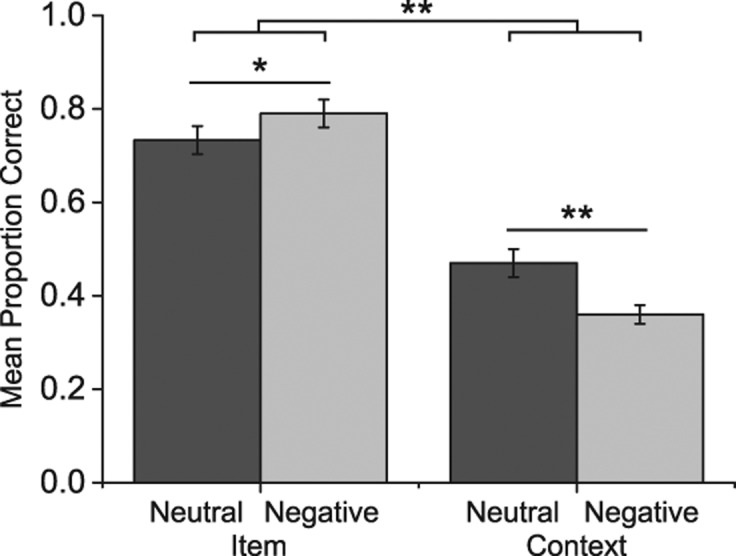
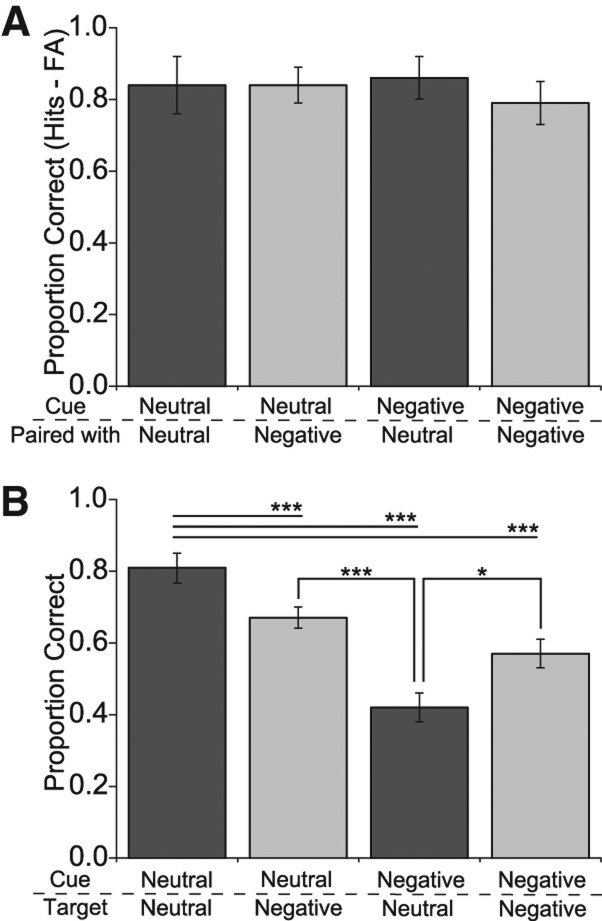
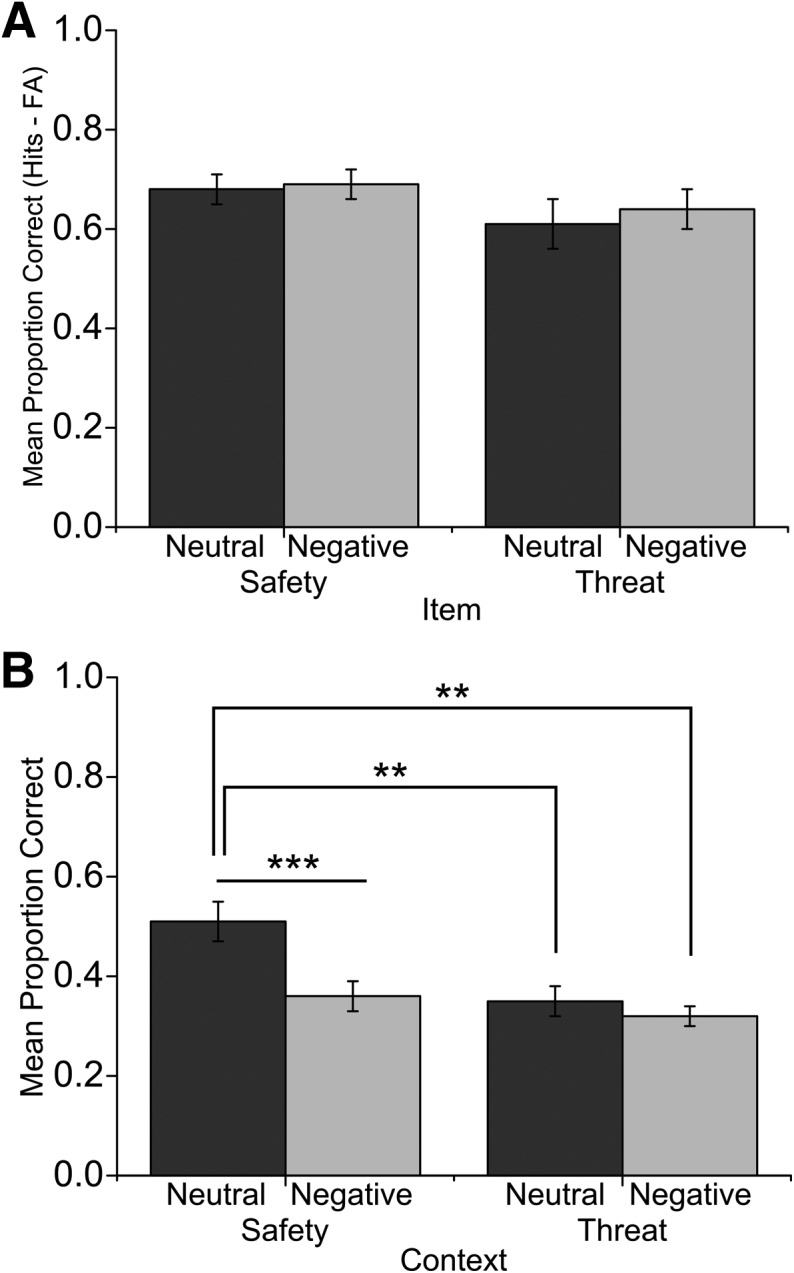
The formation of associations between items and their context has been proposed to rely on mechanisms distinct from those supporting memory for a single item. Although emotional experiences can profoundly affect memory, our understanding of how it interacts with different aspects of memory remains unclear. We performed three experiments to examine the effects of emotion on memory for items and their associations. By presenting neutral and negative items with background contexts, Experiment 1 demonstrated that item memory was facilitated by emotional affect, whereas memory for an associated context was reduced. In Experiment 2, arousal was manipulated independently of the memoranda, by a threat of shock, whereby encoding trials occurred under conditions of threat or safety. Memory for context was equally impaired by the presence of negative affect, whether induced by threat of shock or a negative item, relative to retrieval of the context of a neutral item in safety. In Experiment 3, participants were presented with neutral and negative items as paired associates, including all combinations of neutral and negative items. The results showed both above effects: compared to a neutral item, memory for the associate of a negative item (a second item here, context in Experiments 1 and 2) is impaired, whereas retrieval of the item itself is enhanced. Our findings suggest that negative affect impairs associative memory while recognition of a negative item is enhanced. They support dual-processing models in which negative affect or stress impairs hippocampal-dependent associative memory while the storage of negative sensory/perceptual representations is spared or even strengthened.
项目及其上下文之间的关联的形成被认为依赖于与支持单个项目记忆的机制不同的机制。尽管情绪体验可以深刻地影响记忆,但我们对它如何与记忆的不同方面相互作用的理解还不清楚。我们进行了三项实验来研究情绪对项目及其关联记忆的影响。通过呈现带有背景上下文的中性和负性项目,实验 1 表明,项目记忆受到情绪影响的促进,而相关背景的记忆则减少。在实验 2 中,通过威胁电击来独立于记忆项目来操纵唤醒度,其中编码试验在威胁或安全的条件下进行。与在安全条件下回忆中性项目的背景相比,无论负面情绪是由电击威胁还是负面项目引起的,对背景的记忆都会同样受到损害。在实验 3 中,参与者被呈现中性和负性项目作为配对联想,包括中性和负性项目的所有组合。结果显示了这两种影响:与中性项目相比,负性项目(这里是第二项目,实验 1 和 2 中的上下文)的关联记忆受损,而项目本身的检索则增强。我们的发现表明,负性情绪会损害联想记忆,而对负性项目的识别则增强。它们支持双加工模型,其中负性情绪或应激会损害海马体依赖的联想记忆,而负性感觉/知觉的存储则得以保留甚至增强。