Boudelaa Sami, Marslen-Wilson William D
Department of Linguistics, United Arab Emirates University, Al Ain, UAE ; Department of Experimental Psychology, University of Cambridge, Cambridge, UK.
Department of Experimental Psychology, University of Cambridge, Cambridge, UK ; Medical Research Council Cognition & Brain Sciences Unit, Cambridge, UK.
Lang Cogn Process. 2013 Dec;28(10):1453-1473. doi: 10.1080/01690965.2012.719629. Epub 2012 Oct 31.
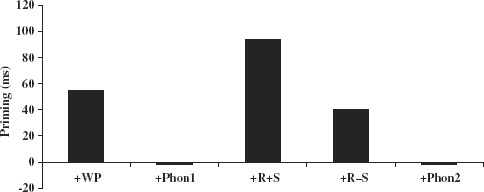
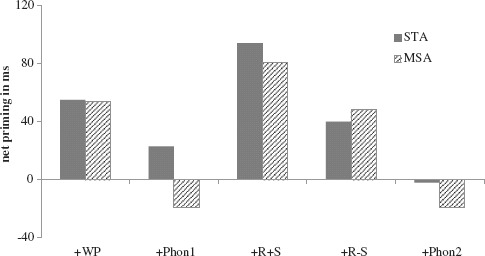
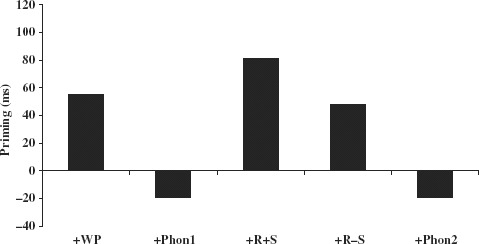
The Arabic language is acquired by its native speakers both as a regional spoken Arabic dialect, acquired in early childhood as a first language, and as the more formal variety known as Modern Standard Arabic (MSA), typically acquired later in childhood. These varieties of Arabic show a range of linguistic similarities and differences. Since previous psycholinguistic research in Arabic has primarily used MSA, it remains to be established whether the same cognitive properties hold for the dialects. Here we focus on the morphological level, and ask whether roots and word patterns play similar or different roles in MSA and in the regional dialect known as Southern Tunisian Arabic (STA). In two intra-modal auditory-auditory priming experiments, we found similar results with strong priming effects for roots and patterns in both varieties. Despite differences in the timing and nature of the acquisition of MSA and STA, root and word pattern priming was clearly distinguishable from form-based and semantic-based priming in both varieties. The implication of these results for theories of Arabic diglossia and theories of morphological processing are discussed.
阿拉伯语母语者习得阿拉伯语时,一方面习得的是作为地区性口语阿拉伯方言的阿拉伯语,这是他们在幼儿期作为第一语言习得的;另一方面习得的是更为正式的变体,即现代标准阿拉伯语(MSA),通常是在童年后期习得的。这些阿拉伯语变体展现出一系列语言上的异同。由于此前阿拉伯语的心理语言学研究主要使用现代标准阿拉伯语,方言是否具有相同的认知特性仍有待确定。在这里,我们聚焦于形态层面,探讨词根和词型在现代标准阿拉伯语和被称为突尼斯南部阿拉伯语(STA)的地区方言中是否发挥相似或不同的作用。在两项模态内听觉-听觉启动实验中,我们发现了相似的结果,两种变体中词根和词型都有很强的启动效应。尽管现代标准阿拉伯语和突尼斯南部阿拉伯语的习得时间和性质存在差异,但在这两种变体中,词根和词型启动都明显有别于基于形式和基于语义的启动。我们讨论了这些结果对阿拉伯语双言制理论和形态加工理论的意义。