Reisman Richard M, Shenoy Pareen J, Atherly Adam J, Flowers Christopher R
Gwinnett Hospital System Pain Management Center, Lawrenceville, GA, U.S.A.
School of Medicine, Emory University, Atlanta, GA, U.S.A.
Subst Abuse. 2009 May 1;3:41-51. doi: 10.4137/sart.s2345. eCollection 2009.
The dramatic rise in the use of prescription opioids to treat non-cancer pain has been paralleled by increasing prescription opioid abuse. However, detailed analyses of these trends and programs to address them are lacking.
To study the association between state shipments of prescription opioids for medical use and prescription opioid abuse admissions and to assess the effects of state prescription drug monitoring programs (PDMPs) on prescription opioid abuse admissions.
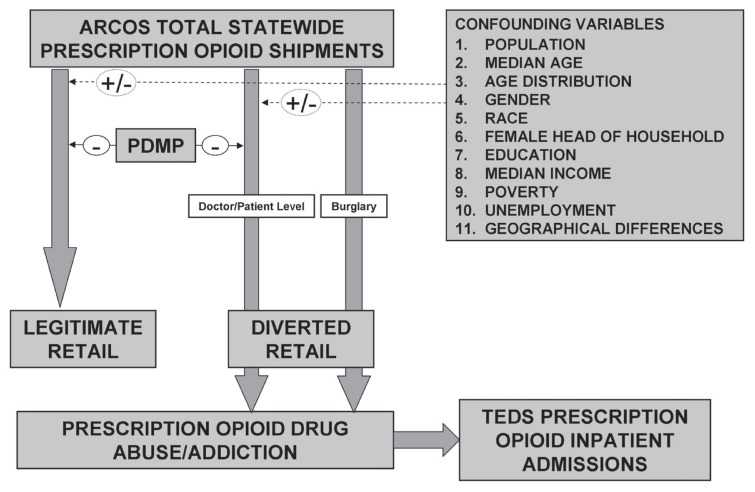
A RETROSPECTIVE ECOLOGICAL COHORT STUDY COMPARING STATE PRESCRIPTION OPIOID SHIPMENTS (SOURCE: Automation of Reports and Consolidated Orders Systems database) and inpatient admissions for prescription opioid abuse (source: Treatment Episode Data Set) in 14 states with PDMPs (intervention group) and 36 states without PDMPs (control group) for the period 1997-2003.
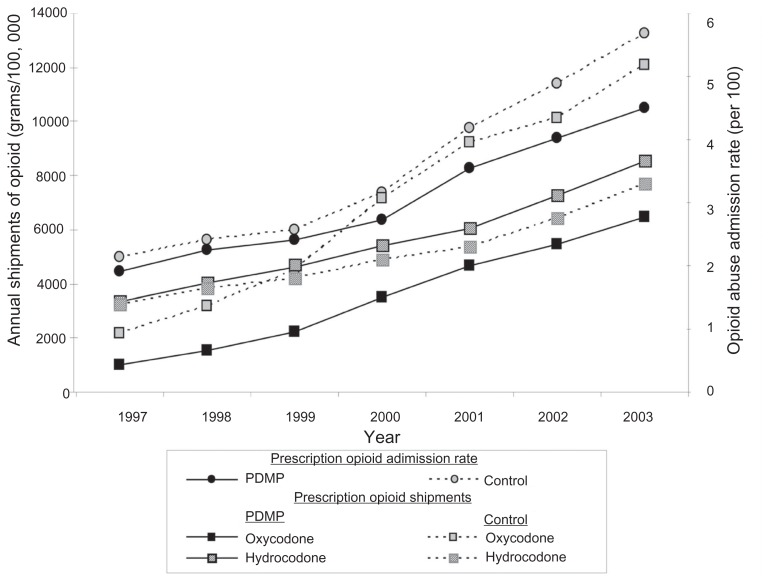
From 1997 to 2003, oxycodone, morphine, and hydrocodone shipments increased by 479%, 100%, and 148% respectively. Increasing prescription oxycodone shipments were significantly associated with increasing prescription opioid admission rates (p < 0.001). PDMP states had significantly lower oxycodone shipments than the control group. PDMP states had less increase in prescription opioid admissions per year (p = 0.063). A patient admitted to an inpatient drug abuse rehabilitation program in a PDMP state was less likely to be admitted for prescription opioid drug abuse (Odds ratio = 0.775, 95% Confidence Interval 0.764-0.785).
PDMPs appear to decrease the quantity of oxycodone shipments and the prescription opioid admission rate for states with these programs. Overall, opioid shipments rose significantly in PDMP states during the study period indicating a negligible "chilling effect" on physician prescribing.
用于治疗非癌性疼痛的处方阿片类药物使用量急剧上升,与此同时,处方阿片类药物滥用现象也日益增多。然而,目前缺乏对这些趋势以及应对措施的详细分析。
研究医用处方阿片类药物的州级发货量与处方阿片类药物滥用入院情况之间的关联,并评估州级处方药监测计划(PDMPs)对处方阿片类药物滥用入院情况的影响。
一项回顾性生态队列研究,比较了1997年至2003年期间有PDMPs的14个州(干预组)和无PDMPs的36个州(对照组)的州级处方阿片类药物发货量(来源:报告与综合订单系统数据库自动化)和处方阿片类药物滥用的住院入院情况(来源:治疗事件数据集)。
1997年至2003年,羟考酮、吗啡和氢可酮的发货量分别增长了479%、100%和148%。处方羟考酮发货量的增加与处方阿片类药物入院率的上升显著相关(p<0.001)。有PDMPs的州的羟考酮发货量显著低于对照组。有PDMPs的州每年处方阿片类药物入院人数的增长较少(p=0.063)。在有PDMPs的州,入住住院药物滥用康复项目的患者因处方阿片类药物滥用而入院的可能性较小(优势比=0.775,95%置信区间0.764-0.785)。
对于实施了这些计划的州,PDMPs似乎会减少羟考酮的发货量和处方阿片类药物入院率。总体而言,在研究期间,有PDMPs的州阿片类药物发货量显著上升,表明对医生开处方的“威慑作用”可忽略不计。