Department of Sociology, Lineberger Comprehensive Cancer Center, Chapel Hill, NC, 27517, USA.
BMC Public Health. 2013 Dec 20;13:1210. doi: 10.1186/1471-2458-13-1210.
Metabolic functions may operate as important biophysiological mechanisms through which social relationships affect health. It is unclear how social embeddedness or the lack thereof is related to risk of metabolic dysregulation. To fill this gap we tested the effects of social integration on metabolic functions over time in a nationally representative sample of older adults in the United States and examined population heterogeneity in the effects.
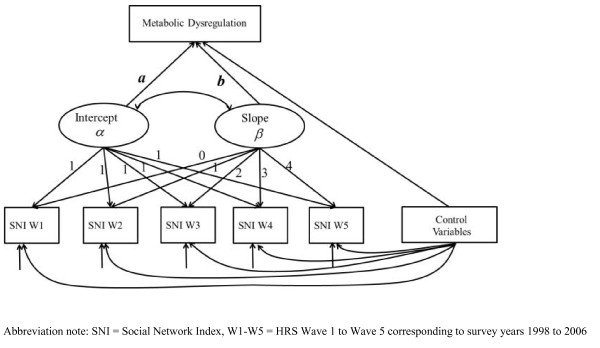
Using longitudinal data from 4,323 adults aged over 50 years in the Health and Retirement Study and latent growth curve models, we estimated the trajectories of social integration spanning five waves, 1998-2006, in relation to biomarkers of energy metabolism in 2006. We assessed social integration using a summary index of the number of social ties across five domains. We examined six biomarkers, including total cholesterol, high-density lipoprotein cholesterol, glycosylated hemoglobin, waist circumference, and systolic and diastolic blood pressure, and the summary index of the overall burden of metabolic dysregulation.
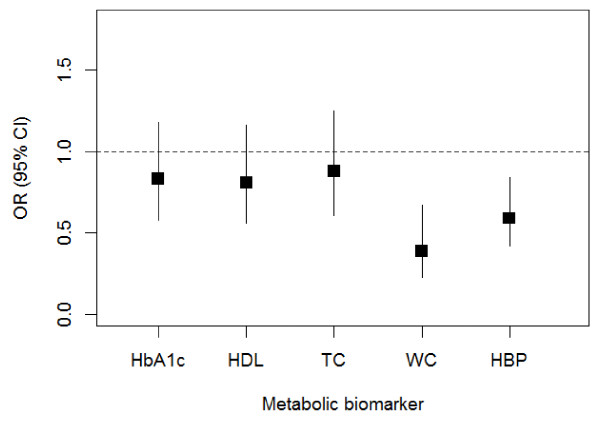
High social integration predicted significantly lower risks of both individual and overall metabolic dysregulation. Specifically, adjusting for age, sex, race, and body mass index, having four to five social ties reduced the risks of abdominal obesity by 61% (odds ratio [OR] [95% confidence interval {CI}] = 0.39 [0.23, 0.67], p = .007), hypertension by 41% (OR [95% CI] = 0.59 [0.42, 0.84], p = .021), and the overall metabolic dysregulation by 46% (OR [95% CI] = 0.54 [0.40, 0.72], p < .001). The OR for the overall burden remained significant when adjusting for social, behavioral, and illness factors. In addition, stably high social integration had more potent metabolic impacts over time than changes therein. Such effects were consistent across subpopulations and more salient for the younger old (those under age 65), males, whites, and the socioeconomically disadvantaged.
This study addressed important challenges in previous research linking social integration to metabolic health by clarifying the nature and direction of the relationship as it applies to different objectively measured markers and population subgroups. It suggests additional psychosocial and biological pathways to consider in future research on the contributions of social deficits to disease etiology and old-age mortality.
代谢功能可能是社会关系影响健康的重要生物生理机制。社会融合或缺乏社会融合与代谢失调风险之间的关系尚不清楚。为了填补这一空白,我们在美国一个具有全国代表性的老年人群体中,通过一项纵向研究,检测了社会融合对代谢功能的影响,并检验了这些影响的人群异质性。
我们利用来自健康与退休研究(Health and Retirement Study)中 4323 名年龄在 50 岁以上的成年人的纵向数据,以及潜在增长曲线模型,估计了跨越五个波次(1998-2006 年)的社会融合轨迹与 2006 年能量代谢生物标志物之间的关系。我们使用跨五个领域的社会关系数量综合指数来评估社会融合。我们检测了 6 种生物标志物,包括总胆固醇、高密度脂蛋白胆固醇、糖化血红蛋白、腰围以及收缩压和舒张压,并评估了代谢失调总体负担的综合指数。
高社会融合度显著预示着个体和整体代谢失调风险降低。具体而言,在调整年龄、性别、种族和体重指数后,拥有 4-5 个社会关系将腹部肥胖的风险降低 61%(比值比[OR] [95%置信区间{CI}] = 0.39 [0.23, 0.67],p = .007),高血压风险降低 41%(OR [95% CI] = 0.59 [0.42, 0.84],p = .021),代谢失调总体风险降低 46%(OR [95% CI] = 0.54 [0.40, 0.72],p < .001)。当调整社会、行为和疾病因素后,OR 对于整体代谢失调负担仍具有统计学意义。此外,稳定的高社会融合度随着时间的推移对代谢产生了更有力的影响,而社会融合度的变化则没有。这些影响在亚人群中是一致的,对年轻老年人(65 岁以下)、男性、白人以及社会经济地位较低的人群更为显著。
本研究通过明确社会融合与代谢健康之间关系的性质和方向,解决了将社会融合与代谢健康联系起来的先前研究中的重要挑战,这种关系适用于不同的客观测量标志物和人群亚组。这表明在未来的研究中,需要考虑更多的心理社会和生物学途径,以了解社会缺陷对疾病病因和老年死亡的贡献。