Center for Hemochromatosis and Metabolic Liver Diseases, Department of Medical and Surgical Sciences, University Hospital of Modena, Modena, Italy.
Center for Hemochromatosis and Metabolic Liver Diseases, Department of Medical and Surgical Sciences, University Hospital of Modena, Modena, Italy.
Gastroenterology. 2014 Apr;146(4):1060-9. doi: 10.1053/j.gastro.2013.12.016. Epub 2013 Dec 17.
BACKGROUND & AIMS: Hepatic gluconeogenesis provides fuel during starvation, and is abnormally induced in obese individuals or those with diabetes. Common metabolic disorders associated with active gluconeogenesis and insulin resistance (obesity, metabolic syndrome, diabetes, and nonalcoholic fatty liver disease) have been associated with alterations in iron homeostasis that disrupt insulin sensitivity and promote disease progression. We investigated whether gluconeogenic signals directly control Hepcidin, an important regulator of iron homeostasis, in starving mice (a model of persistently activated gluconeogenesis and insulin resistance).
We investigated hepatic regulation of Hepcidin expression in C57BL/6Crl, 129S2/SvPas, BALB/c, and Creb3l3-/- null mice. Mice were fed a standard, iron-balanced chow diet or an iron-deficient diet for 9 days before death, or for 7 days before a 24- to 48-hour starvation period; liver and spleen tissues then were collected and analyzed by quantitative reverse-transcription polymerase chain reaction and immunoblot analyses. Serum levels of iron, hemoglobin, Hepcidin, and glucose also were measured. We analyzed human hepatoma (HepG2) cells and mouse primary hepatocytes to study transcriptional control of Hamp (the gene that encodes Hepcidin) in response to gluconeogenic stimuli using small interfering RNA, luciferase promoter, and chromatin immunoprecipitation analyses.
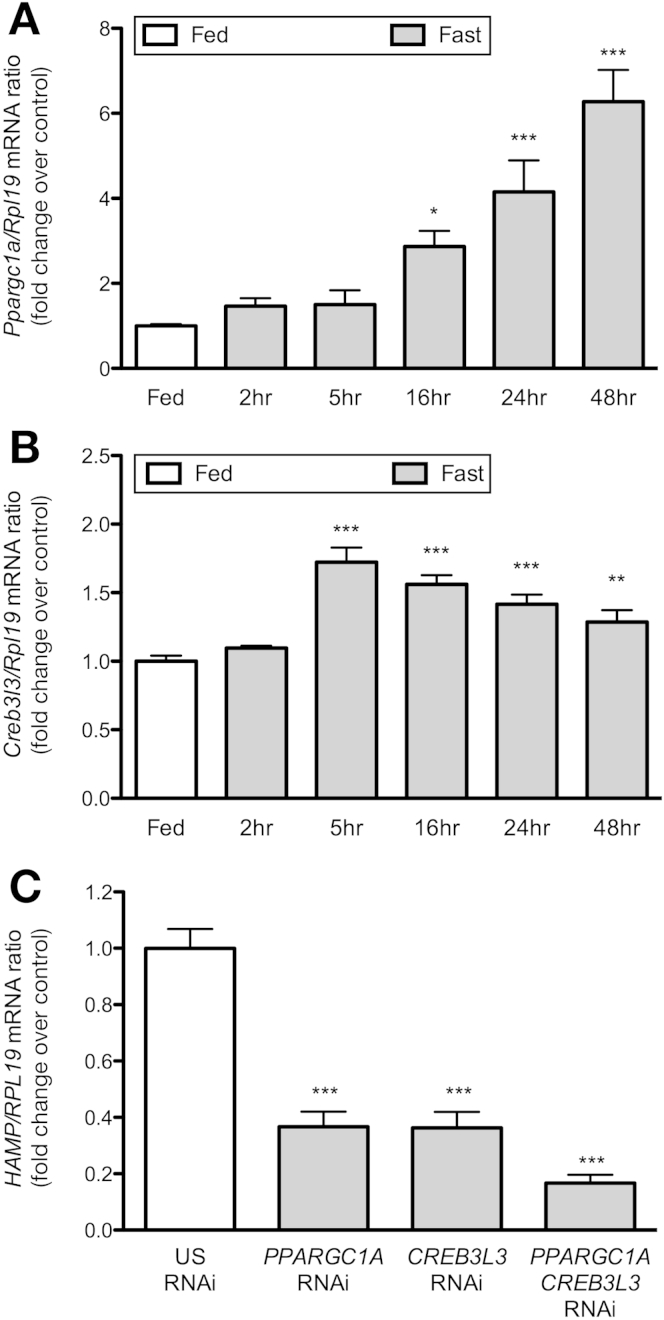
Starvation led to increased transcription of the gene that encodes phosphoenolpyruvate carboxykinase 1 (a protein involved in gluconeogenesis) in livers of mice, increased levels of Hepcidin, and degradation of Ferroportin, compared with nonstarved mice. These changes resulted in hypoferremia and iron retention in liver tissue. Livers of starved mice also had increased levels of Ppargc1a mRNA and Creb3l3 mRNA, which encode a transcriptional co-activator involved in energy metabolism and a liver-specific transcription factor, respectively. Glucagon and a cyclic adenosine monophosphate analog increased promoter activity and transcription of Hamp in cultured liver cells; levels of Hamp were reduced after administration of small interfering RNAs against Ppargc1a and Creb3l3. PPARGC1A and CREB3L3 bound the Hamp promoter to activate its transcription in response to a cyclic adenosine monophosphate analog. Creb3l3-/- mice did not up-regulate Hamp or become hypoferremic during starvation.
We identified a link between glucose and iron homeostasis, showing that Hepcidin is a gluconeogenic sensor in mice during starvation. This response is involved in hepatic metabolic adaptation to increased energy demands; it preserves tissue iron for vital activities during food withdrawal, but can cause excessive iron retention and hypoferremia in disorders with persistently activated gluconeogenesis and insulin resistance.
肝糖异生在饥饿时提供燃料,在肥胖者或糖尿病患者中异常诱导。与活性糖异生和胰岛素抵抗相关的常见代谢紊乱(肥胖、代谢综合征、糖尿病和非酒精性脂肪肝疾病)与铁稳态的改变有关,这些改变会破坏胰岛素敏感性并促进疾病进展。我们研究了在饥饿的小鼠(持续激活糖异生和胰岛素抵抗的模型)中,糖异生信号是否直接控制铁稳态的重要调节剂——hepcidin。
我们研究了 C57BL/6Crl、129S2/SvPas、BALB/c 和 Creb3l3-/- 基因敲除小鼠肝脏中 Hepcidin 表达的调节。在处死前,将小鼠用标准的、铁平衡的标准饲料或缺铁饲料喂养 9 天,或在 24 至 48 小时饥饿期前喂养 7 天;然后收集肝脏和脾脏组织,通过定量逆转录聚合酶链反应和免疫印迹分析进行分析。还测量了血清铁、血红蛋白、Hepcidin 和葡萄糖水平。我们分析了人肝癌(HepG2)细胞和小鼠原代肝细胞,使用小干扰 RNA、荧光素酶启动子和染色质免疫沉淀分析研究了对糖异生刺激的 Hamp(编码 Hepcidin 的基因)的转录控制。
与非饥饿小鼠相比,饥饿导致小鼠肝脏中编码磷酸烯醇丙酮酸羧激酶 1(参与糖异生的一种蛋白质)的基因转录增加,Hepcidin 水平升高,铁蛋白降解,导致低铁血症和肝脏组织中铁的蓄积。饥饿的小鼠肝脏中 Ppargc1a mRNA 和 Creb3l3 mRNA 的水平也增加,它们分别编码参与能量代谢的转录共激活因子和肝脏特异性转录因子。在培养的肝细胞中,胰高血糖素和环腺苷单磷酸类似物增加 Hamp 的启动子活性和转录;用针对 Ppargc1a 和 Creb3l3 的小干扰 RNA 处理后,Hamp 的水平降低。PPARGC1A 和 CREB3L3 结合 Hamp 启动子,在环腺苷单磷酸类似物的刺激下激活其转录。在饥饿期间,Creb3l3-/- 小鼠不会上调 Hamp 或出现低铁血症。
我们确定了葡萄糖和铁稳态之间的联系,表明在饥饿的小鼠中,Hepcidin 是一种糖异生传感器。这种反应涉及肝脏对增加的能量需求的代谢适应;它为食物戒断期间的重要活动保存组织铁,但在持续激活糖异生和胰岛素抵抗的疾病中,可能导致过度的铁蓄积和低铁血症。