Department of Internal Medicine, Pham Ngoc Thach University of Medicine, Thanh Thai Street, District 10, Ho Chi Minh City, Vietnam.
BMC Musculoskelet Disord. 2013 Dec 23;14:366. doi: 10.1186/1471-2474-14-366.
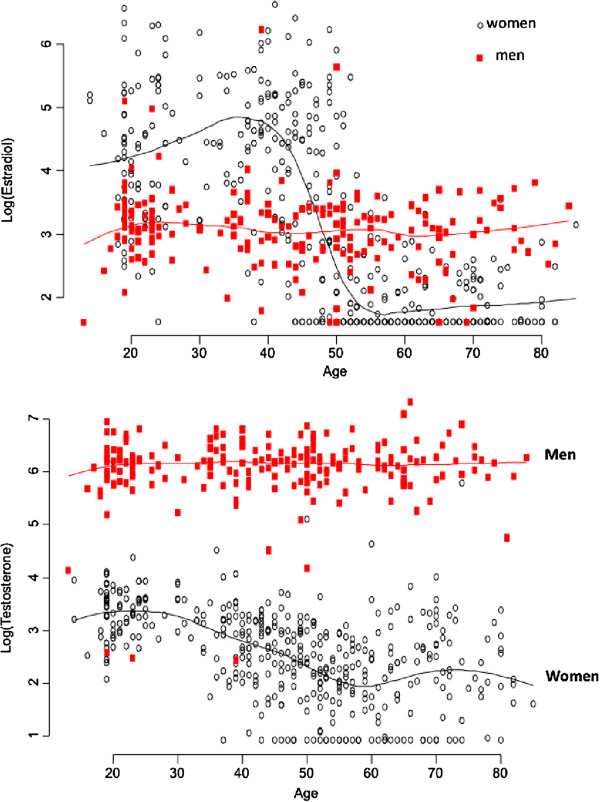
The study quantified the relative contributions of estrogen (E2) and total testosterone (TT) to variation in bone mineral density in men and women.
This was a cross-sectional study which involved 200 men and 415 women aged 18 to 89 years. BMD at the lumbar spine (LS) and femoral neck (FN) was measured by DXA. Serum levels of E2 and TT were measured by electrochemiluminescence immunoassays. The association between E2, TT, and BMD was analyzed by the multiple linear regression model, adjusting for age and BMI. The contribution of each hormone to the variation in BMD was quantified by the bootstrap method.
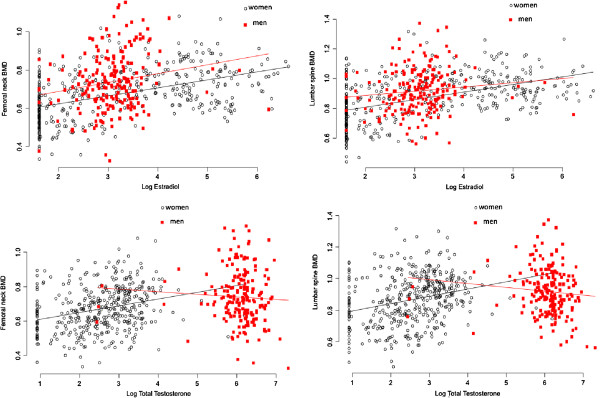
In women, higher serum levels of E2, but not TT, were significantly associated with greater BMD at the FN (P = 0.001) and LS (P < 0.0001). In men, higher serum levels of E2 were independently associated with greater FNBMD (P = 0.008) and LSBMD (P = 0.086). In the multiple linear regression model, age, body weight and E2 accounted for 50-55% variance in FNBMD, and 25% (in men) and 48% (in women) variance in LSBMD. Variation in E2 accounted for 2.5% (95% CI 0.4-7.8%) and 11.3% (95% CI 8.1-15.3%) variation in FNBMD in men and women, respectively. Moreover, E2 contributed 1.2% (95% CI 0.1-5.8%) and 11.7% (95% CI 8.5-15.9%) variation in LSBMD in men and women, respectively.
Estrogen is more important than testosterone in the determination of age-related bone mineral density men and women of Vietnamese background. However, the relative contributions of estrogen to bone mineral density in men are likely modest.
本研究量化了雌激素(E2)和总睾酮(TT)对男性和女性骨密度变化的相对贡献。
这是一项横断面研究,涉及 200 名年龄在 18 至 89 岁的男性和 415 名女性。通过双能 X 线吸收法(DXA)测量腰椎(LS)和股骨颈(FN)的骨密度。采用电化学发光免疫分析法测量血清 E2 和 TT 水平。采用多元线性回归模型,在调整年龄和 BMI 后,分析 E2、TT 与 BMD 的关系。采用自举法量化每种激素对 BMD 变化的贡献。
在女性中,较高的血清 E2 水平,但不是 TT 水平,与 FN(P = 0.001)和 LS(P < 0.0001)的 BMD 更高显著相关。在男性中,较高的血清 E2 水平与 FN 骨密度(P = 0.008)和 LS 骨密度(P = 0.086)增加独立相关。在多元线性回归模型中,年龄、体重和 E2 解释了 FN 骨密度的 50-55%的变异,解释了男性 LS 骨密度的 25%(男性)和女性 LS 骨密度的 48%(女性)的变异。E2 的变异分别解释了男性和女性 FN 骨密度的 2.5%(95%CI 0.4-7.8%)和 11.3%(95%CI 8.1-15.3%)的变异。此外,E2 分别解释了男性和女性 LS 骨密度的 1.2%(95%CI 0.1-5.8%)和 11.7%(95%CI 8.5-15.9%)的变异。
雌激素比睾酮在确定越南背景下男性和女性的年龄相关骨密度方面更为重要。然而,雌激素对男性骨密度的相对贡献可能较小。