Department of Biotechnology, Indian Institute of Technology Kharagpur, Kharagpur, India.
Department of Biotechnology, Indian Institute of Technology Madras, Chennai, India.
PLoS Comput Biol. 2013;9(12):e1003403. doi: 10.1371/journal.pcbi.1003403. Epub 2013 Dec 19.
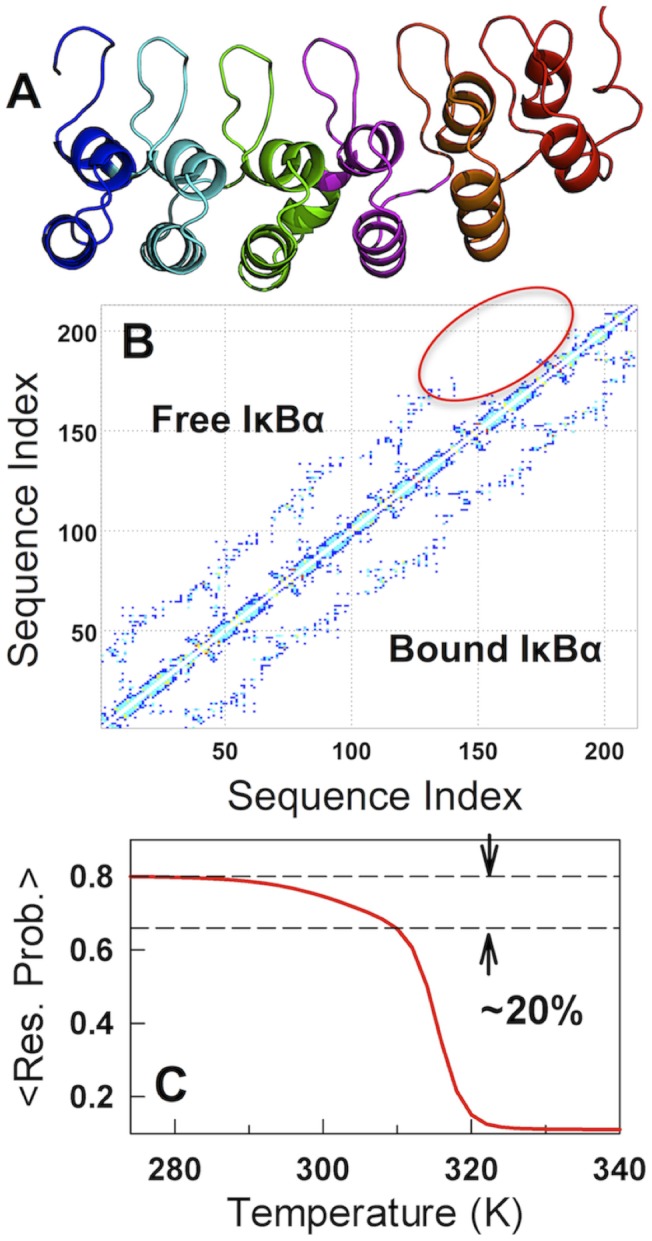
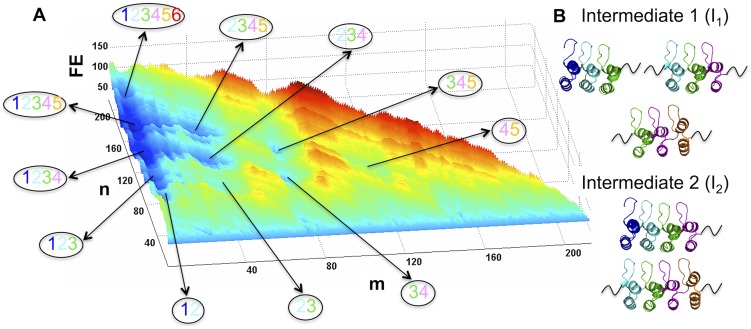
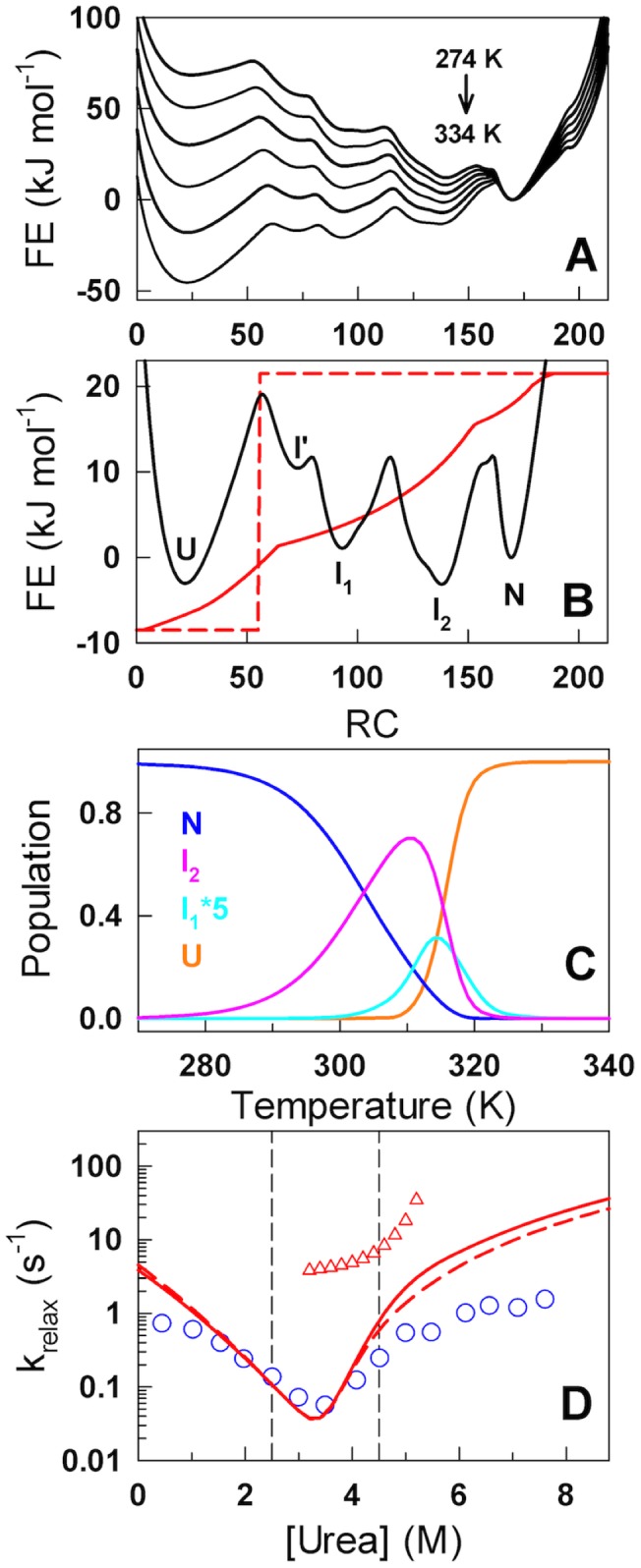
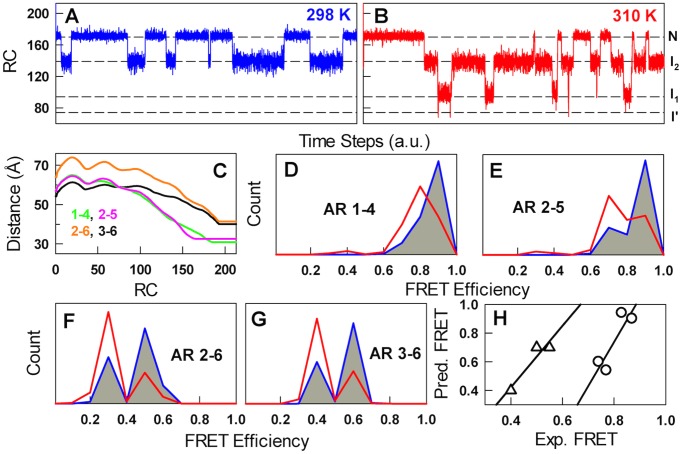
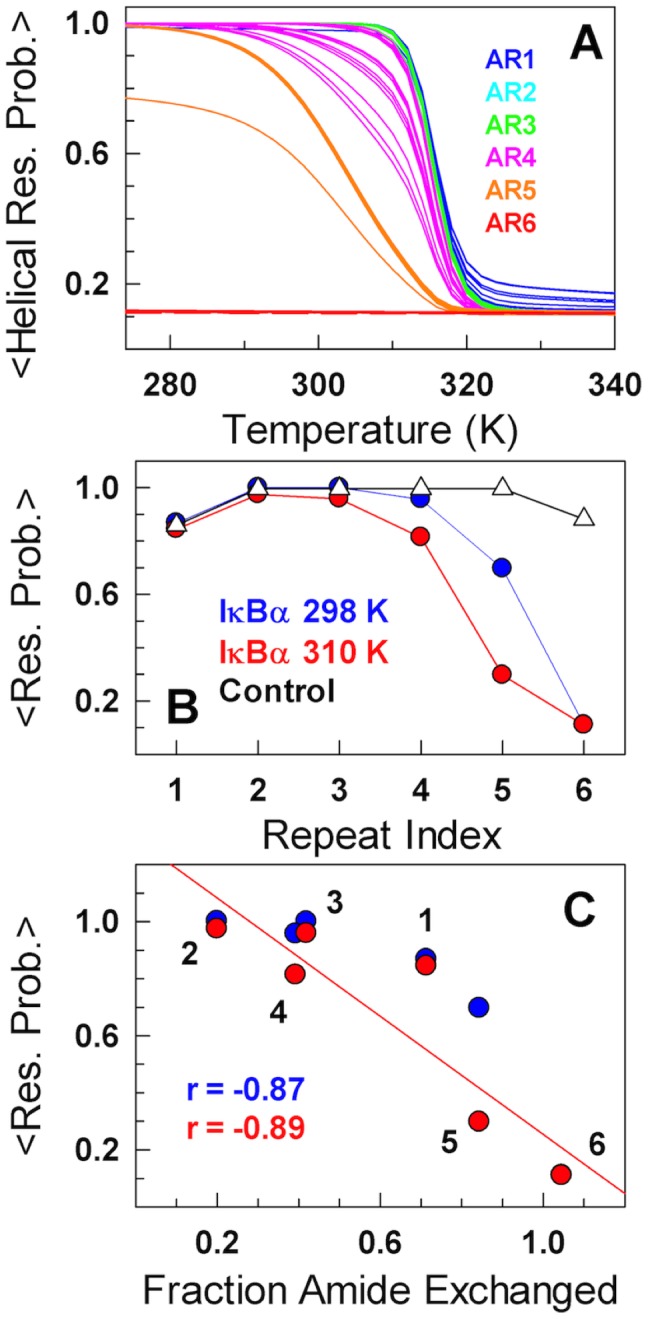
The stability of the repeat protein IκBα, a transcriptional inhibitor in mammalian cells, is critical in the functioning of the NF-κB signaling module implicated in an array of cellular processes, including cell growth, disease, immunity and apoptosis. Structurally, IκBα is complex, with both ordered and disordered regions, thus posing a challenge to the available computational protocols to model its conformational behavior. Here, we introduce a simple procedure to model disorder in systems that undergo binding-induced folding that involves modulation of the contact map guided by equilibrium experimental observables in combination with an Ising-like Wako-Saitô-Muñoz-Eaton model. This one-step procedure alone is able to reproduce a variety of experimental observables, including ensemble thermodynamics (scanning calorimetry, pre-transitions, m-values) and kinetics (roll-over in chevron plot, intermediates and their identity), and is consistent with hydrogen-deuterium exchange measurements. We further capture the intricate distance-dynamics between the domains as measured by single-molecule FRET by combining the model predictions with simple polymer physics arguments. Our results reveal a unique mechanism at work in IκBα folding, wherein disorder in one domain initiates a domino-like effect partially destabilizing neighboring domains, thus highlighting the effect of symmetry-breaking at the level of primary sequences. The offshoot is a multi-state and a dynamic conformational landscape that is populated by increasingly partially folded ensembles upon destabilization. Our results provide, in a straightforward fashion, a rationale to the promiscuous binding and short intracellular half-life of IκBα evolutionarily engineered into it through repeats with variable stabilities and expand the functional repertoire of disordered regions in proteins.
重复蛋白 IκBα 的稳定性在 NF-κB 信号模块的功能中至关重要,该模块参与了一系列细胞过程,包括细胞生长、疾病、免疫和细胞凋亡。从结构上看,IκBα 非常复杂,既有有序区域也有无序区域,这给现有的计算方法提出了挑战,难以对其构象行为进行建模。在这里,我们引入了一种简单的方法来对经历结合诱导折叠的系统进行建模,该方法涉及通过平衡实验观测值来调节接触图,同时结合类似伊辛的 Wako-Saitô-Muñoz-Eaton 模型。仅这一步骤就能复制各种实验观测值,包括整体热力学(扫描量热法、预转变、m 值)和动力学( Chevron 图中的翻转、中间体及其身份),并与氘氢交换测量结果一致。我们通过将模型预测与简单的聚合物物理论据相结合,进一步捕捉到通过单分子 FRET 测量到的结构域之间复杂的距离动力学。我们的结果揭示了 IκBα 折叠过程中独特的工作机制,其中一个结构域中的无序会引发类似多米诺骨牌的效应,从而部分破坏相邻结构域的稳定性,这突出了在一级序列水平上打破对称的影响。其结果是形成一个多态和动态的构象景观,随着失稳,越来越多的部分折叠的构象逐渐填充到这个景观中。我们的结果以简单直接的方式为 IκBα 的广泛结合和短的细胞内半衰期提供了一个合理的解释,这种性质是通过具有可变稳定性的重复序列进化而来的,并扩展了无序区域在蛋白质中的功能范围。