Tanninen Stephanie E, Morrissey Mark D, Takehara-Nishiuchi Kaori
Department of Psychology, University of Toronto, Toronto, Ontario, Canada ; Program in Neuroscience, University of Toronto, Toronto, Ontario, Canada.
Department of Psychology, University of Toronto, Toronto, Ontario, Canada ; Program in Neuroscience, University of Toronto, Toronto, Ontario, Canada ; Department of Cell and Systems Biology, University of Toronto, Toronto, Ontario, Canada.
PLoS One. 2013 Dec 19;8(12):e84543. doi: 10.1371/journal.pone.0084543. eCollection 2013.
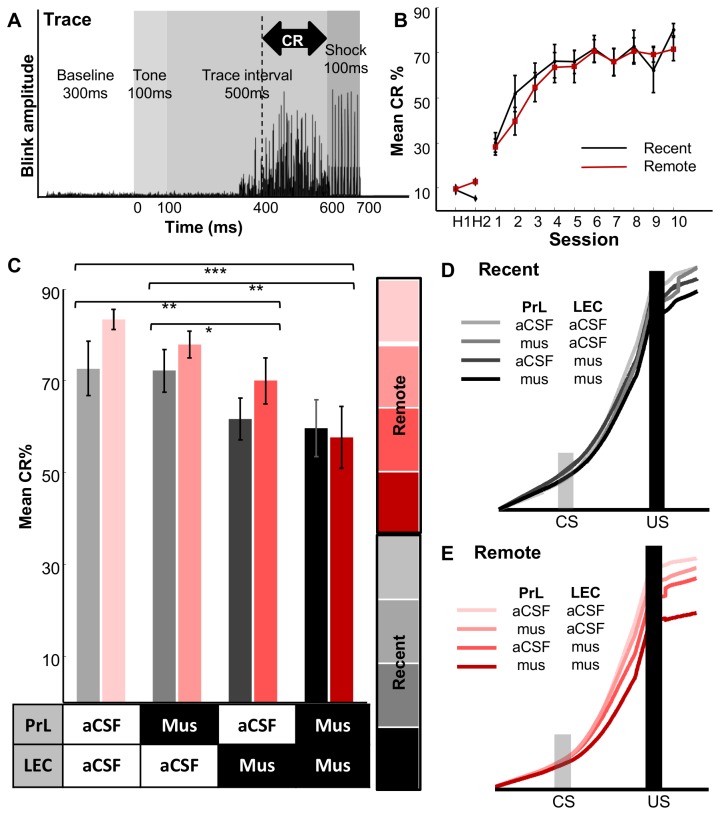
Memory in trace eyeblink conditioning is mediated by an inter-connected network that involves the hippocampus (HPC), several neocortical regions, and the cerebellum. This network reorganizes after learning as the center of the network shifts from the HPC to the medial prefrontal cortex (mPFC). Despite the network reorganization, the lateral entorhinal cortex (LEC) plays a stable role in expressing recently acquired HPC-dependent memory as well as remotely acquired mPFC-dependent memory. Entorhinal involvement in recent memory expression may be attributed to its previously proposed interactions with the HPC. In contrast, it remains unknown how the LEC participates in memory expression after the network disengages from the HPC. The present study tested the possibility that the LEC and mPFC functionally interact during remote memory expression by examining the impact of pharmacological inactivation of the LEC in one hemisphere and the mPFC in the contralateral hemisphere on memory expression in rats. Memory expression one day and one month after learning was significantly impaired after LEC-mPFC inactivation; however, the degree of impairment was comparable to that after unilateral LEC inactivation. Unilateral mPFC inactivation had no effect on recent or remote memory expression. These results suggest that the integrity of the LEC in both hemispheres is necessary for memory expression. Functional interactions between the LEC and mPFC should therefore be tested with an alternative design.
痕迹性眨眼条件反射中的记忆由一个相互连接的网络介导,该网络涉及海马体(HPC)、几个新皮质区域和小脑。学习后,随着网络中心从HPC转移到内侧前额叶皮质(mPFC),这个网络会重新组织。尽管网络发生了重组,但外侧内嗅皮质(LEC)在表达近期获得的依赖HPC的记忆以及远期获得的依赖mPFC的记忆方面发挥着稳定的作用。内嗅皮质参与近期记忆表达可能归因于其先前提出的与HPC的相互作用。相比之下,在网络与HPC脱离联系后,LEC如何参与记忆表达仍然未知。本研究通过检查一侧半球的LEC和对侧半球的mPFC的药理学失活对大鼠记忆表达的影响,测试了LEC和mPFC在远期记忆表达过程中功能相互作用的可能性。LEC - mPFC失活后,学习后一天和一个月的记忆表达显著受损;然而,损伤程度与单侧LEC失活后的损伤程度相当。单侧mPFC失活对近期或远期记忆表达没有影响。这些结果表明,双侧半球LEC的完整性对于记忆表达是必要的。因此,应该用另一种设计来测试LEC和mPFC之间的功能相互作用。