Department of Clinical and Health Psychology, Utrecht University, The Netherlands.
PLoS One. 2013 Dec 18;8(12):e84643. doi: 10.1371/journal.pone.0084643. eCollection 2013.
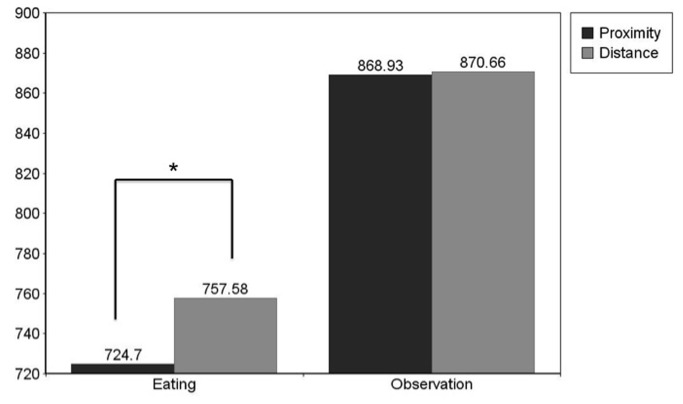
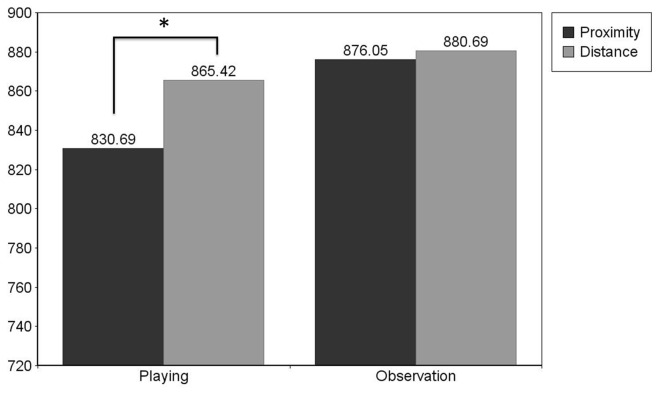
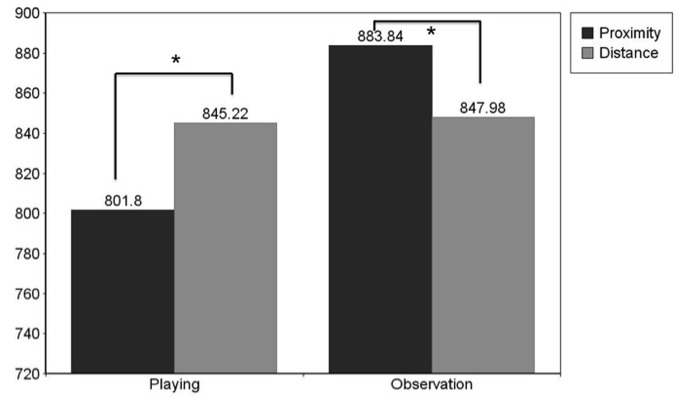
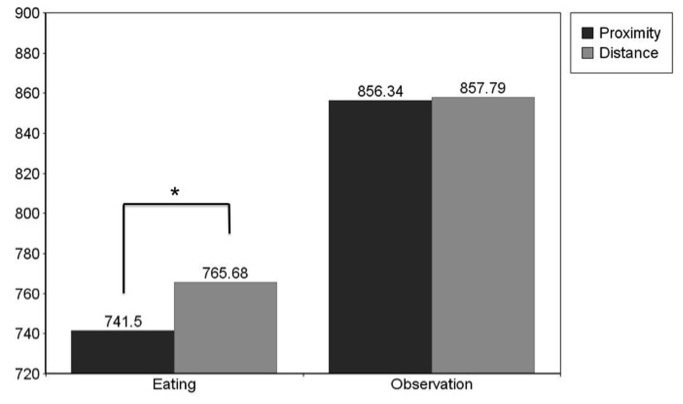
Proximal objects provide affordances that activate the motor information involved in interacting with the objects. This effect has previously been shown for artifacts but not for natural objects, such as food. This study examined whether the sight of proximal food, compared to distant food activates eating-related information. In two experiments reaction times to verbal labels following the sight of proximal and distant objects (food and toys) were measured. Verbal labels included function words that were compatible with one object category (eating and playing) and observation words compatible with both object categories. The sight of food was expected to activate eating-related information when presented at proximity but not at distance, as reflected by faster reaction times to proximal than distant compatible eating words and no difference between reaction times to proximal and distant food for observation words (Experiment 1). Experiment 2 additionally compared the reaction times to wrapped and unwrapped food. The distance effect was expected to occur only for unwrapped food because only unwrapped food is readily edible. As expected, Experiment 1 and 2 revealed faster responses to compatible eating words at proximity than at distance. In Experiment 2 this distance effect occurred only for readily edible, unwrapped food but not for wrapped food. For observation words no difference in response times between the distances was found. These findings suggest that the sight of proximal food activates eating-related information, which could explain people's differential behavioral responses to reachable versus distant food. The activation of eating-related information upon sight of accessible food could provide a cognition-based explanation for mindless eating.
近端物体提供了可供使用的功能,这些功能激活了与物体交互相关的运动信息。这一效应以前在人工制品中得到了证实,但在自然物体(如食物)中尚未得到证实。本研究检验了与远距离食物相比,近端食物的视觉刺激是否会激活与进食相关的信息。在两个实验中,我们测量了参与者在看到近端和远距离物体(食物和玩具)后的口头标签反应时间。口头标签包括与一个物体类别(进食和玩耍)兼容的功能词,以及与两个物体类别都兼容的观察词。当食物呈现在近端时,预计会激活与进食相关的信息,而在远距离时则不会,这反映在近端比远距离更兼容的进食词的反应时间更快,而对观察词的反应时间则没有差异(实验 1)。实验 2还比较了包裹和未包裹食物的反应时间。只有未包裹的食物才是易于食用的,因此预计只有在未包裹的食物中才会出现距离效应。正如预期的那样,实验 1 和 2 显示,与远距离相比,参与者对近端更兼容的进食词的反应更快。在实验 2 中,只有易于食用的未包裹食物出现了这种距离效应,而包裹食物则没有。对于观察词,在距离之间没有发现反应时间的差异。这些发现表明,近端食物的视觉刺激激活了与进食相关的信息,这可以解释人们对可触及和远距离食物的不同行为反应。对可获取食物的视觉刺激激活与进食相关的信息,为无意识进食提供了一种基于认知的解释。