Neurobiology Department, Hebrew University of Jerusalem Jerusalem, Israel ; Department of Neurobiology, Weizmann Institute of Science Rehovot, Israel.
Front Psychol. 2013 Sep 4;4:591. doi: 10.3389/fpsyg.2013.00591. eCollection 2013.
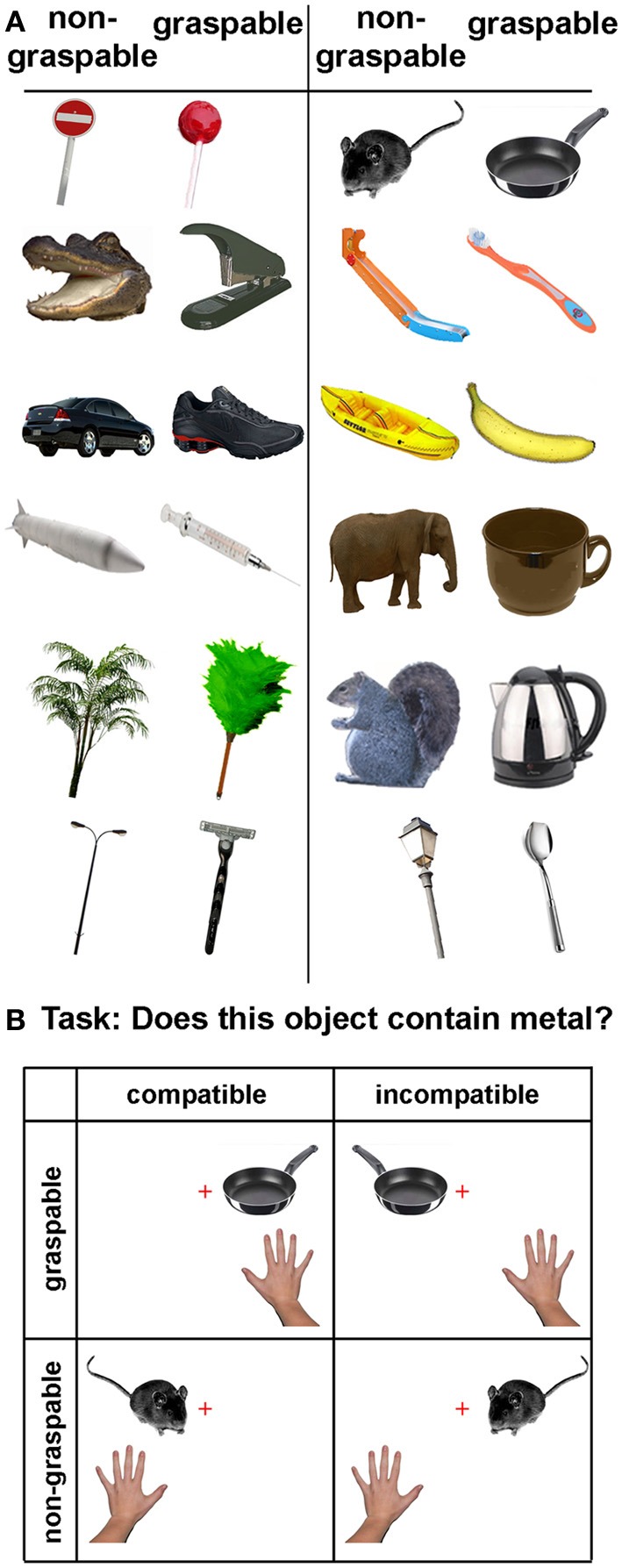
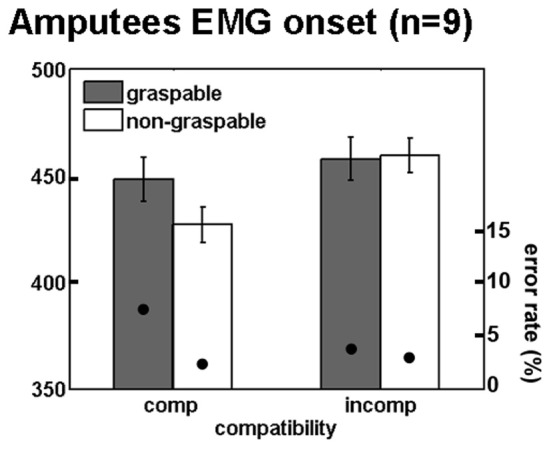
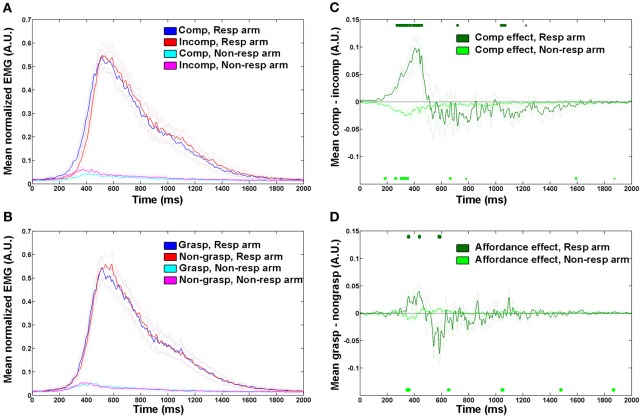
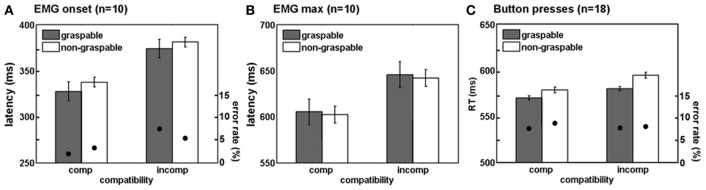
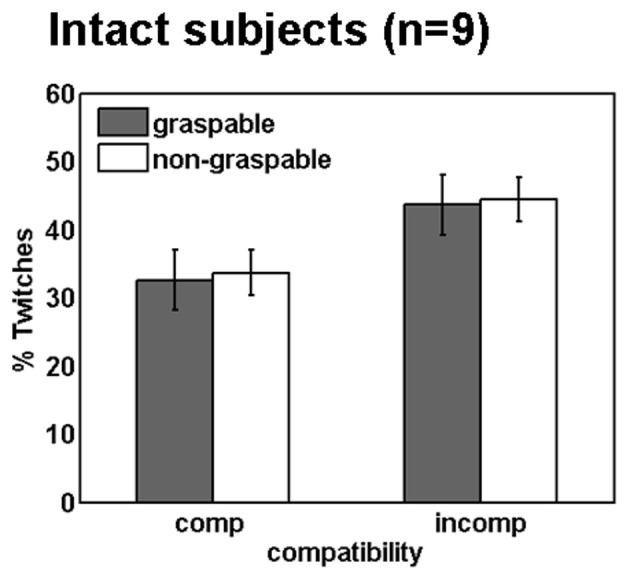
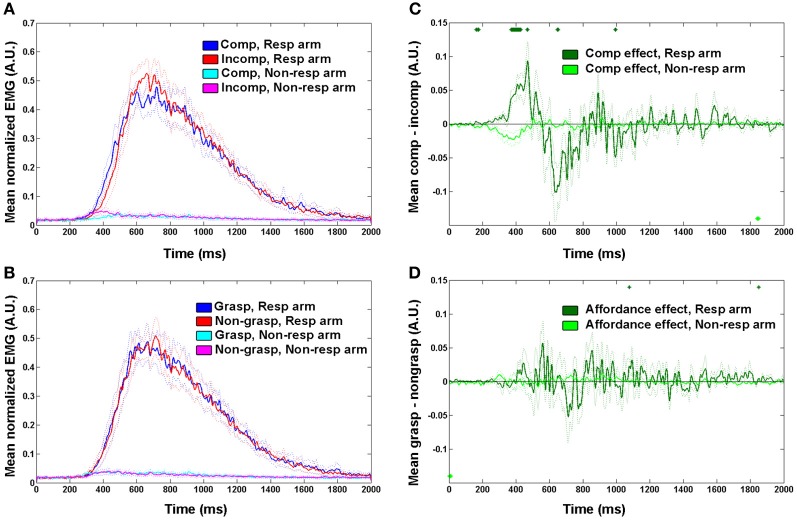
objects may be perceived not only in terms of visual features, but also in terms of possibilities for action. Previous studies showed that when a centrally located object has a salient graspable feature (e.g., a handle), it facilitates motor responses corresponding with the feature's position. However, such so-called affordance effects have been criticized as resulting from spatial compatibility effects, due to the visual asymmetry created by the graspable feature, irrespective of any affordances. In order to dissociate between affordance and spatial compatibility effects, we asked participants to perform a simple reaction-time task to typically graspable and non-graspable objects with similar visual features (e.g., lollipop and stop sign). Responses were measured using either electromyography (EMG) on proximal arm muscles during reaching-like movements, or with finger key-presses. In both EMG and button press measurements, participants responded faster when the object was either presented in the same location as the responding hand, or was affordable, resulting in significant and independent spatial compatibility and affordance effects, but no interaction. Furthermore, while the spatial compatibility effect was present from the earliest stages of movement preparation and throughout the different stages of movement execution, the affordance effect was restricted to the early stages of movement execution. Finally, we tested a small group of unilateral arm amputees using EMG, and found residual spatial compatibility but no affordance, suggesting that spatial compatibility effects do not necessarily rely on individuals' available affordances. Our results show dissociation between affordance and spatial compatibility effects, and suggest that rather than evoking the specific motor action most suitable for interaction with the viewed object, graspable objects prompt the motor system in a general, body-part independent fashion.
物体不仅可以根据视觉特征来感知,还可以根据行动的可能性来感知。先前的研究表明,当位于中心的物体具有明显可抓握的特征(例如手柄)时,它会促进与特征位置相对应的运动反应。然而,这种所谓的可供性效应已被批评为源于空间兼容性效应,因为可抓握特征造成了视觉上的不对称性,而不管是否存在可供性。为了将可供性和空间兼容性效应分开,我们要求参与者执行一个简单的反应时任务,对具有相似视觉特征的典型可抓握和不可抓握的物体(例如棒棒糖和停车标志)进行反应。反应通过在类似于伸手的运动中对近端手臂肌肉进行肌电图(EMG)或用手指按键来测量。在 EMG 和按钮按下测量中,当物体与反应手处于相同位置或可抓握时,参与者的反应速度更快,从而产生了显著且独立的空间兼容性和可供性效应,但没有交互作用。此外,虽然空间兼容性效应存在于运动准备的最早阶段,并贯穿于运动执行的不同阶段,但可供性效应仅限于运动执行的早期阶段。最后,我们使用 EMG 测试了一小群单侧手臂截肢者,发现存在残余的空间兼容性但没有可供性,这表明空间兼容性效应不一定依赖于个体的可用可供性。我们的结果表明可供性和空间兼容性效应的分离,并表明可抓握的物体不是唤起与所观察物体最适合交互的特定运动动作,而是以一种通用的、与身体部位无关的方式提示运动系统。