ten Siethoff Lasse, Lard Mercy, Generosi Johanna, Andersson Håkan S, Linke Heiner, Månsson Alf
Department of Chemistry and Biomedical Sciences, Linnaeus University , SE-391 82 Kalmar, Sweden.
Nano Lett. 2014 Feb 12;14(2):737-42. doi: 10.1021/nl404032k. Epub 2014 Jan 2.
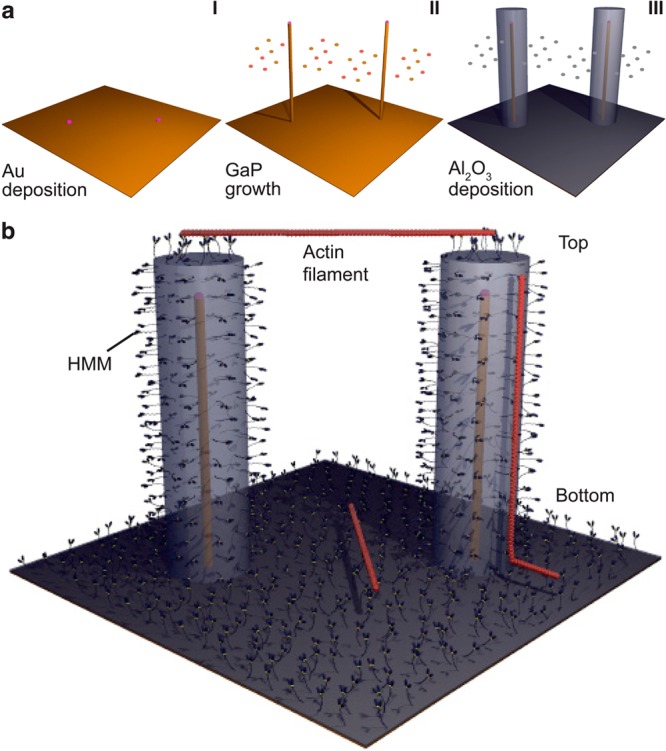
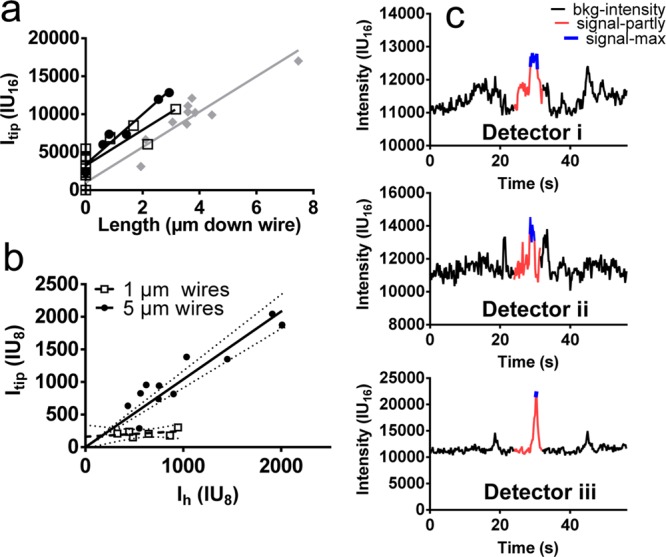
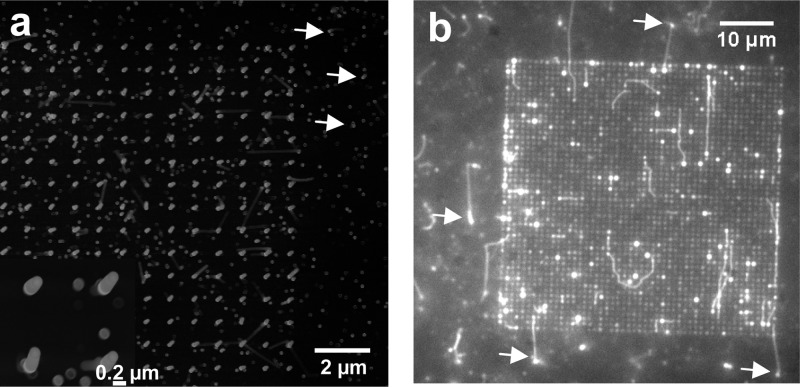
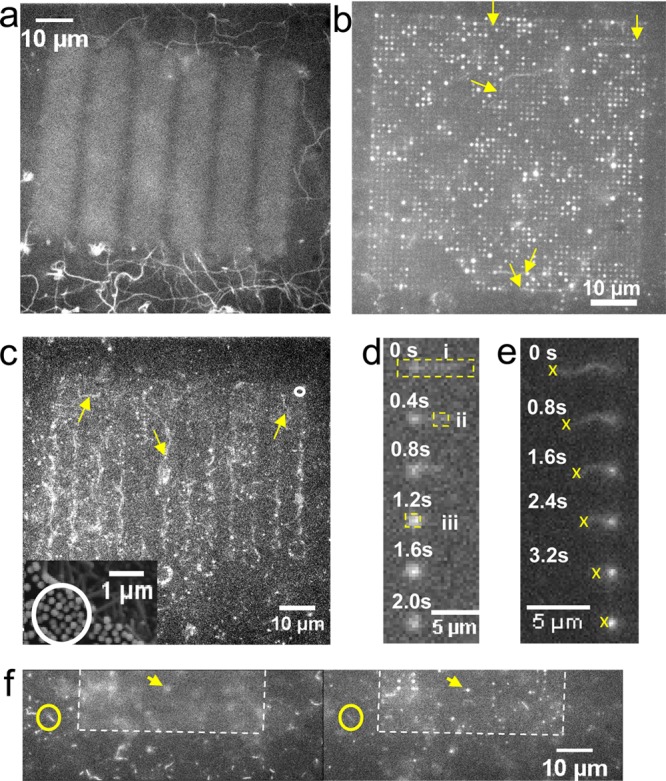
Semiconductor nanowire arrays offer significant potential for biosensing applications with optical read-out due to their high surface area and due to the unique optical properties of one-dimensional materials. A challenge for optical read-out of analyte-binding to the nanowires is the need to efficiently collect and detect light from a three-dimensional volume. Here we show that light from fluorophores attached along several μm long vertical Al2O3 coated gallium phosphide nanowires couples into the wires, is guided along them and emitted at the tip. This enables effective collection of light emitted by fluorescent analytes located at different focal planes along the nanowire. We unequivocally demonstrate the light-guiding effect using a novel method whereby the changes in emitted fluorescence intensity are observed when fluorescent cytoskeletal filaments are propelled by molecular motors along the wires. The findings are discussed in relation to nanobiosensor developments, other nanotechnological applications, and fundamental studies of motor function.
半导体纳米线阵列因其高表面积以及一维材料独特的光学特性,在具有光学读出功能的生物传感应用中展现出巨大潜力。对于纳米线与分析物结合的光学读出而言,一项挑战在于需要有效地收集和检测来自三维空间的光。在此,我们展示了附着在数微米长的垂直氧化铝包覆磷化镓纳米线上的荧光团发出的光耦合进入纳米线,沿着纳米线传播并在尖端发射。这使得能够有效收集沿纳米线位于不同焦平面的荧光分析物发出的光。我们使用一种新颖的方法明确地证明了光导效应,即当荧光细胞骨架细丝由分子马达沿着纳米线推动时,观察发射荧光强度的变化。结合纳米生物传感器的发展、其他纳米技术应用以及马达功能的基础研究对这些发现进行了讨论。