Brödel Andreas K, Sonnabend Andrei, Roberts Lisa O, Stech Marlitt, Wüstenhagen Doreen A, Kubick Stefan
Fraunhofer Institute for Biomedical Engineering (IBMT) Branch Potsdam-Golm, Potsdam, Germany.
Faculty of Health and Medical Sciences, University of Surrey, Guildford, United Kingdom.
PLoS One. 2013 Dec 20;8(12):e82234. doi: 10.1371/journal.pone.0082234. eCollection 2013.
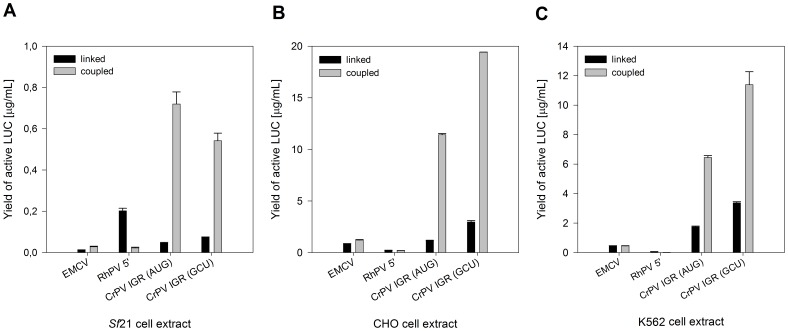
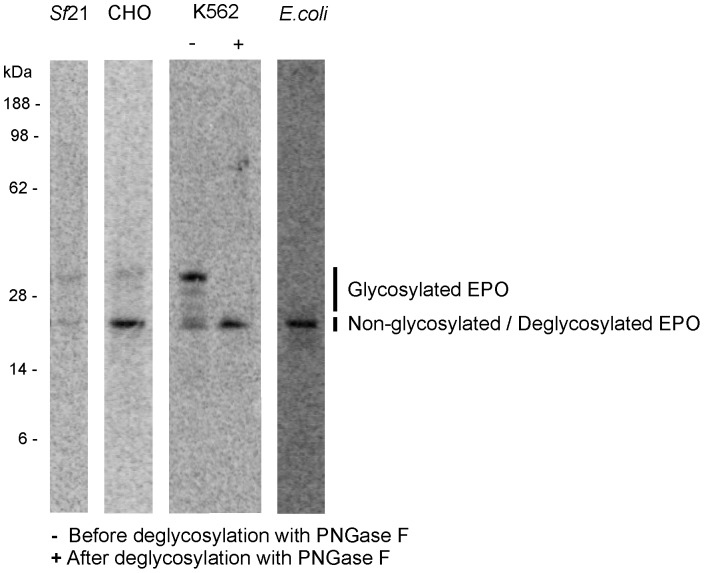
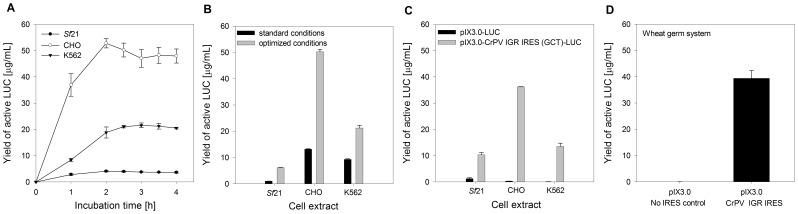
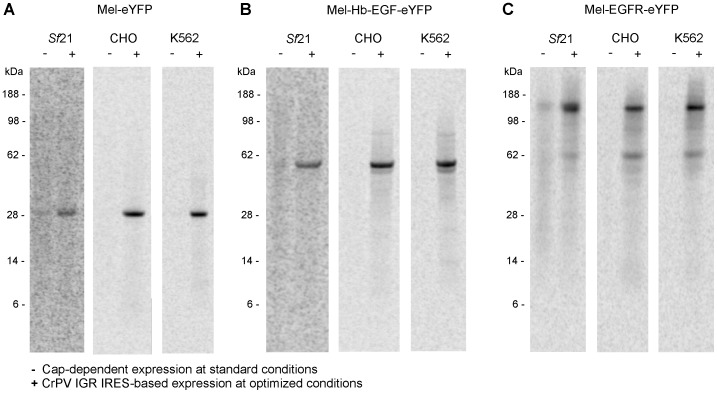
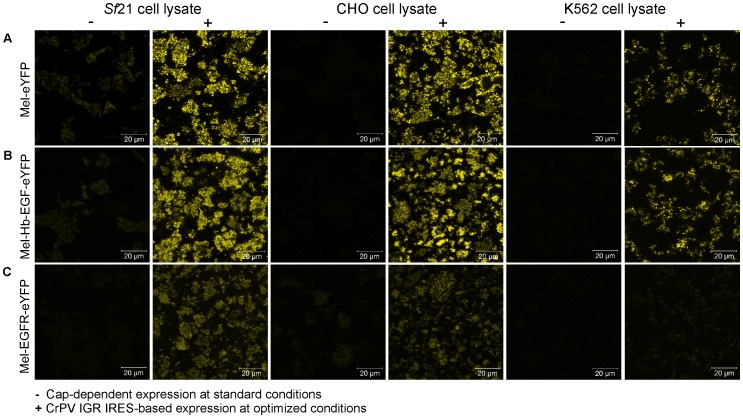
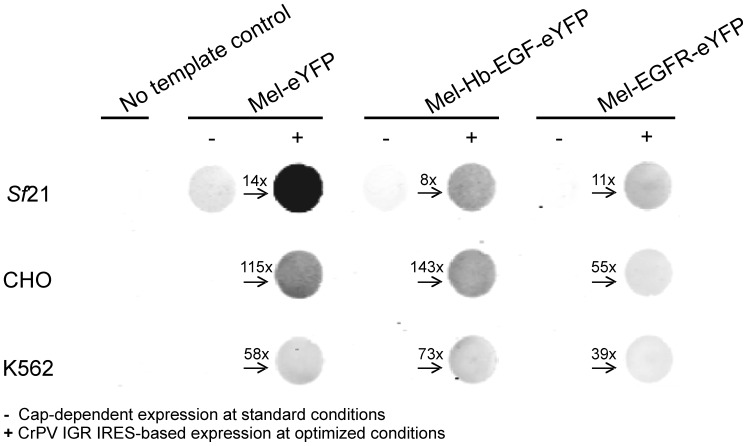
Internal ribosome entry site (IRES) elements found in the 5' untranslated region of mRNAs enable translation initiation in a cap-independent manner, thereby representing an alternative to cap-dependent translation in cell-free protein expression systems. However, IRES function is largely species-dependent so their utility in cell-free systems from different species is rather limited. A promising approach to overcome these limitations would be the use of IRESs that are able to recruit components of the translation initiation apparatus from diverse origins. Here, we present a solution to this technical problem and describe the ability of a number of viral IRESs to direct efficient protein expression in different eukaryotic cell-free expression systems. The IRES from the intergenic region (IGR) of the Cricket paralysis virus (CrPV) genome was shown to function efficiently in four different cell-free systems based on lysates derived from cultured Sf21, CHO and K562 cells as well as wheat germ. Our results suggest that the CrPV IGR IRES-based expression vector is universally applicable for a broad range of eukaryotic cell lysates. Sf21, CHO and K562 cell-free expression systems are particularly promising platforms for the production of glycoproteins and membrane proteins since they contain endogenous microsomes that facilitate the incorporation of membrane-spanning proteins and the formation of post-translational modifications. We demonstrate the use of the CrPV IGR IRES-based expression vector for the enhanced synthesis of various target proteins including the glycoprotein erythropoietin and the membrane proteins heparin-binding EGF-like growth factor receptor as well as epidermal growth factor receptor in the above mentioned eukaryotic cell-free systems. CrPV IGR IRES-mediated translation will facilitate the development of novel eukaryotic cell-free expression platforms as well as the high-yield synthesis of desired proteins in already established systems.
在mRNA的5'非翻译区发现的内部核糖体进入位点(IRES)元件能够以不依赖帽子结构的方式起始翻译,因此在无细胞蛋白质表达系统中是依赖帽子结构翻译的一种替代方式。然而,IRES功能在很大程度上依赖物种,所以它们在来自不同物种的无细胞系统中的效用相当有限。克服这些限制的一个有前景的方法是使用能够从不同来源募集翻译起始装置组分的IRES。在这里,我们提出了这个技术问题的解决方案,并描述了一些病毒IRES在不同真核无细胞表达系统中指导高效蛋白质表达的能力。蟋蟀麻痹病毒(CrPV)基因组基因间区域(IGR)的IRES在基于培养的Sf21、CHO和K562细胞以及小麦胚芽提取物的四种不同无细胞系统中显示出高效功能。我们的结果表明,基于CrPV IGR IRES的表达载体普遍适用于广泛的真核细胞裂解物。Sf21、CHO和K562无细胞表达系统是生产糖蛋白和膜蛋白特别有前景的平台,因为它们含有内源性微粒体,有助于跨膜蛋白的整合和翻译后修饰的形成。我们展示了基于CrPV IGR IRES的表达载体在上述真核无细胞系统中用于增强合成各种靶蛋白,包括糖蛋白促红细胞生成素、膜蛋白肝素结合表皮生长因子样生长因子受体以及表皮生长因子受体。CrPV IGR IRES介导的翻译将促进新型真核无细胞表达平台的开发以及在已建立系统中高产合成所需蛋白质。