Department of Social Medicine and Health Education, School of Public Health, Peking University, Beijing, China.
VIP Medical Service Department, Peking Union Medical College Hospital, Beijing, China.
PLoS One. 2013 Dec 20;8(12):e83262. doi: 10.1371/journal.pone.0083262. eCollection 2013.
The two-gram salt-restriction-spoons, which can be used to reduce the salt intake of people, had been handed out for free by the Chinese government to the citizens several years ago, but only a small fraction of residents use such a spoon currently. Since no studies have been conducted to investigate relevant influencing factors, this study was designed to explore the determinants of salt-restriction-spoon using behavior (SRB) in China.
This cross-sectional study was conducted in Beijing, China. Altogether 269 rural residents and 244 urban residents aged over 18 were selected by convenience sampling method in 2012. Variables measured in a questionnaire designed according to the Health Belief Model (HBM) included socio-demographics, perceived susceptibility, perceived severity, perceived benefits, perceived objective barriers, perceived subjective barriers, self-efficacy, knowledge of hypertension, cues to action, and SRB. Answers to the questionnaire were obtained from all the participants, and 24-hour urine samples were collected to determine the 24-hour urinary sodium excretion (24HUNa). Path analyses were used to explore the determinants of SRB.
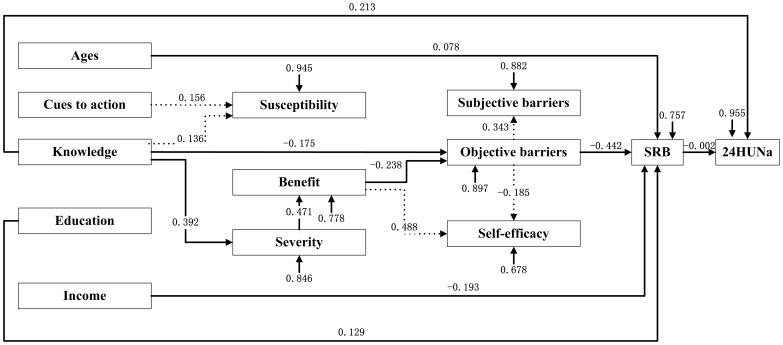
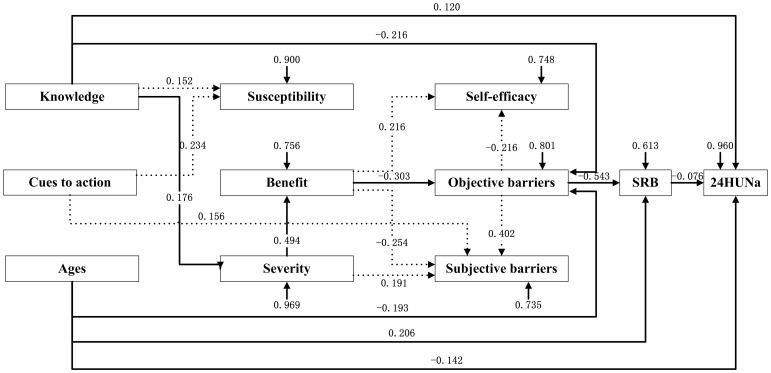
Approximately 22.7% and 45.3% of residents used a salt-restriction-spoon everyday in the rural and urban areas, respectively. The average 24HUNa was 211.19±98.39 mmol for rural residents and 109.22±58.18 mmol for urban residents. Path analyses shown that perceived objective barriers, perceived benefits, perceived severity, knowledge and age were related to SRB and 24HUNa for both rural and urban participants, among which perceived objective barrier (β = - 0.442 and β = - 0.543, respectively) was the most important determinant.
Improvement of the current salt-restriction-spoon and education on the right usage of the salt-restriction-spoon, the severity of hypertension, and the benefit of salt reduction are necessary, especially among those who are relatively young but at risk of hypertension, those who have lower education levels, and those who live in the rural areas.
几年前,中国政府曾免费向市民发放二克盐勺,以减少人们的盐摄入量,但目前只有一小部分居民使用这种勺子。由于没有研究调查相关的影响因素,因此本研究旨在探讨中国居民控盐勺使用行为(SRB)的决定因素。
本横断面研究于 2012 年在北京进行,采用便利抽样方法选择了 269 名农村居民和 244 名城市居民。根据健康信念模型(HBM)设计的问卷中测量了变量,包括社会人口统计学、感知易感性、感知严重性、感知益处、感知客观障碍、感知主观障碍、自我效能、高血压知识、提示因素和 SRB。所有参与者都回答了问卷,并采集 24 小时尿液样本以确定 24 小时尿钠排泄量(24HUNa)。路径分析用于探讨 SRB 的决定因素。
农村和城市居民每天使用控盐勺的比例分别约为 22.7%和 45.3%。农村居民的平均 24HUNa 为 211.19±98.39mmol,城市居民为 109.22±58.18mmol。路径分析显示,感知客观障碍、感知益处、感知严重性、知识和年龄与农村和城市参与者的 SRB 和 24HUNa 相关,其中感知客观障碍(β= - 0.442 和β= - 0.543)是最重要的决定因素。
需要改进当前的控盐勺,并对控盐勺的正确使用方法、高血压的严重程度以及减少盐摄入量的益处进行教育,特别是针对那些相对年轻但有高血压风险、教育程度较低以及居住在农村地区的人群。