Rajati Fatemeh, Mostafavi Firoozeh, Sharifirad Gholamreza, Sadeghi Masoomeh, Tavakol Kamran, Feizi Awat, Pashaei Tahereh
Department of Public Health, Faculty of Health, Kermanshah University of Medical Sciences, Kermanshah, Iran.
Department of Health Education and Promotion, School of Public Health, Isfahan University of Medical Sciences, Isfahan, Iran.
J Res Med Sci. 2013 Aug;18(8):659-67.
Regular exercise has been associated with improved quality of life (QoL) in patients with heart failure (HF). However, less is known on the theoretical framework, depicting how educational intervention on psychological, social, and cognitive variables affects physical activity (PA). The purpose of this study is to assess the effectiveness of a social cognitive theory-based (SCT-based) exercise intervention in patients with HF.
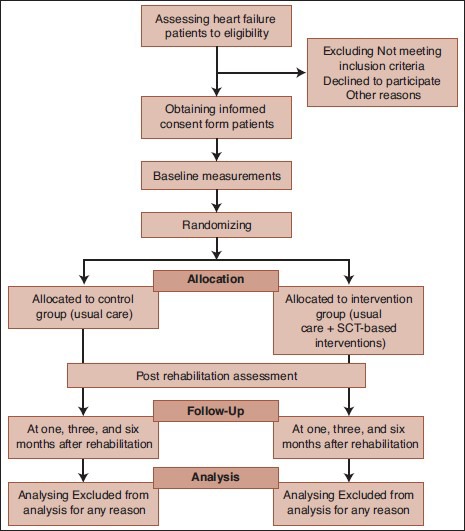
This is a randomized controlled trial, with measurements at baseline, immediately following the intervention, and at 1, 3, and 6 months follow-up. Sixty patients who are referred to the cardiac rehabilitation (CR) unit and meet the inclusion criteria will be randomly allocated to either an intervention group or a usual-care control group. Data will be collected using various methods (i.e., questionnaires, physical tests, paraclinical tests, patients' interviews, and focus groups). The patients in the intervention group will receive eight face-to-face counseling sessions, two focus groups, and six educational sessions over a 2-month period. The intervention will include watching videos, using book and pamphlets, and sending short massage services to the participants. The primary outcome measures are PA and QoL. The secondary outcome measures will be the components of SCT, heart rate and blood pressure at rest, body mass index, left ventricular ejection fraction, exercise capacity, and maximum heart rate.
The findings of this trial may assist with the development of a theoretical model for exercise intervention in CR. The intervention seems to be promising and has the potential to bridge the gap of the usually limited and incoherent provision of educational care in the CR setting.
规律运动与心力衰竭(HF)患者生活质量(QoL)的改善相关。然而,关于描述心理、社会和认知变量的教育干预如何影响身体活动(PA)的理论框架,我们所知甚少。本研究的目的是评估基于社会认知理论(SCT)的运动干预对HF患者的有效性。
这是一项随机对照试验,在基线、干预后立即以及随访1、3和6个月时进行测量。60名被转诊至心脏康复(CR)单元且符合纳入标准的患者将被随机分配至干预组或常规护理对照组。将使用多种方法(即问卷调查、体格检查、辅助检查、患者访谈和焦点小组)收集数据。干预组患者将在2个月内接受8次面对面咨询、2次焦点小组讨论和6次教育课程。干预将包括观看视频、使用书籍和宣传册以及向参与者发送短信息服务。主要结局指标为PA和QoL。次要结局指标将包括SCT的组成部分、静息心率和血压、体重指数、左心室射血分数、运动能力和最大心率。
本试验的结果可能有助于开发CR中运动干预的理论模型。该干预似乎很有前景,并有可能弥补CR环境中通常有限且不连贯的教育护理提供方面的差距。