Mazloomy-Mahmoodabad Seyed Saeed, Navabi Zohreh Sadat, Ahmadi Alireza, Askarishahi Mohsen
Professor, Department of Health Education and Promotion, Social Determinants of Health Research Center, School of Public Health, Shahid Sadoughi University of Medical Sciences, Yazd, Iran.
MSc Student, Department of Health Education and Promotion, Social Determinants of Health Research Center, School of Public Health, Shahid Sadoughi University of Medical Sciences, Yazd, Iran.
ARYA Atheroscler. 2017 Jul;13(4):176-183.
The increased prevalence of overweight and obesity in children and adolescents is associated with type 2 diabetes, hypertension, dyslipidemia, and cardiovascular diseases. The theory of planned behavior (TPB) efficiently explains the ability of perceived behavioral control and possibly attitude to enhance the motivations of the obese people to lose weight. Our aim was to investigate the effect of TPB-based education on weight loss in obese and overweight adolescents.
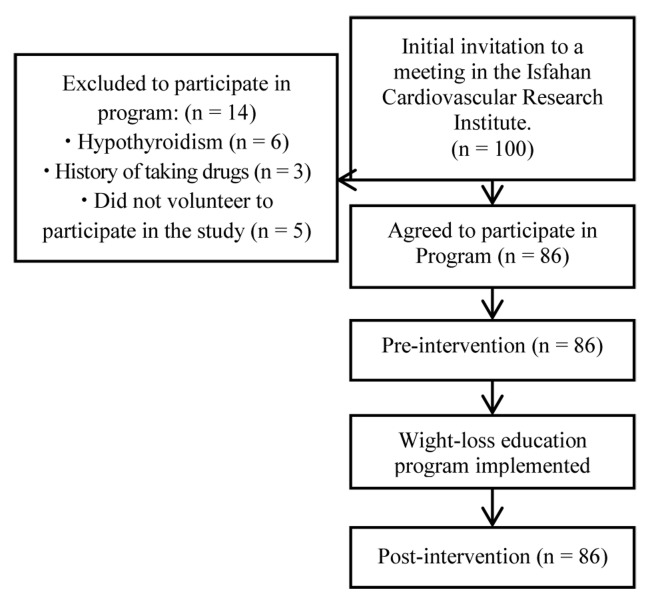
In an interventional study, simple random sampling was used to select 86 overweight and obese adolescents aged 13-18 years in the pediatric clinic at the Isfahan Cardiovascular Research Institute. Anthropometric measures and TPB constructs were collected using a researcher-made questionnaire. The questionnaires were filled out before and six weeks after the intervention. Participants received 5 sessions of training based on the constructs of the TPB.
A significant increase was observed in the mean score for knowledge and TPB constructs (attitudes, subjective norms, perceived behavioral control, intention, and behavior) six weeks after the educational intervention (P < 0.001). Moreover, significant decrease in body mass index (P < 0.001), weight (P = 0.001), and waist circumference (P < 0.001) of adolescents were found after the educational intervention.
The TPB-based interventions seem to be effective in losing weight in obese and overweight adolescents. This theory serves as a helpful theoretical framework for health-related behaviors and can be an appropriate pattern to plan for educational interventions.
儿童和青少年超重及肥胖患病率的增加与2型糖尿病、高血压、血脂异常和心血管疾病相关。计划行为理论(TPB)有效地解释了感知行为控制以及可能的态度增强肥胖人群减肥动机的能力。我们的目的是研究基于TPB的教育对肥胖和超重青少年体重减轻的影响。
在一项干预性研究中,采用简单随机抽样法从伊斯法罕心血管研究所儿科门诊选取86名13 - 18岁的超重和肥胖青少年。使用研究者自制的问卷收集人体测量指标和TPB相关指标。问卷在干预前和干预六周后填写。参与者接受了基于TPB相关指标的5次培训课程。
教育干预六周后,知识和TPB相关指标(态度、主观规范、感知行为控制、意图和行为)的平均得分显著提高(P < 0.001)。此外,教育干预后青少年的体重指数(P < 0.001)、体重(P = 0.001)和腰围(P < 0.001)显著下降。
基于TPB的干预措施似乎对肥胖和超重青少年的体重减轻有效。该理论为与健康相关的行为提供了一个有用的理论框架,并且可以作为规划教育干预措施的合适模式。