Department of Basic Sciences, Isfahan Payam -e -Noor University, Isfahan, Iran.
Department of Basic Sciences, Islamic Azad University, Khorasgan Branch, Isfahan, Iran.
Iran J Basic Med Sci. 2013 Oct;16(10):1091-9.
OBJECTIVE(S): Drug addiction is one of the fastest growing social problems that researchers, for many years, have been trying to find proper strategies for its prevention and treatment. Short-term physical activity is considered as acceptable for the treatment and prevention of addiction. On the other hand, prefrontal cortex is known to be responsible for many of the complex behavioral responses, especially those relevant to addiction and drug abuse. In this study, the effects of short-term physical activity (treadmill running) on withdrawal symptoms in rats, with or without medial Prefrontal Cortex (mPFC) area was evaluated.
In this experimental study, male Wistar rats, weighing 250-300 g. Were selected and divided into four groups: control, sham, test1 and test 2 groups, with one group having a surgery (test 2). In order to study the effects of short-term physical activity, we employed a treadmill with the adjustable speed of 17 m/min, and a 15% incline. Following the injection of three different doses of morphine (10, 20 and 40 mg/Kg) for 9 days, treadmill running was completed on the tenth day and then the symptoms of addiction were evaluated.
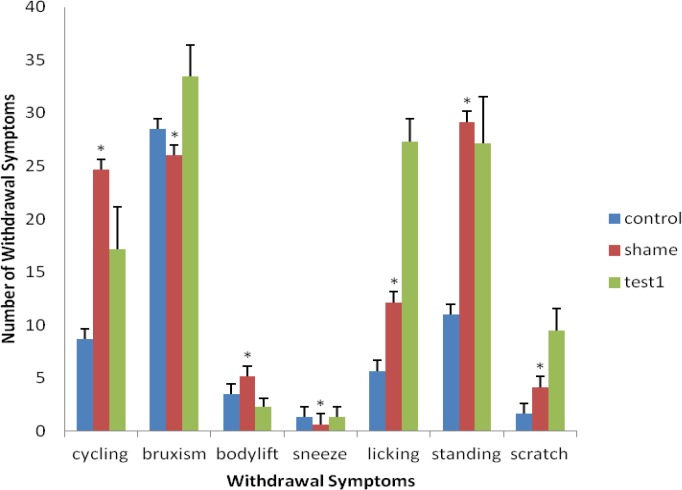
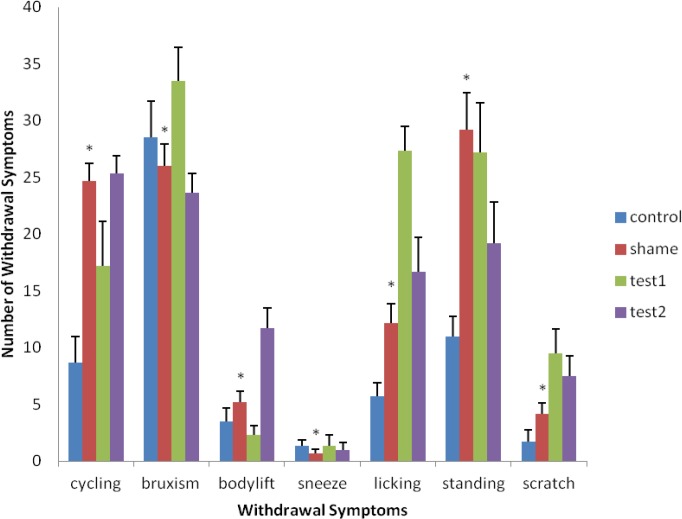
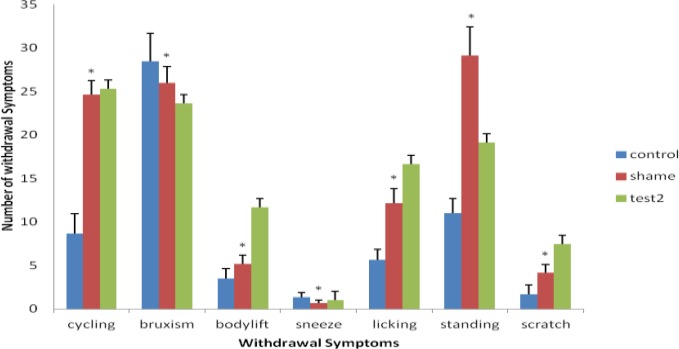
Administration of morphine as aforementioned, and treadmill running on rats with mPFC area, significantly alleviated some of the symptoms and signs, such as, bruxism, cycling, body lift, licking, standing and scratching (P<0.05). Therefore, there are noticeable differences in these symptoms between the exercise and morphine groups (P<0.05). Conclusion : We propose that when using morphine mPFC plays an important role in the reduction of reward symptoms. Running lessens the effects of morphine. Moreover, short-term physical activity might decrease the tendency to use morphine in those with mPFC area, compared to other groups, especially with the one undergoing an mPFC operation.
药物成瘾是近年来研究人员一直在努力寻找预防和治疗方法的最快增长的社会问题之一。短期的身体活动被认为是可接受的治疗和预防成瘾的方法。另一方面,前额叶皮层被认为负责许多复杂的行为反应,特别是与成瘾和药物滥用有关的反应。在这项研究中,评估了短期身体活动(跑步机跑步)对有或没有内侧前额叶皮层(mPFC)区域的大鼠戒断症状的影响。
在这项实验研究中,选择了体重为 250-300 克的雄性 Wistar 大鼠,并将其分为四组:对照组、假手术组、测试 1 组和测试 2 组,其中一组进行了手术(测试 2 组)。为了研究短期身体活动的影响,我们使用了可调速度为 17 m/min 和 15%坡度的跑步机。在连续 9 天注射三种不同剂量的吗啡(10、20 和 40 mg/Kg)后,在第 10 天进行跑步机跑步,然后评估成瘾症状。
如上所述,对 mPFC 区域的大鼠进行吗啡注射和跑步机跑步,显著缓解了磨牙、循环、身体抬起、舔舐、站立和搔抓等一些症状和体征(P<0.05)。因此,在这些症状之间,运动和吗啡组之间存在明显差异(P<0.05)。
我们提出,在使用吗啡时,mPFC 在后奖赏症状的减轻中发挥重要作用。跑步减轻了吗啡的作用。此外,与其他组相比,尤其是与接受 mPFC 手术的组相比,短期身体活动可能会降低 mPFC 区域大鼠使用吗啡的倾向。