Helen Keller International, PO Box 352, Freetown, Sierra Leone.
Parasit Vectors. 2014 Jan 9;7:14. doi: 10.1186/1756-3305-7-14.
Schistosoma mansoni was moderately-highly endemic in the northeast of Sierra Leone. The national neglected tropical disease control program started mass drug administration (MDA) with praziquantel (PZQ) in six districts in 2009 targeting primary school children only. The effort was scaled-up to seven districts in 2010 targeting school aged children (SAC) and at-risk adults. A cross-sectional sentinel site survey was conducted in 2012 after three rounds of MDA to evaluate the impact of the national program.
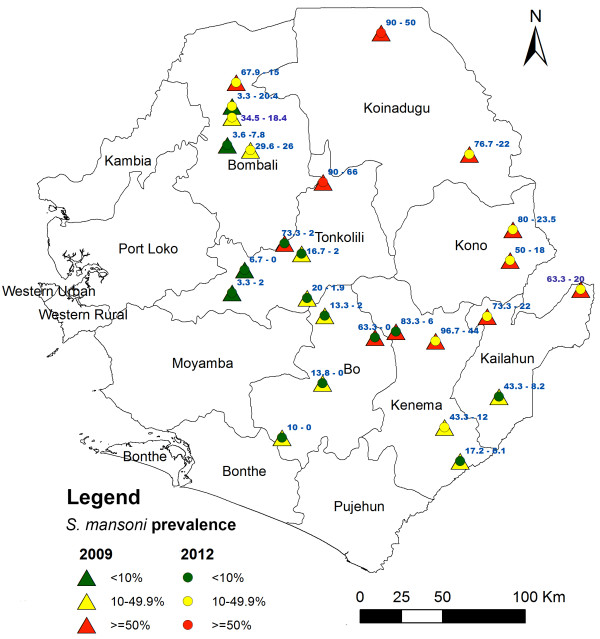
Twenty-six (26) sentinel sites were randomly selected from the baseline mapping survey sites stratified according to the baseline prevalence into high, moderate or low endemic category. Fifty (50) school children (25 males and 25 females) were randomly selected per site. Fresh stool samples were examined in the field using the Kato Katz technique. The results were compared with the baseline data.
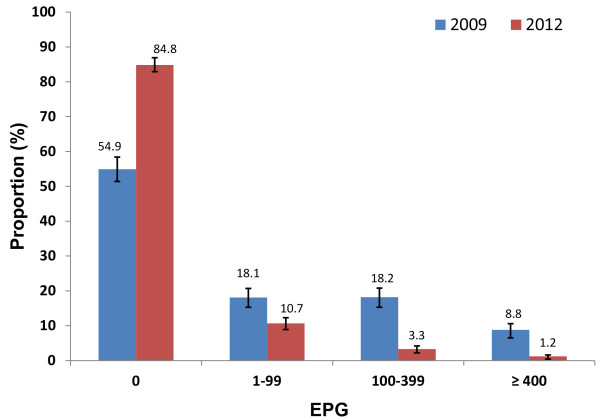
Program coverage of 94.8%, 77.1% and 81.7% was reported in 2009, 2010 and 2011 respectively. Independent monitoring in 2011 showed program coverage of 83.9%, not significantly different from the reported result in the same year. The overall prevalence of S. mansoni was 16.3% (95% CI: 14.4-18.4%) and mean intensity was 18.98 epg (95% CI: 11.46-26.50 epg) in 2012, representing 67.2% and 85.9% reduction from the baseline respectively. The proportion of moderately and heavily infected children was 3.3% and 1.2%, a significant reduction from 18.2% and 8.8% at baseline respectively.
Sierra Leone has maintained effective MDA coverage with PZQ since 2009. Three rounds of MDA led to a significant reduction of S. mansoni infection in the country. In line with the significant progress made in controlling schistosomiasis, the national treatment strategy has been reviewed and MDA will be expanded to include school age children in low endemicity districts with the new national objective for the elimination of schistosomiasis. Sierra Leone is well on its way to eliminate schistosomiasis as a public health problem.
曼氏血吸虫在塞拉利昂东北部呈中度至高度流行。2009 年,国家被忽视的热带病控制规划开始在六个区用吡喹酮(PZQ)开展大规模药物治疗(MDA),目标人群仅为小学生。2010 年,该工作扩大到七个区,目标人群为学龄儿童(SAC)和高危成年人。在经过三轮 MDA 后,于 2012 年开展了一项横断面哨点监测调查,以评估国家规划的影响。
从基线绘图调查的哨点中随机选择 26 个哨点,根据基线流行率将其分层为高、中或低流行类别。每个哨点随机选择 50 名学龄儿童(25 名男性和 25 名女性)。现场使用加藤厚涂片法检查新鲜粪便样本。将结果与基线数据进行比较。
2009 年、2010 年和 2011 年报告的方案覆盖率分别为 94.8%、77.1%和 81.7%。2011 年独立监测显示,方案覆盖率为 83.9%,与同年报告结果无显著差异。2012 年曼氏血吸虫的总流行率为 16.3%(95%CI:14.4-18.4%),平均感染强度为 18.98 epg(95%CI:11.46-26.50 epg),分别比基线下降了 67.2%和 85.9%。中度和重度感染儿童的比例分别为 3.3%和 1.2%,与基线时的 18.2%和 8.8%相比,显著下降。
自 2009 年以来,塞拉利昂一直用 PZQ 维持有效的 MDA 覆盖率。三轮 MDA 导致该国曼氏血吸虫感染显著减少。随着在控制血吸虫病方面取得的显著进展,国家治疗战略已进行了审查,MDA 将扩大到低流行区的学龄儿童,国家消除血吸虫病的新目标也将包括这些地区。塞拉利昂即将消除血吸虫病这一公共卫生问题。