Minghelli Beatriz, Nunes Carla, Oliveira Raul
School of Health Jean Piaget Algarve, Piaget Institute, Portugal.
National School of Public Health - NOVA University of Lisbon, Portugal.
N Am J Med Sci. 2013 Nov;5(11):653-9. doi: 10.4103/1947-2714.122309.
The recommended anthropometric methods to assess the weight status include body mass index (BMI), skinfold thickness, and waist circumference. However, these methods have advantages and disadvantages regarding the classification of overweight and obesity in adolescents.
The study was to analyze the correlation between the measurements of BMI, skinfold thickness and waist circumference to assess overweight and obesity in Portuguese adolescents.
A sample of 966 students of Portugal was used. Of them, 437 (45.2%) were males and 529 (54.8%) were females aged between 10 and 16 years. The evaluations included BMI calculation, skinfold thickness, and waist circumference measurements.
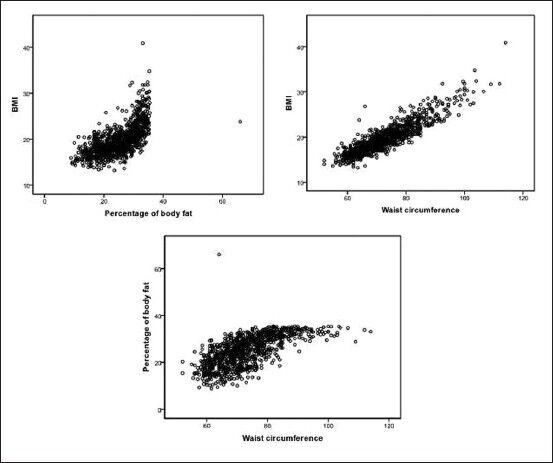
This study revealed a high prevalence of overweight and obesity with values ranging from 31.6%, 61.4%, and 41.1% according to the measurement of BMI, skinfold thickness, and waist circumference, respectively. The results found a high level of correlation between BMI and skinfold thickness (P < 0.001, r = 0.712), between BMI and waist circumference (P < 0.001, r = 0.884), and waist circumference and skinfold thickness (P < 0.001, r = 0.701).
This study revealed a high prevalence of overweight and obesity in Portuguese adolescents using three different anthropometric methods, where the BMI showed the lowest values of prevalence of overweight and obesity and the skinfold thickness showed the highest values. The three anthropometric methods were highly correlated.
推荐用于评估体重状况的人体测量方法包括体重指数(BMI)、皮褶厚度和腰围。然而,这些方法在青少年超重和肥胖的分类方面各有优缺点。
本研究旨在分析BMI、皮褶厚度和腰围测量值之间的相关性,以评估葡萄牙青少年的超重和肥胖情况。
采用了966名葡萄牙学生的样本。其中,437名(45.2%)为男性,529名(54.8%)为女性,年龄在10至16岁之间。评估内容包括BMI计算、皮褶厚度和腰围测量。
本研究显示超重和肥胖的患病率较高,根据BMI、皮褶厚度和腰围测量,患病率分别为31.6%、61.4%和41.1%。结果发现BMI与皮褶厚度之间存在高度相关性(P < 0.001,r = 0.712),BMI与腰围之间存在高度相关性(P < 0.001,r = 0.884),腰围与皮褶厚度之间也存在高度相关性(P < 0.001,r = 0.701)。
本研究使用三种不同的人体测量方法显示葡萄牙青少年超重和肥胖的患病率较高,其中BMI显示的超重和肥胖患病率最低,皮褶厚度显示的患病率最高。这三种人体测量方法高度相关。