Statistics Department, University of California-Berkeley, Berkeley, California, United States of America ; Integrative Biology Department, University of California-Berkeley, Berkeley, California, United States of America.
Integrative Biology Department, University of California-Berkeley, Berkeley, California, United States of America ; Department of Ecology and Evolutionary Biology, University of California, Los Angeles, Los Angeles, California, United States of America ; Interdepartmental Program in Bioinformatics, University of California, Los Angeles, Los Angeles, California, United States of America.
PLoS Genet. 2014 Jan;10(1):e1004064. doi: 10.1371/journal.pgen.1004064. Epub 2014 Jan 9.
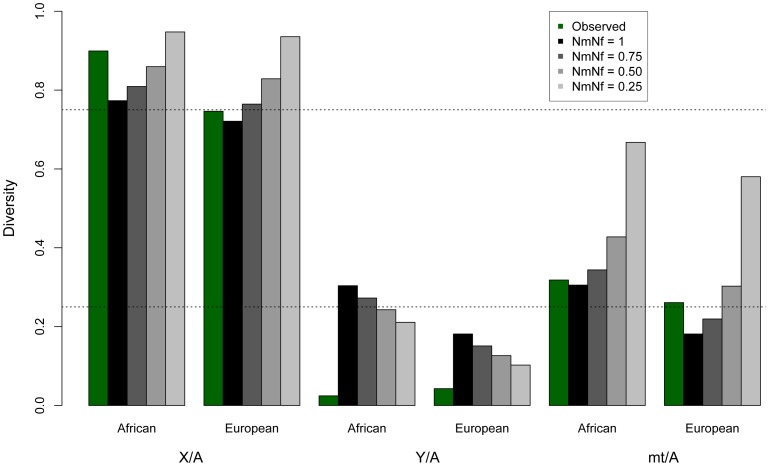
The human Y chromosome exhibits surprisingly low levels of genetic diversity. This could result from neutral processes if the effective population size of males is reduced relative to females due to a higher variance in the number of offspring from males than from females. Alternatively, selection acting on new mutations, and affecting linked neutral sites, could reduce variability on the Y chromosome. Here, using genome-wide analyses of X, Y, autosomal and mitochondrial DNA, in combination with extensive population genetic simulations, we show that low observed Y chromosome variability is not consistent with a purely neutral model. Instead, we show that models of purifying selection are consistent with observed Y diversity. Further, the number of sites estimated to be under purifying selection greatly exceeds the number of Y-linked coding sites, suggesting the importance of the highly repetitive ampliconic regions. While we show that purifying selection removing deleterious mutations can explain the low diversity on the Y chromosome, we cannot exclude the possibility that positive selection acting on beneficial mutations could have also reduced diversity in linked neutral regions, and may have contributed to lowering human Y chromosome diversity. Because the functional significance of the ampliconic regions is poorly understood, our findings should motivate future research in this area.
人类的 Y 染色体显示出令人惊讶的低遗传多样性。如果由于男性后代数量的方差高于女性,男性的有效种群大小相对于女性减少,那么这种情况可能是由中性过程导致的。或者,对新突变起作用并影响连锁中性位点的选择,可能会降低 Y 染色体上的可变性。在这里,我们使用 X、Y、常染色体和线粒体 DNA 的全基因组分析,结合广泛的群体遗传模拟,表明观察到的低 Y 染色体变异性与纯粹的中性模型不一致。相反,我们表明,净化选择模型与观察到的 Y 多样性一致。此外,估计受净化选择的位点数量大大超过了 Y 连锁编码位点的数量,这表明高度重复的扩增区域的重要性。虽然我们表明消除有害突变的净化选择可以解释 Y 染色体上的低多样性,但我们不能排除有益突变的正选择也可能降低了连锁中性区域的多样性,并且可能促成了人类 Y 染色体多样性的降低。由于扩增区域的功能意义理解甚少,我们的发现应该激发该领域的未来研究。